• TalkBass has been independent since 1998. Add your voice.
    Create a free account to reply to discussions, view embedded media, and browse with fewer display ads.
    Join freeLog in
    Want zero display ads or expanded classifieds tools? Compare plans.

Roasted maple tru oil - sticky - options?

That's because torrefied wood has a very closed cell structure. Half of the mechanism for drying TO is penetration into the open pores or cells in the wood. If you're going to use TO on roasted necks then apply it thinner than normal. Buff between each coat for longer than normal, wait between each coat for longer then normal....... you get the idea. Frankly I don't see why torrefied wood even needs anything more than a light buffing of wax. I wouldn't put wax over anything done with TO until at least a month passed even on a normal neck. Semi-Oxidative drying oils, which TO has can take up to a month at times to polymerize.
 
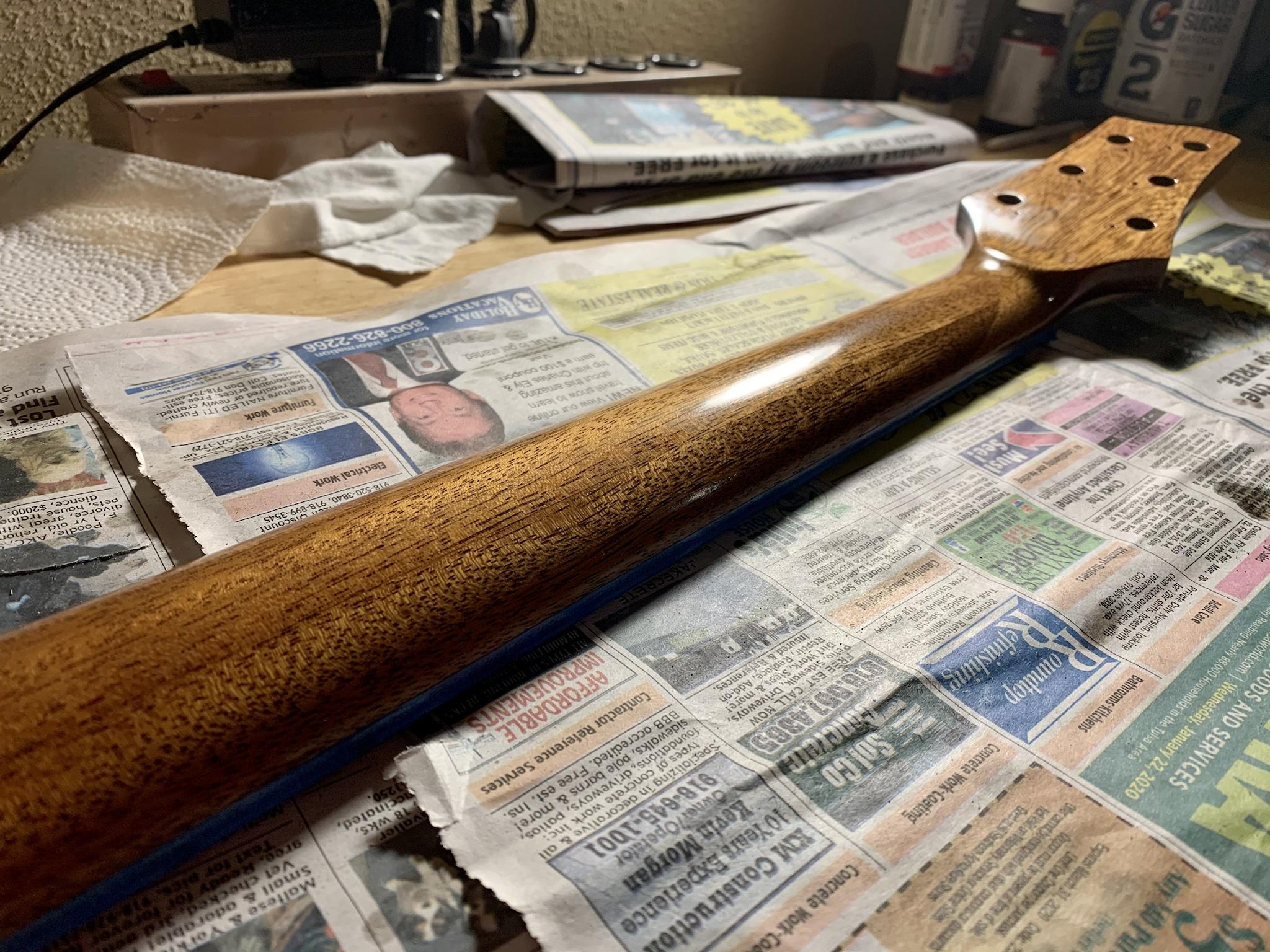
Here is a guitar neck I finished with Tru Oil. My method:
  1. Cut up an old t-shirt into small squares
  2. Balled up a piece of paper towel into one of the squares
  3. Applied extremely thin coat of Tru Oil
  4. Let dry for 24 hours, then sanded with 720 grit sandpaper
  5. Repeat process for another six coats
  6. After letting final coat dry for a week, rubbed with 0000 steel wool
  7. Buffed lightly with rubbing compound
It's smooth as silk -- not sticky at all.
EDIT: Keep in mind this was done in Oklahoma during summer, so that helped the process.
O3YEeqe.jpg
 
I've used Truoil on necks for years and never had this problem. I also have never waxed them. My finish of choice for necks is a wipe on poly gel. IMHO, if the stickiness is not from the wax, it might be because the neck is roasted. From what I've read, roasted woods are harder and more brittle which may be from the pores and grain being tightened up from being roasted. This would make it harder for the finish to soak into the wood. Just a guess.
 
  • Like
Reactions: deff
Tru Oil isn’t something that sinks in, as you found out. Tung or teak oil is what you’re looking for, I believe.

Straight up Tung oil will be thick and sticky at first, kinda like Motor Honey. Best to thin it out to start with and let it dry thoroughly between coats. Apply it fast and don't play with it or it will fuzz up on you. It will color the finish to a golden amber and give it a vintage look.
 
  • Like
Reactions: JimmyM
So, you've done Tru Oil on a wenge neck? My other 2 raw wood necks are both wenge. I've thought about putting some thin finish off just to protect them from dirt and wondered how well Tru Oil would work on an oily wood like wenge.
I use Tru Oil on my Warwick Wenge neck, plays fantastic. I wipe on and wipe off 2-3 times, and its not perfect till it dries out or gets some playing time first.
 
Just a thought, Tru-oil is not compatible with some of the oilier exotic woods. When I put it on Cocobolo it wouldn't fully cure and stayed soft/sticky. I had to strip it off and spray a thin layer of shellac on the Cocobolo and then put the tru-oil on top to match the rest of the base.
 
Fixed - (maybe)

I addressed the stickiness by sanding the back of the neck with 600 grit paper. It took the wax off and may have taken some or all of the Tru Oil off. I'm not really sure. The neck has a bit of a wood smell now which suggests to me it is down to the bare wood.

The net result is that the neck is much smoother with no stickiness.
 
  • Like
Reactions: Beej
I finish rifle stocks all the time. I prefer pure Tung oil to Tru-Oil but have used Tru-oil with good success, the key to a good hand rubbed oil finish is to rub in the oils until you generate some warmth from friction.

Best way to use Tru-oil is to whisker and sand down to minimum of 400 wet or dry sand paper. Once you've whisker'd and have the neck butter smooth, you can either fill the grain with sealer or use the my prefered method of wet sanding with the Tru-Oil acting as a lube and glue to fill the pores. Wipe it dry and put it in a warm dry place for 48 hours, then apply many thin coats to your base with 24-48 hours drying time between them.
^This/
I'll use a Tru-Oil brand pore sealer first, then lots of thin coats (drying time here in the summer is pretty good and I might get two on in the same day). I knock it down every three coats. Once I've knocked down the last one I leave for about a week then use a car wax burnished on (it squeaks when it gets warm). Shiny, good depth, and not sticky.