• TalkBass has been independent since 1998. Add your voice.
    Create a free account to reply to discussions, view embedded media, and browse with fewer display ads.
    Join freeLog in
    Want zero display ads or expanded classifieds tools? Compare plans.

Double Bass Robo's first extension build!

Aug 1, 2005
3,546
1,421
Cologne, Germany
www.basscapos.com
Disclosures
Private Inventor - Bass Capos
100_9816.jpg


Slideshow:
http://s389.photobucket.com/albums/oo340/robobass/Purple%20Heart/

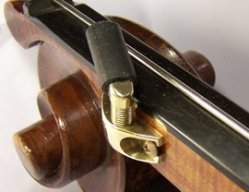
I still haven't mounted it. Also need to smooth out the varnish a bit. This is the only one I've made from scratch. I roughed it out years ago but never got around to finishing it. Good thing I procrastinated. At the time I had no ambition to do a "no-hole" installation. It will mount with only a single screw under the nut. I ended up with just enough room to bring the string back over the scroll and over a second smaller pulley which sends the string down to the "A" tuner. The purple heart will look great with the red varnish on my Geiger bass.
 
I don't know much about extensions (being a 3-string player:) ), but that looks pretty.

Did you make the metal parts from scratch? If so, and if I may ask, how do you finish them? (what is the base metal and what type of plating).

I recently got into nickel plating (different musical instrument) with decent success.

George
 
very nice, do you have wheels in side to reflex the string or are you running it through a wooden (or other material) channel?

Click on the slideshow. I carved out channels under the fingerboard with a table saw and ran the string over sealed bearing pulleys. Most extensions of this type use three pulleys (or one pulley and two bushings), but in this case the scroll geometry allowed me to get away with only two and still have a clear string path.
 
I don't know much about extensions (being a 3-string player:) ), but that looks pretty.

Did you make the metal parts from scratch? If so, and if I may ask, how do you finish them? (what is the base metal and what type of plating).

I recently got into nickel plating (different musical instrument) with decent success.

George

George,
Those metal parts are a garage business of mine. They are machined from 360 brass and shaped and finished with standard sanders and polishing wheels. I don't plate or lacquer them, so eventually they dull and patina just like most tuners.
 
I presume it was made for a specific bass, how do you plan to it it to the winding, or is it pretty much a set it on and fit the nut around it thing now? Very nice work, by the way.

Edit: Sorry RC, when I first read it I coulndn't figure out what you were asking.

This was fitted to and created around the Geiger bass I mentioned. If you look at the slideshow you'll see how the string comes over the smaller pulley then through a hole and straight on to the "A" tuner. Yes, the nut has to be routed to fit over the "E-Stop" bracket.
 
I'm not a bassist, so perhaps this question is born of naiveté, but--what would be the disadvantage to going with a five-string bass to start with, and not needing the extension?

I've only built the one bass (you all saw it at the time), and it is still being played by the original owner who is still very happy with it. But everyone seems to want that Low C or Low B...so, is there something wrong about five-string basses, built with the low B already in place?

Not trying to criticize or be argumentative, at all; just thinking ahead, as I am STILL hoping to build another bass sometime soon, and I am sorta thinking that a 5-string might be a good idea. If not, please 'splain it to me.

Working on yet another batch of violins and violas right now.

Chet
 
I'm not a bassist, so perhaps this question is born of naiveté, but--what would be the disadvantage to going with a five-string bass to start with, and not needing the extension? ...

There are many, many threads on this. Some ongoing, I believe, and there are some strong (no fierce) opinions on either side. It comes down to there being advantages and disadvantages to either approach. I of course lobby for extensions:hyper:
 
There are many, many threads on this. Some ongoing, I believe, and there are some strong (no fierce) opinions on either side. It comes down to there being advantages and disadvantages to either approach. I of course lobby for extensions:hyper:

Well...never having gained expert status on the search function, I'm asking: Can you give me a short list of the theoretical pro and con arguments?

Not trying to start or perpetuate an argument; I'd just like to hear (from you, an Afficionado of Extensions) why it makes better sense to make an already very tall instrument significantly taller, rather than an already wide instrument marginally wider...and maybe only on the fingerboard/neck/bridge?

I can go either way, I have no dog in the fight, so to speak.
 
Well...never having gained expert status on the search function, I'm asking: Can you give me a short list of the theoretical pro and con arguments?

Not trying to start or perpetuate an argument; I'd just like to hear (from you, an Afficionado of Extensions) why it makes better sense to make an already very tall instrument significantly taller, rather than an already wide instrument marginally wider...and maybe only on the fingerboard/neck/bridge?

I can go either way, I have no dog in the fight, so to speak.

I haven't used five stringers nor extensions, but from what I gather the pros of an extension seem to be:

*addable/removable on a normal 4 stringer

*often gives a nicer sounding E string, due to extra string length. often the low notes below E sounds better on an extension, because of longer vibrating length.


The pros for a five string seem to be:

*easier to play advanced stuff in the low range (you don't have to move your hand across the tuners)

*The E string always ends on an E, no fiddeling with capos.

Arguably, some say that a fiifth string makes for easier fingerings, but in many specific cases, the ability of an extension to set a variable low note is also handy. My assumtion would be that for the occational notes below E, an extension is the easier way to go. For frequent (different) notes below E, a five-string would be the choice.
 
While I'm not particularly interested in having an extra low B string, I do also have a 5-string db, tuned E-A-D-G-c. This allows higher parts to be played with longer string lengths, yielding easier/better intonation, less dampening & more harmonics. Maybe my hands are a bit small, but I tend to find 5-str db necks a bit of a hand full, compared to a normal 4-str neck.

To the above, I'd like to add as con's for a 5-stringer:

* string length a bit short for the frequency, so thicker, stiffer strings (and/or lower tension), which tend to be less tone-rich;

* 5-str necks tend to be bigger, which may be perceived as more awkward;

* at 24% more tension, the body needs to be constructed stronger, which together with the bigger neck + fb + tp makes for an heavier instrument.

The first obviously only is a con for a 5th low B (= 30.87Hz). Of course it all remains a subjective choice.