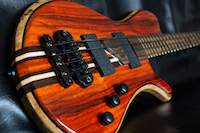
Mike Lipe and I have built a few guitars with all-Indian rosewood necks. We did one within the last several months. It was done "match" style, where the fingerboard was sliced off of the same board, the truss rod was installed from the top, and the fingerboard glued back on. So, it ends up looking like a one-piece rosewood neck.
No big issues building it. It somewhat depends on the rosewood that you have. Some rosewood boards can be packed with the purplish resin; others not so much. The one I did recently wasn't real heavy on resin. It was a little heavier than rock maple, but not a whole lot. It routed and machined just fine.
My guess is that an all-rosewood bass will tend to be on the bright end, more like a multi-lam neck-thru. It's true that the resin in the rosewood does some damping, but overall, the rosewood frame will be dense and stiff. The stiffer the frame, the brighter the bass will be. Warm tone basses have flexible frames. Your rosewood frame isn't going to be flexible.
Chambering the body will help warm up the tone (if you want to), but you'd have to do a lot of chambering have much effect. Again, the rosewood is dense and stiff, as compared to most body woods. Chambering the body to save some weight is a good idea, but you have to be careful not to end up making it real neck heavy. The neck is going to be heavy, and there isn't too much you can do about that. If you chop too much weight out of the body, it'll get unbalanced. Do the chambering in the forward end of the body (towards the neck), and leave the wood in the back end to help it balance. And leave a generous upper horn to get the upper strap button out over the neck.
I'd also recommend a fairly thin body, like 1 1/4". That will help with the weight. You won't have any structural issues.