So I take my TI Flats off my Mustang and put the 77s on.
Tune it up, set the witness points, re-tune and let the strings settle a couple of hours.
Re-tune and plug in. Sounds great but the intonation is off. Every string is fairly sharp at the 12th fret.
So I start with the E string and run out of adjustment. The spring is totally compressed and I'm going to wind up with far too much silk beyond the breakpoint of the saddle.
So I'm thinking bad E string, and go ahead and set the intonation on the other three strings. Got them intonated but I've got silk past the break point of the saddle on the A & G string and the D string is short of the breakpoint by just a hair.
I think I can trim the silk back on the A & G string and leave enough silk on the ball end.
So the only thing I can think of at this point on the E string is remove the spring and replace it with a short one off of a vintage Strat trem.
I put the short spring on the saddle adjustment bolt but I can see I'm still going to have a problem. I'm going to wind up having the thinnest part of the string at the ball end on the saddle. In other words the end of the outer wrap will wind up well past the breakpoint on the saddle.
So I take a break and think of what I can do if anything, and got this idea to use ball ends to extend the ball end of the string further from the hole in the bridge. Tried two at first but it wasn't quite enough so I had to add a third.
As soon as I got the string on the post and started winding up the slack I noticed that the ball end was at an angle downward toward the body and touching it. So I slid the ink tube out of a ballpoint pen under the ball end I used as an extension nearest the ball string's ball end so the string could twist or turn freely without touching the body as I tuned to pitch. Then I placed a small piece of cardboard under the ball end of the string and pulled the ink tube out. Not much pressure at all where it touches the body though.
Got the E intonated, and to my surprise it sounds better then it did initially.
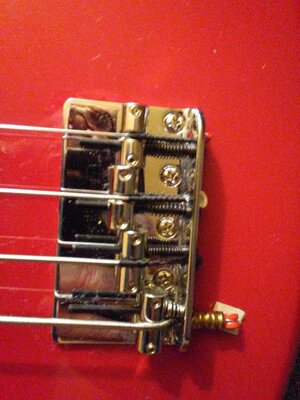
Here is what it wound up looking like.
Bad string ?
Tune it up, set the witness points, re-tune and let the strings settle a couple of hours.
Re-tune and plug in. Sounds great but the intonation is off. Every string is fairly sharp at the 12th fret.
So I start with the E string and run out of adjustment. The spring is totally compressed and I'm going to wind up with far too much silk beyond the breakpoint of the saddle.
So I'm thinking bad E string, and go ahead and set the intonation on the other three strings. Got them intonated but I've got silk past the break point of the saddle on the A & G string and the D string is short of the breakpoint by just a hair.
I think I can trim the silk back on the A & G string and leave enough silk on the ball end.
So the only thing I can think of at this point on the E string is remove the spring and replace it with a short one off of a vintage Strat trem.
I put the short spring on the saddle adjustment bolt but I can see I'm still going to have a problem. I'm going to wind up having the thinnest part of the string at the ball end on the saddle. In other words the end of the outer wrap will wind up well past the breakpoint on the saddle.
So I take a break and think of what I can do if anything, and got this idea to use ball ends to extend the ball end of the string further from the hole in the bridge. Tried two at first but it wasn't quite enough so I had to add a third.
As soon as I got the string on the post and started winding up the slack I noticed that the ball end was at an angle downward toward the body and touching it. So I slid the ink tube out of a ballpoint pen under the ball end I used as an extension nearest the ball string's ball end so the string could twist or turn freely without touching the body as I tuned to pitch. Then I placed a small piece of cardboard under the ball end of the string and pulled the ink tube out. Not much pressure at all where it touches the body though.
Got the E intonated, and to my surprise it sounds better then it did initially.
Here is what it wound up looking like.
Bad string ?