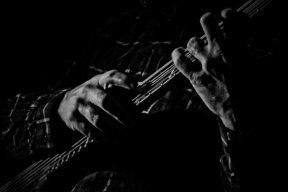
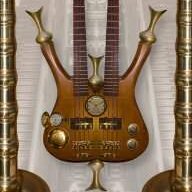
Or you can go with a Gittler and have no board at all, just frets: The Gittler Bass Guitar - redesigned and improved - at NAMM 2016

TalkBass has been independent since 1998. Add your voice.
Create a free account to reply to discussions, view embedded media, and browse with fewer display ads.
Join free Log in
Want zero display ads or expanded classifieds tools? Compare plans.
What cheese is best for metal? \m/I don't know how they sound, but if it's anything like scalloped potatoes, I'll bet they taste good.
A few partial scallops in like Billy's bass shouldn't do much. Scalloping the entire fretboard would change things. I'd question if the wood lost could compromise stability. The guitar variants are known to have some tonal change, part of which may because the action is changed and ya play it different.

The only difference is how far you can bend notes by pushing straight down instead of across.
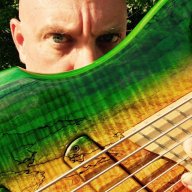

You can easily ruin a neck by scalloping it, sure. I'm talking about instruments that are designed with the scallop in mind.
Action doesn't change with scalloping, as long as the neck is still stable. The tops of the frets are in the same place.
The only difference is how far you can bend notes by pushing straight down instead of across.
Scalloping doesn't work that way on a bass - the strings are too thick.You can easily ruin a neck by scalloping it, sure. I'm talking about instruments that are designed with the scallop in mind.
Action doesn't change with scalloping, as long as the neck is still stable. The tops of the frets are in the same place.
The only difference is how far you can bend notes by pushing straight down instead of across.

What cheese is best for metal? \m/
It would be shellfish of you to own a bass with a scalloped fingerboard!

I got a guitar with a scalloped fretboard. It´s 100% a matter of playability, 0% of the sound
what?
I doubt you will ever press down a string so hardly, that it touches the fretboard between the frets. It´s just there for the fingers to go deeper down in between the frets
I wouldn't destroy the Spector to experiment. I haven't heard of any bassists utilizing it. Very few guitarists use scalloped frets.

View attachment 768448
This is my Spector Euro (and my cheapo DB).
It was a gift from my late father, and that is why I'm never letting go of this bass.
However...
About 4-5 years ago I fell in love with the fretless bass. Gone through some basses, but I realized that this is the one I want to play. Wanted to convert it to fretless, but the inlay wouldn't work great with it I'm afraid, and besides it would look terrible. So I'd have the fingerboard replaced, but that is costly and not something I wish to invest in ATM.
However... Some time ago I found a couple of scalloped bass samples (no idea where they were) and those sounded great to me, though the tone might have been due to lowered tunings and whatnot.
But it got me thinking... Since this fretboard is going to get replaced anyway sooner or later, I might scallop out the frets and play the heck out of it again.
That brings us to the crux of the question: have you ever had a fully scalloped bass? Are there any downsides I should be aware of? And do you have or know any recordings I can hear to make up my mind?
I might just end up purchasing a cheapo to try it out, at least.