• TalkBass has been independent since 1998. Add your voice.
    Create a free account to reply to discussions, view embedded media, and browse with fewer display ads.
    Join freeLog in
    Want zero display ads or expanded classifieds tools? Compare plans.

Double Bass Shen Owner's Club

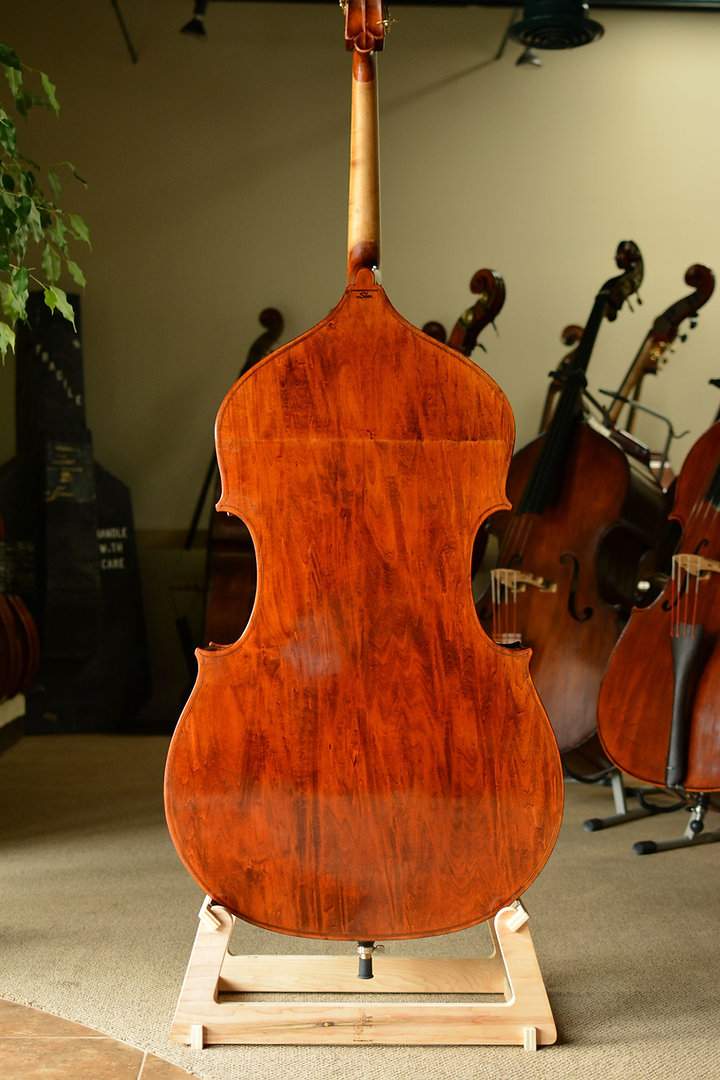
I am not into "clubs" on TB. however I am driving out to The Bass Violin Shop in NC from the Houston area on March 13th to pick up one of the newest FLATBACK 150s. IMO a model that was long overdue, but so very glad they decided to make them!

The bass is a 150, in a violin pattern, carved top, ply sides and a flatback with Bob's killer setup...what's not to like? A sturdy, GREAT sounding gigging bass! Bob has it sounding GREAT, as he took the time to send me videos. And, if it isn't dialed in with the setup, or isn't "The One", I am 100% in the right place to go hunting with one of the best setup guys on the planet standing by right there in the shop! If it is coming home with me, it is going to audition a FC, Lifeline and a Yamahiko pickup. I was studio and practice room mates with Dave Messina, and he is making me a custom maroon and cream/tan cover, picking up with the bass!
f20237_acb7191f554b4b648f6a238a94c53c71_mv2 (1).jpg
f20237_be1b1dcac5984301b6aa0ad89db94bc6_mv2.jpg
 
Last edited:
It's here. It's ALLA that! The Bass Violin Shop nailed it, and it is by far the best set up bass I've ever owned, and this has to be the 7th or 8th Shen I've bought.
John Sprague...if you read this, this is everything I had hoped for
16482999748174991136232557504777.jpg
. A great jazz bass. Thank you x 100000! For real, if you need a killer sounding and playing Shen, it's a full stop with this model. A flatback with violin corners and carved top. Nailed it!
 
I picked up a Shen SB90 this summer when I moved to a new city (I sold my old Stentor plywood before moving to save on the hassle). Since then, I have been rehearsing with the Shen in a country group, a trad jazz trio, and a bluegrass quartet. The Shen seems to hold it's own and I expect it'll be as much bass as I need for the foreseeable future - pretty too. I'll try to post some action shots from a gig next weekend!
 
I’ve been having some intonation issues lately. To the point I might go with the backup for some upcoming jobs. At first, I attributed it to the D neck, but now I’m not so sure. Really don’t want this bass to not work out.
If you are having any intonation issues with a bass, play the hell out of it. 2 octave arpeggios/scales/whatever. Don't play your backup at all. You will be surprised at how comfortable you get with it. As long as it is comfortable for you to play.
 
  • Like
Reactions: Inky13 and lurk
Another benefit to playing arpeggios, besides improving intonation, is that you’ll learn a lot about the twilight zone - a.k.a. the fingerboard.
I call this exercise ‘Neck-Row Philia’
Imagine an E minor, raised 7th scale.
Now play the low (open) E, followed by F#, G, A, B, C (natural), and D#.
Now start on the E above that D# and play the same scale up to the E on tye G string. At some point you’ll want to continue up the neck one more octave, but for now, let’s go back to the low E.

play every-other note of that E minor scale, up to the high D#, and play the same notes back down to low E.

Now start on G from that original scale and play every other note up, and back down.

now start on A and play every other note up two octaves and down again.

Start the next arpeggio on B, etc.

Voila! You will be improving intonation even as your left hand learns how to find intervals. And the added bonus is outlining most of the 7th chords you will ever need:
E min 7 raised 7
F# min 7 b5
G augmented 7
A minor 7
B7 (dominant 7)
C major 7
D# fully diminished

the following day make F your starting note. By the end of the
 
Another benefit to playing arpeggios, besides improving intonation, is that you’ll learn a lot about the twilight zone - a.k.a. the fingerboard.
I call this exercise ‘Neck-Row Philia’
Imagine an E minor, raised 7th scale.
Now play the low (open) E, followed by F#, G, A, B, C (natural), and D#.
Now start on the E above that D# and play the same scale up to the E on tye G string. At some point you’ll want to continue up the neck one more octave, but for now, let’s go back to the low E.

play every-other note of that E minor scale, up to the high D#, and play the same notes back down to low E.

Now start on G from that original scale and play every other note up, and back down.

now start on A and play every other note up two octaves and down again.

Start the next arpeggio on B, etc.

Voila! You will be improving intonation even as your left hand learns how to find intervals. And the added bonus is outlining most of the 7th chords you will ever need:
E min 7 raised 7
F# min 7 b5
G augmented 7
A minor 7
B7 (dominant 7)
C major 7
D# fully diminished

the following day make F your starting note. By the end of the
second week you’ll be proud of your improvement and increased awareness.

I left out the F# in the example, but you ‘sharp’ cats noticed the omission
 
  • Like
Reactions: Inky13
Appreciate all the excellent advice. TBH, I felt it was more of an issue with the bass. All of a sudden things felt out of wack. This bass had position markers that I hated, but they looked factory.
Nope. Pulled them today and it feels much better. I kept seeing them out of the corner of my eye. I’m so relieved that they’re gone. I won’t lie, things like minor 7 arpeggios are beyond my pay grade, but I keep plugging and learning.
 
Just got my first upright double bass, a Shen SB100. I have an NS Design EUB that I picked up recently as well. I really enjoyed what I was getting out of the EUB (my first upright) but know that the physical interaction with a full double bass would force/teach me more proper technique. I’ve played bass guitar for almost 30 years and some of what I’m now playing (1950s blues) was recorded on DB so I’m taking the plunge. Summer goals!

So, action seems low from what I’ve read. I’m getting 2.5 mm under the G string at the finegerboard edge and 4mm at the E string. Am I right in thinking this is low? The bridge unjustness look like they have already been let out some…not sure how much more you can adjust them.

It’s a gently used bass from someone who bought it new just before the pandemic hit and then never played it. As such, I haven’t had it checked out by anyone and I’m not sure where the nearest place to get it checked out and possibly set up even is. I’m in central PA. I don’t mind the low action if this is in the accesptable range. I’m just not familiar with DB standards on set up. I do my own set ups (and even refrets) on my bass guitars.
5A6F7D95-5EE2-4365-9368-1C8AE92A1438.jpeg
 

Attachments

  • 14FEEAF6-69B1-416B-9A5F-D8761242536B.jpeg
    14FEEAF6-69B1-416B-9A5F-D8761242536B.jpeg
    820.9 KB · Views: 75
  • B46A6E6F-3BBC-4558-A990-9B8C944BBC86.jpeg
    B46A6E6F-3BBC-4558-A990-9B8C944BBC86.jpeg
    664 KB · Views: 71
  • 9E4CE73F-7D5A-4261-89B0-85569C81BE0A.jpeg
    9E4CE73F-7D5A-4261-89B0-85569C81BE0A.jpeg
    750.2 KB · Views: 76
  • 35BFB626-78FC-4E6D-A965-DDD2F87B66C0.jpeg
    35BFB626-78FC-4E6D-A965-DDD2F87B66C0.jpeg
    813.3 KB · Views: 63
Just got my first upright double bass, a Shen SB100. I have an NS Design EUB that I picked up recently as well. I really enjoyed what I was getting out of the EUB (my first upright) but know that the physical interaction with a full double bass would force/teach me more proper technique. I’ve played bass guitar for almost 30 years and some of what I’m now playing (1950s blues) was recorded on DB so I’m taking the plunge. Summer goals!

So, action seems low from what I’ve read. I’m getting 2.5 mm under the G string at the finegerboard edge and 4mm at the E string. Am I right in thinking this is low? The bridge unjustness look like they have already been let out some…not sure how much more you can adjust them.

It’s a gently used bass from someone who bought it new just before the pandemic hit and then never played it. As such, I haven’t had it checked out by anyone and I’m not sure where the nearest place to get it checked out and possibly set up even is. I’m in central PA. I don’t mind the low action if this is in the accesptable range. I’m just not familiar with DB standards on set up. I do my own set ups (and even refrets) on my bass guitars.
View attachment 4691825
You have some room on the adjusters to raise the strings a bit if you like. Turn counter-clockwise.
 
  • Like
Reactions: GlenParks
You have some room on the adjusters to raise the strings a bit if you like. Turn counter-clockwise.
That’s good to know! Any idea how I know not to adjust too far? What gap size would be max? It’s 5mm of the adjuster shaft visible on the treble side and 3mm on the bass side. I’d like to add about 2mm to my string height on both sides. Thanks!
 
That’s good to know! Any idea how I know not to adjust too far? What gap size would be max? It’s 5mm of the adjuster shaft visible on the treble side and 3mm on the bass side. I’d like to add about 2mm to my string height on both sides. Thanks!
I am not sure but you have at least a couple of turns. Both sides should be equal as well.
 
  • Like
Reactions: GroovyBaby