• TalkBass has been independent since 1998. Add your voice.
    Create a free account to reply to discussions, view embedded media, and browse with fewer display ads.
    Join freeLog in
    Want zero display ads or expanded classifieds tools? Compare plans.

Double Bass Shen Willow Belt Scratch Tips?

Wondering if anyone has any tips on reducing the visibility of these belt scratches. They are indentations with scratching, not entirely void of color. These are on the rib of a Shen Willow 3/4. Any suggestions?
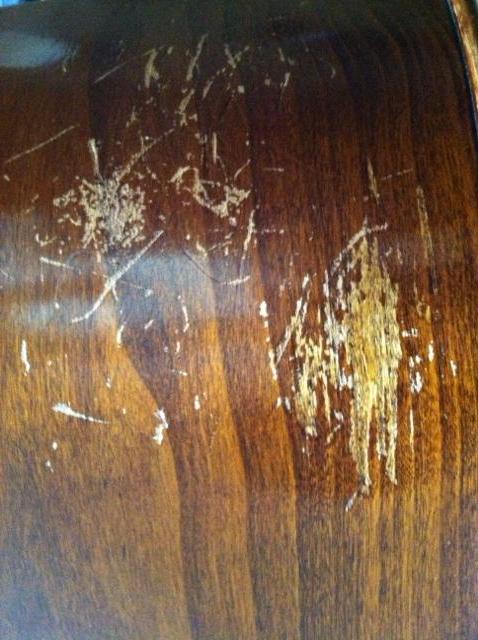
ShenWillowBeltScratches1.jpg


There is a technique which, if I understand correctly, uses alcohol to dissolve the existing varnish so that it can be redistributed to blend scratches and blemishes. I don't have any firsthand experience doing it, but I've been told It's tricky, so I highly recommend reading up on the subject and asking someone with some experience before you attempt it yourself.
 
Thank you both for the advice. It would be nice to build up the scratched area to be level with the rest of the rib, but I might just do something to color it. The Shen website says the Willow has oil varnish. I think it would be quite a process to restore it to it's original condition.

csrund - That sounds promising, but tricky to do right as you mentioned. I would need to test whatever solvent system I choose on an inconspicuous area first, I imagine. I see streaking varnish in my future. :smug: Hmmm.... methanol in chloroform, toluene, ethanol, benzene (though carcinogenic)... so many possibilities (not really being serious about these).

Michael - Have you found the markers ever coming off onto clothing or your hands? Maybe there are wood specific touch up markers. Definitely a good option for smaller scratches. I might go this route for the short term. I wonder if it might make it difficult to finish properly in the future though. (These scratches weren't my doing :) I always shift my buckle to the right when I play. )

 
Buy a walnut. Remove the nut from the shell, and rub the nut on it. the oils in the nut will take away the bright "you did this yesterday" look from the scratches, and make them look like they've been there longer. You could use a dot of walnut oil on a clean rag as well, but buying a whole bottle for one drop is a bit excessive. If you are really concerned, the next time you are in the shop your luthier can put some more varnish on that spot. It isn't going to go away or look like it isn't there, (you would have to sand and revarnish that whole section of the rib to accomplish that) but it will look better and protect the wood.

I would avoid using a marker (or whatever the Copic pens are) and I definitely would not experiment with alcohol. I do not doubt that there is a way that you could successfully do something with it, but I am very sure you can make the problem dramatically worse and strip even more varnish with alcohol.
 
Michael - Have you found the markers ever coming off onto clothing or your hands? Maybe there are wood specific touch up markers. Definitely a good option for smaller scratches. I might go this route for the short term. I wonder if it might make it difficult to finish properly in the future though.

I don't find the color coming off after it dries. However, immediately after you do the touch-up, you can blend it in a bit, mixing colors if you like. After a time, some areas, such as where the upper bout rests on my belly, does wear away, just as the original finish did. These pens amount to a light surface stain—not a permanent solution.

BTW, it was my luthier who recommended the touch-up pens to me for small repairs to the Shen oiled finish.

I forgot about the walnut trick. I did that on a teak table once, and it worked. Try that first, as it's easy, cheap, and nutritious.
 
Sorry Michael, I am not very familiar with Copic. I just got scared when I did a quick google search and was thinking "Oh no, it's a sharpie". As an art pen that can be blended etc, I am sure it is a safer/better idea.

I personally like the walnut trick, (I have walnut oil for French polish) and feel like it is a more natural option that will get you to the next time your luthier sees the bass. At that point, depending on the extent of the other work they are doing for you, they will likely put some touch up varnish on it without charge, or for a nominal fee.

I still think that alcohol is a dangerous idea. Although it can be a component of various finishing methods, it is universally used for stripping finish. The "test a small spot if you are brave" idea makes sense, but I really don't want "I heard it on the internet" to be the reason why you've got to get the rib professionally revarnished.
 
Thanks, Mike. Walnut oil sounds like a good idea. I've heard of the same concept for violins using almonds. I wasn't planning on trying out a bunch of things, especially alcohol or some organic solvent, without extensive research and a call to a trusted luthier. I don't see how a mild oil would do much harm though, especially in such a small amount as would come off of a nut. Would be worth a shot. And for thinner scratches, a nicely blended marker color may be perfect and harmless.

Thanks for the input!
 
When you're all done, you might consider one of these. My bass has worn one from day one. :)

Thanks, drurb. Yes, I may get a bib. I've had one on another bass I used to own. I've also gone years without one on a different bass still without injury to the bass as I always slide my buckle over when I play, bib or no bib. I didn't cause these current scratches, they came with the recent trade/sale for my previous bass. I'll probably go for a bib sooner than later though.
 
Hi Chang,
We touch up that varnish with Copic marker #YR24 pale sepia, followed by artist oil color burnt umber. It's not the materials that make or break the job, it's the application. Just cover what you need to, not worrying about building it up. It won't take much. The idea here is to get it back to similar color. As for the indentations, let it be beautifully worn, most attempts to try to level it out will end badly.
Good luck!