• TalkBass has been independent since 1998. Add your voice.
    Create a free account to reply to discussions, view embedded media, and browse with fewer display ads.
    Join freeLog in
    Want zero display ads or expanded classifieds tools? Compare plans.

Show and tell: finishes

What is this tung poly mix?
What are the components and what are the amounts used?

I believe that just a few posts below the one you quoted, Hoyt described the process in fairly extensive detail;

sorry for the inconvenience, SJ...I thought I'd get tricky on the webpage and it backfired. it's back up now:


actually about everything you need to know I shared above: sand to 320, mix about 60% tung oil and 40% polyurethane into about a pint container. Put on some vinyl gloves and make sure you have plenty of ventilation and/or respiration. Wet the bass liberally and use the 320 wet/dry paper to wet sand (with the grain is best ) the whole bass... add the mix if things start getting sticky.

once you have wet-sanded thoroughly, wipe off the excess and let it dry. the next day (maybe more if it's really humid) buff with 000 steel wool.

repeat this again, adding a little more poly to the mixture......repeat the wet sanding just one more time.

after your second wet-sanding/wiping off/steel wool session, you can start just using a rag and rubbing the mixture into the wood relatively dryly. (kind of like polishing shoes)

the numbers of coats is totally dependent on your taste. Minimum I feel is three coats.

after the last coat, let it sit about a week in a nice dry location. then buff with steel wool and apply wax: I use minwax hard finishing wax or boston polish and buff vigorously. This will give you a nice finish that is pretty rugged.

you can spot repair any dings at any time, expecially if you keep your jar of poly stuff handy.

have fun.

Karl Hoyt
 
New here guys, and I am pretty sure that the KISS method will work for me. I just received my Warmoth 6 string body and neck in the mail, and now it's time to do the finish.

So deets and pics...it is a swamp ash body with the figured walnut on top. The neck is wenge with an ebony fingerboard.

So, I am hoping someone will confirm to me that using Tru-Oil will help make that walnut POP a little more. Also, I have been reading about using some kind of filler but as smooth as that top seems, do I really need to use a filler? Thought Tru-Oil had filler properties in it.

Second...do I do the entire body including the pickup holes and rear routed area or just the body?

Third...the neck. Should I be using the same Tru-Oil on the neck too...I assume not on the ebony fingerboard but from what I gather it's natual oils keep it good.

I'm uneasy mixing stuff and am very much hoping for a simple application, sand, apply sand apply type of thing. Does not have to be super shiny but just enough and enough to protect. Here's the pic.

Paulie
 

Attachments

  • Body shot.jpg
    Body shot.jpg
    21.6 KB · Views: 206
I jsut got the same neck from Warmoth (Wenge\Ebony). I'm a bit aways from finishing the guitar, still working on the body. If you get yours done first post some pics, I'm still not sure what to use for finishing the bass with (Solid Wenge Body, Wenge\Ebony Neck).
 
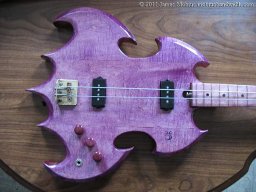
This is a very interesting thread, does anyone have any advice for the lazy luthier? lol. Ready to finish my bass which is maple and mahogany, stained with trans tint purple stain. leaning towards a glossier finish than not, but open minded. would a gel varnish like Bartley's work on top of a coloured stain? I haven't finished a coloured instrument in 2.7 decades. I actually have some Bartley's left too but if I'm gonna use a rub in finish would probably use Rockler's brand. I'll have to use some kind of poly on the face of the headstock as I'm afraid I'm planning on coating it with purple glitter glue. (sorry!) lol.

http://www.talkbass.com/forum/f57/bat-bass-749410/

oh I should mention it's a slide bass so the finish on the fingerboard doesn't have to be super epoxy hard as the strings will never actually touch it.
 
Hi Luthiers,

I'm about to start a Danish Oil finish. Does anyone have images from a build that used Danish Oil, and tips for application?


well if you're going to that, you'll have to buy a bunch of cheese danishes and squeeze all the oil out of them, you can't really eat them afterwards because they're too dry, unless you dip them in tea I suppose.

just kidding. d: good luck! I did use that stuff once, on something... oh yes, a platform I built for this lady, she had a desk but the floor was very uneven under it, so she had me build a plywood platform for it, like a mini drum riser, that was levelled with lots of legs. odd project but that's what she wanted. it looked good! years ago, I don't remember any trouble using the stuff. she wanted it used as well. I would have used shellac probably, or wipe on poly.
 
New here guys, and I am pretty sure that the KISS method will work for me. I just received my Warmoth 6 string body and neck in the mail, and now it's time to do the finish.

So deets and pics...it is a swamp ash body with the figured walnut on top. The neck is wenge with an ebony fingerboard.

So, I am hoping someone will confirm to me that using Tru-Oil will help make that walnut POP a little more. Also, I have been reading about using some kind of filler but as smooth as that top seems, do I really need to use a filler? Thought Tru-Oil had filler properties in it.

Second...do I do the entire body including the pickup holes and rear routed area or just the body?

Third...the neck. Should I be using the same Tru-Oil on the neck too...I assume not on the ebony fingerboard but from what I gather it's natual oils keep it good.

I'm uneasy mixing stuff and am very much hoping for a simple application, sand, apply sand apply type of thing. Does not have to be super shiny but just enough and enough to protect. Here's the pic.

Paulie

My experience with tru-oil on walnut (claro and Black) is that it tends to hide the figure a bit, rather than make it 'pop.' It has a brownish-yellow tint to it that I find a little unflattering. It's easy to apply and it's durable, but I don't like the look. I'm not a fan of it.
 
barnaclebeau said:
My experience with tru-oil on walnut (claro and Black) is that it tends to hide the figure a bit, rather than make it 'pop.' It has a brownish-yellow tint to it that I find a little unflattering. It's easy to apply and it's durable, but I don't like the look. I'm not a fan of it.

I like it on blonde woods, not on dark so much. I prefer Formby's for this exact reason. It doesn't seem to hide the grain as much as Tru-Oil does.
 
sorry for the inconvenience, SJ...I thought I'd get tricky on the webpage and it backfired. it's back up now:


actually about everything you need to know I shared above: sand to 320, mix about 60% tung oil and 40% polyurethane into about a pint container. Put on some vinyl gloves and make sure you have plenty of ventilation and/or respiration. Wet the bass liberally and use the 320 wet/dry paper to wet sand (with the grain is best ) the whole bass... add the mix if things start getting sticky.

once you have wet-sanded thoroughly, wipe off the excess and let it dry. the next day (maybe more if it's really humid) buff with 000 steel wool.

repeat this again, adding a little more poly to the mixture......repeat the wet sanding just one more time.

after your second wet-sanding/wiping off/steel wool session, you can start just using a rag and rubbing the mixture into the wood relatively dryly. (kind of like polishing shoes)

the numbers of coats is totally dependent on your taste. Minimum I feel is three coats.

after the last coat, let it sit about a week in a nice dry location. then buff with steel wool and apply wax: I use minwax hard finishing wax or boston polish and buff vigorously. This will give you a nice finish that is pretty rugged.

you can spot repair any dings at any time, expecially if you keep your jar of poly stuff handy.

have fun.

Karl Hoyt


hi, i'm really interested on doing this kind of finish in some future instrument, but I have a few questions to do it, do you cut up the mix of tung/ poli with something like turpentine or mineral spirits? if so, what proportions do yo use?

sorry for all the trouble and my poor english

greetigns from Argentina
 
your English is WAY better than my Spanish:-), Igneo.

I do add mineral spirits ...... the approximate ratio is 40% tung/40%poly/20%mineral spirits to start, add poly as I go along.

it's not an exact science, but I have finished dozens of basses with this system with excellent results.

Karl
 
A client brought me a Epi Les Paul to rewire and refinish. He is crazy about the way it plays and wanted to put his money into upgrading instead of buying another guitar. It had a heavy poly finish with flame decals applied during the finish process. I could see that there was a flamed maple veneer on the top underneath the decals so I set out to sand off the poly down to the veneer but not through the veneer...........:eek:!
Here is the guitar before sanding.
Blackberrypictures185.gif


I sanded the top down as far as I could. Here is a process pic....
2.gif


I sanded with 400 grit paper as I started getting close so I didn't remove the veneer. Then I used transtint dye in water to stain it black......
3.gif


Once it dried, I sanded the top lightly with 600 grit to remove the stain from the grain raised areas.
I then used transtint blue, green and yellow too create a burst on the top. I did this with small cotton rags over the black stained top, then laid up top colors in the finish to highlight the burst...
4.gif


5.gif


I sprayed Target Coatings water based lacquer for the finish. I've used this on several guitars now and am pretty pleased.
I sprayed around 12 or so coats usually 2 hrs apart but no more than 12 hrs apart. I have learned that if you give this stuff too long between coats it doesn't burn into the previous coat too well and leaves witness lines when you sand it out.
I let it cure for 2 weeks then started with an 800 grit wet sand, progressively working up to a 2000 grit. I then used a couple of 3M polishing compounds to finish it up.
Here is the end result....
6.gif


Hope this info can be of help to someone! Joe
 
OK experts...I have put the last coat of finish on the body and will be polishing Tuesday after a few days of curing, The Tru-Oil looks freakin awesome and pics will be coming soon....last question:

My neck, it is Wenge with an ebony fingerboard....Warmoth says on their website that it does NOT need to be oiled or finished. Thoughts on should I or should I not do the neck as well?


Paulie
 
This thread seems like a great idea to help narrow down the choice of many available finishes. Especially for those of us who are relatively new to many of them. So, here are the materials, suppliers and a breif description of the finish process on a bass that I am wrapping up. This bass is for my son and he wanted a "mirror" like finish.
I went a pretty traditional route as follows:

I was dealing with some pretty open grain wood so I started with Lawrence McFadden transparent filler from Stew Mac. I left it on a little too thick and it was a real pain in the butt removing the excess.

...

Sir, I have been working with and around wood for over 2 decades (I am only 35), and I have seen every form of finish you can apply to wood...

...BUT, I have NEVER in my life seen a finish like that.

That piece should be in a museum.

It is beautifully breathtaking. Utterly the most beautiful guitar body I've ever seen...

Thank you very much for sharing, and for setting the bar high enough, to insure I'll be working a long long LONG time.

---ETA---

This site is linked to or with the "Stew Mac" folks who make arguably the greatest finish I have ever seen...

Until now, I didn't know they even existed.

I have only just began refinished instruments, as I have been working with small wooded items and furniture since high school shop. So far, I have done a violin, an acoustic guitar, a P-bass, and I am about to start in on a Jazz bass.

I only ever been in love with Formby's Tung Oil. It is a hard penetrating oil, and after 20+ coats and lots of sanding, I can get a 'reflective' surface, especially after polishing with an automotive compound.

I think I am seriously considering changing brands...
 
Sir, I have been working with and around wood for over 2 decades (I am only 35), and I have seen every form of finish you can apply to wood...

...BUT, I have NEVER in my life seen a finish like that.

That piece should be in a museum.

It is beautifully breathtaking. Utterly the most beautiful guitar body I've ever seen...

Thank you very much for sharing, and for setting the bar high enough, to insure I'll be working a long long LONG time.

---ETA---

This site is linked to or with the "Stew Mac" folks who make arguably the greatest finish I have ever seen...

Until now, I didn't know they even existed.

I have only just began refinished instruments, as I have been working with small wooded items and furniture since high school shop. So far, I have done a violin, an acoustic guitar, a P-bass, and I am about to start in on a Jazz bass.

I only ever been in love with Formby's Tung Oil. It is a hard penetrating oil, and after 20+ coats and lots of sanding, I can get a 'reflective' surface, especially after polishing with an automotive compound.

I think I am seriously considering changing brands...


First off, thank you for the kind words on my finish. It is one of the toughest steps in building an instrument.....if you really want to get it right.
Glad that the Stewmac link is of help to you. Another is lmii. I think that both of these suppliers are carrying McFadden's lacquer labeled under the Seagraves label now.
I've been using a water based lacquer lately and it is working out pretty well. It still doesn't burn in like nitro and you have to be really careful not to sand through previous coats to avoid "witness lines". I cant get quite the reflective quality of nitro either. Close, but not quite there. I made the switch in the name of sustaining good health but do still spray nitro from time to time......It is my favorite!
Thanks again.
Joe
 
A client brought me a Epi Les Paul to rewire and refinish. He is crazy about the way it plays and wanted to put his money into upgrading instead of buying another guitar. It had a heavy poly finish with flame decals applied during the finish process. I could see that there was a flamed maple veneer on the top underneath the decals so I set out to sand off the poly down to the veneer but not through the veneer...........:eek:!

i dont even like flame type finishes, but the fact that you got THAT out of something that was produced with stickers on it is incredible. you sir are an artist
 
nateo I've seen your work in another thread (on this very neck I think). You, and everyone posting here, have given me LOTS of info to work into this new hobby of mine.

I'm about to start my first epoxy coating on a fretless conversion for my son and I'm curious what you found in your experimenting with heat. Does applying heat to the neck before coating give noticeable results? Are there particular techniques to heat application (with a heat gun for example) that make things easier? I don't think I'm looking for "always face north and work east to west" but any insights on things like how to know if you're lingering too long in one spot or moving too rapidly etc. would probably help... Dos and Don'ts from your experience..

Thanks,

D