• TalkBass has been independent since 1998. Add your voice.
    Create a free account to reply to discussions, view embedded media, and browse with fewer display ads.
    Join freeLog in
    Want zero display ads or expanded classifieds tools? Compare plans.

Double Bass Sit at a bass, like a cello?

Not cello sized! Get the electric to practice the finger patterns and build your eub. Jaco got a fretless because he couldn't afford cheap uprights that kept needing repairs. Kay built only a few hundred baby basses for schools on their cello body and it couldn't take the tension AND it sounded crappy.
 
Just go for an electric bass and a little combo amplifier.
Get the electric to practice the finger patterns and build your eub.

There's a couple votes for getting a fretless bass guitar to practice with. Does anyone want to make a counter argument?

Here's what I've been looking at:
Invalid Link Removed

Why those two? Because they are the cheapest that Guitar Center offers. I've read some reviews and they seem to be solid instruments. The biggest complaint seemed to be that the strings suck, but then that seems to be a common complaint on every review I've read even for multi-thousand dollar EUBs. I keep going back and forth between on which would be better. The Dean does not need any electronics to make sound, and has a pickup if I want to plug it in, it's also lighter than the Rogue but is an unusual size, which would make finding a case or bag more difficult. The Rogue is a pretty standard shape and size, making finding a case or bag easy, is smaller, but heavier.

Both can be found on the second hand market for not that much money.

I've looked for secondhand fretless basses in the area and none are as cheap as the new ones I saw at Guitar Center. Finding even a fretted bass guitar that cheap might even be difficult. I do think I should check out what's at the local pawn shops (as opposed to the music shops I've visited), I might see something useful there.

When it comes to getting an amp I think I'll try to keep it cheap by going with the acoustic and/or just using an amplified computer speaker. The electric Rogue is cheaper than the acoustic/electric Dean but the price difference disappears if I have to buy an amp.

Jaco got a fretless because he couldn't afford cheap uprights that kept needing repairs.

Who's Jaco?

If you're making a cello sized EUB, you'll just end up with a cello tuned in 4ths.
Not cello sized!

If a cello sized EUB is just a cello tuned in 4ths then is an electric bass guitar just a guitar with two strings removed? One thing I'd want is something that sounds close to the real thing. I think I see what you mean but I'll counter by pointing out that a cello is the wrong octave. Some people might be able to make that octave shift in their head but I can't. The shift from a 42 inch scale to a 27 inch scale is quite the compromise and may lead to bad habits when playing the real thing. The shift to a 34 inch bass guitar is a compromise but my instructor seems to think that is worthwhile.

Mom gave me her guitar, she got it a long time ago but never got around to learning how to play it. We found it in a closet when she moved and offered it to me since it's just been collecting dust. I tried using that to practice with but two things bother me, frets and it's off by an octave. The extra strings can be a problem too. Before anyone suggests putting bass strings on it I'll say this is a cheap guitar which is unlikely to survive bass string tension. Also, while it's worth next to nothing it is valuable to me, if you get the idea.

I'm not saying that building a cello sized EUB is necessarily a good idea, but it is an idea. From what I've seen it's a fairly low risk project, the parts would be cheap and easy to find, given that I've seen a number of people try something similar with good results the probability of success seems high (with varying degrees of "success"). It'd be small, light, and therefore easy to move and store. There's also a level of novelty to it. I might end up trying this at some point anyway, just for grins and giggles.

A full sized EUB could be 6 feet long, although it might be possible to make it as short as 4 feet if I "cheat" on the head and tail. I'll look some more on finding a 34 inch scale EUB and for the parts to build one. That seems like a compromise that I could live with and which many people have already done and been pleased with. I've seen a lot of good things about the NS Design Omni-Bass and I'd like to have one but that's just a bit too big of an investment right now.

I know we've veered quite a bit off the original topic here but this is really about how to learn the bass while being easy on my feet (and on my wallet), not just in finding the right seating position.
 
Jaco Pastorias - wicked technique
I did a Google search on that name and I see he's a jazz musician. That explains why I haven't heard of him. I have a wide variety of musical tastes but I never got into jazz. I'll listen to rock of many kinds (soft, hard, folk, classic, alternative), some country, some bluegrass. I'll take a look at some of his videos.

Fretless bass guitar- cello angles and spacing and fingering is different enough to mess you up - unless you are working on fifths tuned bass.
I think there is a misunderstanding here. I'm thinking of making a "cello sized bass" but it would be tuned in fourths, not fifths. Since I've been a bit all over the place I'll try to summarize what I've been considering as instrument options.

Option 1: Less than $300, Fretless bass guitar
Variation A: Electric bass guitar:
Quite a few options, common size (which would make finding a case, bag, and other accessories easy), will need electronics to make sound, which also means I can practice while making little noise. I can potentially use amplified computer speakers to avoid having to buy a proper guitar amp.
Variation B: Electric/acoustic bass guitar
Potentially lighter than the electric, does not need electronics to make sound, this also means I cannot practice without making sound, unusual size means having difficulty in finding cases and such.
Variation C: Other options?
Getting something like a fretted BG, short scale BG, pure acoustic BG, and so on tends to mean a bigger compromise in learning to play an upright bass and/or no savings in money over the other options.

Option 2: Less than $600, Build my own EUB
Variation A: 1/16 scale EUB (or "cello sized bass")
A 1/16 scale bass has a scale length of about 27 inches, which is roughly the same as a 4/4 scale cello, short scale BG, and classic guitar. This means I can get a build-your-own bass guitar kit, some cello parts, short scale bass strings, and build an EUB that can fit in a classic guitar case. I can plan on giving it a small sound box with a general violin-ish shape and still have it fit in a guitar case and practice without an amp.
Variation B: 3/4 scale EUB
Like above but instead of cello parts I get common 3/4 scale upright bass parts. This won't fit in a guitar case but it will more closely approximate playing on the real thing while still not taking up as much space.
Variation C: 34 inch (bass guitar) scale length EUB
A compromise in scale between first two variants but making obtaining parts more difficult. Using a flat bridge would simplify the design but then I'd be effectively building an electric bass guitar, which I can buy already made for less money.
Variation D: Other options?
Anything else seems to push up the cost or create compromises that I would not want to deal with.

Option3: More than $600, too much for me to spend right now
Variant A: A real and honest upright bass
Big, heavy, difficult to move and store, but sounds so sweet.
Variant B: 3/4 scale EUB
Much smaller, very close to the real thing in how it is played, and generally a nice compromise.
Variant C: 34 inch scale EUB
Still acceptable compromise, great on saving space, potential for playing skills trivially transferable to fretless bass guitar (and vice versa).
Variant D: Other options?
I don't see any other option worth mentioning.

I'm considering building a 1/16 scale EUB because finding parts are trivial, cheap, and therefore something I think I can tackle with minimal expense and risk. It would look (and play) a lot like a cello but it'd sound like a bass. Well, it'd sound like an electric bass. Just to be clear, it would most definitely be tuned in fourths, not fifths.

I'm really close to just buying an electric/acoustic bass guitar. What really sold me on this is my bass instructor brought it up without me bringing it up first. I mentioned EUBs, bass shaped objects, and building my own before. I may have mentioned a bass guitar before but that would have been a year ago. I do remember him saying how playing an EUB would be a very different instrument and I should not consider it. Something changed his mind on this in that time.
 
re: 4ths cello (Oscar Pettiford): Then you would need to buy a set of fourths helicore strings, but that will also be very different to bow.
One advantage- quicker response when working on technical passages. The fingering spacing will allow you to work out things quicker.
 
re: 4ths cello (Oscar Pettiford): Then you would need to buy a set of fourths helicore strings, but that will also be very different to bow.
I'm confused, are you suggesting I put cello strings on my bass? Are you referring to strings like this? -> Invalid Link Removed

Why would I not get proper bass strings? That is my intention, strings like this. -> [This invalid link has been removed]
 
I believe I found a much better option for strings. -> D'Addario Orchestral : Product Details : Helicore Orchestral Bass String Set, 1/10 Scale, Medium Tension
These are proper upright bass strings, not bass guitar strings, and closer to the right scale length. D'Addario calls them 1/10 scale but I've seen them called 1/16 scale elsewhere. Perhaps the difference is that 1/10 scale means 28 inch scale length and 1/16 scale means 27 inch scale length. Either way if I do this then a 4/4 scale cello fingerboard, and other such parts, would be an inexpensive option for building my EUB.

I believe people are getting stuck on thinking I want to build a cello, I don't. I just think that if I build my own EUB then for the sake of keeping costs low I'll have to limit myself to 3/4 scale or 1/16 scale (or generally 4/4 cello size). Finding inexpensive 3/4 bass parts or 4/4 cello parts is trivial. Using some cello parts doesn't make it a cello, it'd be a bass. Still a bass, just a small one.
 
I believe I found a much better option for strings. -> D'Addario Orchestral : Product Details : Helicore Orchestral Bass String Set, 1/10 Scale, Medium Tension
These are proper upright bass strings, not bass guitar strings, and closer to the right scale length. D'Addario calls them 1/10 scale but I've seen them called 1/16 scale elsewhere. Perhaps the difference is that 1/10 scale means 28 inch scale length and 1/16 scale means 27 inch scale length. Either way if I do this then a 4/4 scale cello fingerboard, and other such parts, would be an inexpensive option for building my EUB.

I believe people are getting stuck on thinking I want to build a cello, I don't. I just think that if I build my own EUB then for the sake of keeping costs low I'll have to limit myself to 3/4 scale or 1/16 scale (or generally 4/4 cello size). Finding inexpensive 3/4 bass parts or 4/4 cello parts is trivial. Using some cello parts doesn't make it a cello, it'd be a bass. Still a bass, just a small one.

You could do that. Kay tried it -'baby bass'- and discontinued it because bass strings destroyed the bass bar and table on too many of them. That's why D'addario created an octave set of fourths cello strings.
 
You could do that. Kay tried it -'baby bass'- and discontinued it because bass strings destroyed the bass bar and table on too many of them. That's why D'addario created an octave set of fourths cello strings.
Now I know you are confused. The intention is not to build a cello, or do a cello conversion, the intention is to build an electric upright bass, aka EUB. Have I been using the wrong acronym? It's common use on this forum that EUB means "electric upright bass", right?

I'm also not set on making my own 1/16 scale EUB but that is where I am leaning.
 
Now I know you are confused. The intention is not to build a cello, or do a cello conversion, the intention is to build an electric upright bass, aka EUB. Have I been using the wrong acronym? It's common use on this forum that EUB means "electric upright bass", right?

I'm also not set on making my own 1/16 scale EUB but that is where I am leaning.

Refer to my avatar ,..I play Baby basses and sit.
 
Refer to my avatar ,..I play Baby basses and sit.
That's not the same kind of "baby bass" that etorgerson was referring to, unless you are about 4 feet tall. The Kay baby bass was a bass made on a cello body. From what I've read the only real difference between the Kay cello and this "baby bass" was the use of bass tuners and strings tuned in fourths. I've read conflicting accounts on whether the strings were at octave or an octave above what one would expect on a bass. The "baby bass" you, audiorep2, have in that photo does look like something I might want to try. I've been reading some threads here on how to choose an EUB. If I don't find the answers I'm looking for then I might start a new thread on that.

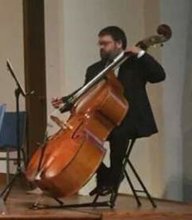
The bass I'm renting from the university has a carved back and I can put my left knee in the "valley" of the curve of the carved back as I sit. I'll keep both feet flat on the floor, and my right knee is kind of in the c-bout. I've seen people claim that it is impossible for me to truly play a bass like one would play a cello since a full sized bass cannot fit between the knees, well I think I could get the bass between my knees but I would rather turn the bass a bit to make the bowing more natural.

Some of the comments above mentioned concerns on if the bass is leaned back too far that the end pin could slip across the floor. I have an end pin anchor to prevent that. It's the kind that has a strap with a loop on one end to put around a chair leg and a cup for the end pin on the other. Thankfully the practice rooms have carpeting which keep the end pin from moving on me and I don't have to bother with it there.

If I buy or build my own bass then I'll have to think about what kind of seating I should get. If I get an EUB then that changes how I'll sit at it, unless I get the kind that has a frame that approximates the outline of an acoustic. Getting a stand would work too, as opposed to just the end pin. All things I'll need to consider.
 
Also, finding a comfortable standing and/or sitting position takes time for all of us. I would just give it time. Make sure you have a comfortable standing position just in case there is music you really want to play and there is no stool!
Work with a standard stool for a year or so before going rogue. Setting up weird obstacles for yourself won't help in the long run, you already have the damaged feet to deal with.
I practice mainly sitting now, but play standing.
 
  • Like
Reactions: gerry grable
Also, finding a comfortable standing and/or sitting position takes time for all of us. I would just give it time. Make sure you have a comfortable standing position just in case there is music you really want to play and there is no stool!
Work with a standard stool for a year or so before going rogue. Setting up weird obstacles for yourself won't help in the long run, you already have the damaged feet to deal with.
I practice mainly sitting now, but play standing.
I envy you and all players that have found comfortable sitting positions. I can't play upright sitting and I've tried for a lifetime. It feels like I'm playing a fence post, too rigid. Ironically, I hate playing fender while standing. I've actually turned down fender gigs because they didn't think a sitting bass player "looked right."
 
I envy you and all players that have found comfortable sitting positions. I can't play upright sitting and I've tried for a lifetime. It feels like I'm playing a fence post, too rigid. Ironically, I hate playing fender while standing. I've actually turned down fender gigs because they didn't think a sitting bass player "looked right."
Look up Rabbath. He stood with a laid out horizontal bass with the neck on his shoulder. I model my seated position on his standing position and find that I get by with a regular end pin just fine. I find it sounds better, I'm more relaxed, can play at least twice as long, have much better access to the upper registers, etc. etc. etc.
 
Weird work-arounds are not going to get you anywhere! Just learn to sit with the bass. You always have the option of just listening to music.

Reposted for truth. Seriously. There is a position, sitting or standing, for everyone. Take the time to find it. It's called practice for a reason.
 
Check out Ovidiu Badila and how he sits next to cellist Catalin Ilea here:


You can see when he comes onstage that he uses what looks like a drum throne:


Show that to the Prof. and tell him you'd like to play like Ovidio . . . maybe a low stool could help :)
 
I hate playing fender while standing.

Gerry,
(At the risk of being given the BOOT for discussing the oft-hated Slab here in the DB Ivory Tower...)
Do you use a strap on your Fender while sitting? I think you should consider using one, if you don't currently.
I encourage/require my Slab Students to always use a strap, both sitting and standing (DUH!), so that the bass remains in a fairly consistent relationship to both the LH and RH (especially.) The cutout on most "Fender" basses, causes the bass to slide too much to the player's right-side by resting on the Right hip - thus mucking up the RH + LH placement. There should be very little difference in the overall geometry whether sitting or standing, IMO.
Just my $0.03.
Thanks.
 
  • Like
Reactions: damonsmith
Gerry,
(At the risk of being given the BOOT for discussing the oft-hated Slab here in the DB Ivory Tower...)
Do you use a strap on your Fender while sitting? I think you should consider using one, if you don't currently.
I encourage/require my Slab Students to always use a strap, both sitting and standing (DUH!), so that the bass remains in a fairly consistent relationship to both the LH and RH (especially.) The cutout on most "Fender" basses, causes the bass to slide too much to the player's right-side by resting on the Right hip - thus mucking up the RH + LH placement. There should be very little difference in the overall geometry whether sitting or standing, IMO.
Just my $0.03.
Thanks.
Thanks, Don,
I agree 100% with everything you wrote. And yes, I have always used a wide leather strap ( it cost me $6.50, big bucks at the time- still use the funky thing) with my Jazz Bass- sitting or standing for all the reasons you have mentioned. You're the first person I ever heard verbalize it ( I notice that Damon agrees, too ). From 1969 thru the mid-70s, I played nothing but Fender in NYC, working steady gigs, 5, 6 and 7 days a week, and at that time a "night" was 5 or 6 hours. The good old days! I think I'd be a hunchback if I hadn't been sitting most of the time.
 
  • Like
Reactions: Don Kasper

Latest posts