Go over every detail of your basses to determine which tool is best for the job. Here's a few tips to help you out
-to lay frets, scale length / 1.059463094 = placement for fret 1 and then subtract that from the original length and then divide again to get fret 2, etc. is there really any point to this these days? All templates for nearly every scale are in the stickies above on printable pdf templates - thanks mikeyswood!
-look for straight grain for best results in the neck. The grain should always go in the direction of the strings to avoid warping and other issues I've never seen this emphasized before and I've read all the books - I can see it going along the fretboard, but I've also seen layered veneer necks, wavy necks and others that defy this idea and still work just fine. Also, both quartersawen, flatsawn and laminated necks are used although I guess the grain orientation mostly goes from body to wood.
-lay out and ANALYZE every little detail of your plans to be sure of a smooth build. Now this I can completely agree with!
-ibanez style tuner hole size is 9/16ths
-good height from body-fretboard is 7-8mm I don't know if this can be a rule of thumb, doesnt' it really have to depend on the neck to body join type as well as the type of bridge used, height over body and length of fretboard?
-angled headstocks are best at 13 degrees I have read builders who swear by 7 degrees or thereabouts and Ken Parker (of parker fly fame now an archtop guitar expert) has built necks of all angles and now swears by 4 1/2 degrees as it is the minimum angle to give the required load of strings across the nut to hold them in place with tension, but the least angle introduced to the headstock to avoid weakening it. I guess he doesnt' use scarf joints?
-route out truss rod cavity before cutting out the neck, it makes routing a straight line much easier
-look for body wood materials to be a minimum of an inch an a half thick All of my bodies (5 now) have been 1 3/16" because this is the minimum body depth for my electronics choices, but I dont' see any reason to go any thicker since it's just adding weight to the body and I've always enjoyed thinner guitars.
-make templates of the neck and body for best result and make them exact (bolt on necks need to fit tight in the neck pocket for best resonance) I have not built any templates yet, i just use stringers clamped to the body as routing guides and so far my three neck pockets have been tight enough to hold the guitar up with no screws in it. I can see making a template if you will be repeating the exact operation again and again, but if each instrument is unique like mine, there is no point as nothing is gained by making a template.
-always predrill holes for screws, don't go heman and try to force the screw into the wood with brute force, chances are you will crack the wood. So very true in my own wood cracking experience. I also am using a little wax on the screws now, thanks Syco Bass!
-avoid woods like pine for any portion of the build. Hardwoods are the best, maple, mahogany, ash, bubinga, purple heart, wenge, ebony, etc. I don't want to be rude but that's just plain wrong. ANy wood can be used to make a bass as long as it's structurally sound and there are several pine instruments on this board and in this forum that are beautiful strong and sound great.
-neck width is the builders choice, but just know if you choose an odd size, you will probably have to make the nut yourself
-measure once, twice, three times, four times, and of your feeling like a perfectionist, five times. 1 wrong measurement could throw everything off.
-sand with the grain of the wood to avoid unsightly scratches and also begin sanding at 80 and work your way up to 400-600 or which ever you prefer.
-I find the best thing for a smooth neck is 600 grit sandpaper and tung oil, it makes for a schecter studio like neck
I hope some of this helps! Have fun!



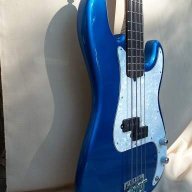
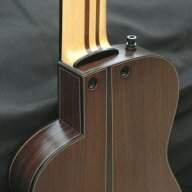



 as for headstock angle, I just dig 13 degrees, of course different strokes for different folks, but I like the tension it puts on the nut so I swear by it. And for the rise at the end of the finger board, it too is subjective to discussion. It's all really what you prefer. I was just posting my methods and tips. And for the wood grain direction, it keeps the neck stable better and it's not as prone to twist and go all sidhbaihbdiudsbhsn.


