• TalkBass has been independent since 1998. Add your voice.
    Create a free account to reply to discussions, view embedded media, and browse with fewer display ads.
    Join freeLog in
    Want zero display ads or expanded classifieds tools? Compare plans.

So if wood type makes no difference in tone...

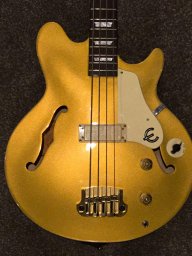
... How come hollow bodies sound different from solid bodies? Hmmmm?

:D

...for the same reason DB sounds different than EB.
...for the same reason Corvettes drive differently than Yugos.
...for the same reason a machete cuts differently than a steak knife.

Shall I continue? :roflmao:
 
Whenever I read a few posts of these kind of threads, I always think of the folks from major league arguing over whether the home run was too high or too hard...
preview.jpg
 
Yes, wood matters but so does everything else;density, construction, neck join, pickups, preamps, strings, frets...

In the end it's what the string is doing that's sensed by the pickup. Now if you change any parameters the string vibration will change so it will sound different, it may be subtle or it may be very noticeable. Even changing the player makes it sound different.

On a hollowbody it's definitely going to vibrate differently so there is a massive change in sound.
 
Did you see the results from the Leonardo Guitar project a few years back

6 luithers built 12 guitars, same specs like internal bracing etc. Each built 1 from traditional acoustic timbers and 1 from poplar,plane and a few other timbers. Blind folded audience was asked which were traditional.

Turned out each guitar got 50% of the votes and the folks behind the test put this down to guessing. Once the blindfolds came off the traditional timbers gained 75%.
The problem with this study design is there is no control. To properly test it you need a control. This is a randomized single blind uncontrolled study. I don't know what you gain from it.
 
  • Like
Reactions: Kubicki Fan
People believe what they want to believe. Of course wood matters. But that's not the crowdthink opinion here. That's fine.

I no longer care to "educate" a public that has no interest in learning anything. And OP, I'd advise you to just give it up as well.

Is there a difference from wood to wood, of course. Is it really discernible when mixed in with the rest of the band/ensemble with different EQs, presence in this, and strings? Probably not if you are honest.
 
The problem with this study design is there is no control. To properly test it you need a control. This is a randomized single blind uncontrolled study. I don't know what you gain from it.
The only thing that can truly be gained is that at best, while blinded nobody could tell the difference above random chance.

You don't need a control when comparing two competitors. No placebo needed.

"Which one is traditional, ie, "better" which one is non-traditional, ie "shouldn't be as good"- or more generically: can blind listeners recognize Spruce, Mahogany and maple vs "non-musical" woods.

If a control was introduced one might compare each guitar individually vs a pre-war D28 then have the blinded listeners guess which was the Martin and which was the "variable" guitar in each case. But that is not the same question put forth in the above exercise.
 
The problem with this study design is there is no control. To properly test it you need a control. This is a randomized single blind uncontrolled study. I don't know what you gain from it.
You gain a very strong indication that the audible differences between these wood types is at most very minor and unable to be discerned by the audience attending, while the visual differences are much more readily apparent.
What you choose to do with that information is up to you.
 
  • Like
Reactions: DrMole and StayLow
Does wood matter:
ACOUSTICALLY - Yes, because you are using the wood as your sound board to transmit sound through the air.

SOLID BODY ELECTRIC - No. You are going to have to get around physics for this one because wood has NO effect on a magnetic field. That is what you pickup is using to "read" the METAL string that is vibrating and inducing a voltage across that coil of the pickup. That is transmitted through the OUTPUT jack of your instrument. Again, wood has no effect on a magnetic field.

>> wood has no effect on a magnetic field>> Nobody claims that ever. But bevor the "pickup is using to "read" the METAL string", the string is already affected by the structure. The formants* change with the structure.
*Formant: what is a formant?
 
  • Like
Reactions: Frank Tuesday
When the construction is as different as solid vs. hollow then the wood that’s used is meaningless.
But that nullifies the argument that the tone is all in the pick up and strings. No? If the construction of the body can affect the tone of an instrument, it simply cannot all be in the pickups and strings. I see no way around this. Does say, alder vs ash make anywhere near the same difference as hollow vs solid? I have never heard ANYONE make that argument.
 
The real question is does alder vs ash make any more difference than alder vs different piece of alder?
That's the one all the tonewood guys ignore when they say bass X sounds different to bass Y
I have no idea where you get that. Every "tonewood guy" will tell you that every piece of wood is different. The characteristics attributed to alder and ash are generally true as probabilities. But that's it - probability, not certainty. There's a difference between the two that too many can't comprehend, whether it's wood, or something like girls aren't as good as guys at math. If you assume a probability is a good measure of certainty, there's a good chance you are making a mistake. There are girls who can shame most guys at math. But, that doesn't mean probability is pointless. It's just not reliable to specific instances. For every 7 out of ten, there are the other three.
 
The only thing that can truly be gained is that at best, while blinded nobody could tell the difference above random chance.

You don't need a control when comparing two competitors. No placebo needed.

"Which one is traditional, ie, "better" which one is non-traditional, ie "shouldn't be as good"- or more generically: can blind listeners recognize Spruce, Mahogany and maple vs "non-musical" woods.

If a control was introduced one might compare each guitar individually vs a pre-war D28 then have the blinded listeners guess which was the Martin and which was the "variable" guitar in each case. But that is not the same question put forth in the above exercise.

Correct, the null hypothesis is that guitars made from "traditional" woods do not sound different from guitars made from non-traditional woods. They used a valid basic experimental design. The problem I see is that the particulars of the methodology are messy. Both the traditional and non-traditional groups used different combinations of woods. The intra vs. inter group variation is not parsed out (i.e., were the sonic differences between the various traditional guitars or between the various non-traditional guitars more or less than the differences between tradition and nontraditional?). Also the listeners were random people recruited via social media who responded via survey online - not exactly a well controlled test group. I'm just not sure how much you can take away from this study.
 
People believe what they want to believe. Of course wood matters. But that's not the crowdthink opinion here. That's fine.

I no longer care to "educate" a public that has no interest in learning anything. And OP, I'd advise you to just give it up as well.


I have build enough basses to know the pickups and strings make the most difference. I have 3 p basses with different woods. They all sound like p basses.