• TalkBass has been independent since 1998. Add your voice.
    Create a free account to reply to discussions, view embedded media, and browse with fewer display ads.
    Join freeLog in
    Want zero display ads or expanded classifieds tools? Compare plans.

Solo bass guitar for a beginner...

Greetings All. I'm new here and I've come to ask some basic advice from people who know the bass guitar. I'm a guitarist (amateur) and play classical, blues and jazz but have always enjoyed the bass as an instrument...I love its timbre, the way it provides structure for an ensemble and the way that its resonance penetrates your body...perhaps like no other.

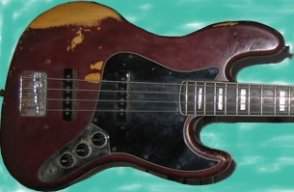
So here's the story: a couple of weeks ago at a flea market in Brussels I bought a Fender Jazz in horrible condition, but that didn't worry me as I do most of my own guitar tech work. And indeed, I had little trouble whipping it into shape; it looks like the beat up old instrument that it is, but it sounds great (original pickups as far as I can tell) and plays easily (the neck is perfect and I did a very thorough setup to factory specs). I bought a beat up (once again) Gallien Kreuger amp (cost more than the Fender, but the two together came to less than $200) and have been enjoying playing guitar bass runs and driving my neighbours batty.

My question is, where do I go from here. I have no great ambitions, but would be beyond delighted if I could learn to handle the instrument competently and to build up a repertoire of simple bass solos (I'm not even sure that such pieces exist). If anyone could give me some guidance on, for example a book or an Internet site that can get me started on technique, as well as some suggestions for repertoire, I would be very grateful. Best to all, Robert
 
Welcome to the world of bass!

My recommendation for learning to solo is to start with dirt-simple melodies: nursery rhymes, church hymns, holiday songs, patriotic tunes, TV/movie themes, etc. For example if you can play "Amazing Grace" with feeling and emotional content, then you are off to a good start!

Then the next step is to transcribe and study performances by solo-bass masters: Jaco Pastorius, Victor Wooten, Michael Manring, etc. But I would encourage you to "learn to crawl before you learn to run" and not rush into material that is too difficult. Maybe there are some tunes you already know quite well on guitar, that it would be a good exercise to adapt them for bass? :)

PS Jaco is dead, but Wooten and Manring are alive, and are excellent teachers. You could take lessons with someone of their caliber if you really want to excel! Many of the top instructors give Skype lessons these days.
 
Last edited:
Welcome to the world of bass!

My recommendation for learning to solo is to start with dirt-simple melodies: nursery rhymes, church hymns, holiday songs, patriotic tunes, TV/movie themes, etc. For example if you can play "Amazing Grace" with feeling and emotional content, then you are off to a good start!

Then the next step is to transcribe and study performances by solo-bass masters: Jaco Pastorius, Victor Wooten, Michael Manring, etc. But I would encourage you to "learn to crawl before you learn to run" and not rush into material that is too difficult. Maybe there are some tunes you already know quite well on guitar, that it would be a good exercise to adapt them for bass? :)


Many thanks for the sage advice, Mushroo. I like the idea of Amazing Grace as I can play that on the guitar...should be able to transpose the 1 and 2 strings pretty easily. I'll give it a try this evening until the neighbours start banging things until I give them some peace (It's amazing how well bass notes carry...even through walls). Thanks again. R.
 
  • Like
Reactions: Mushroo
There is a difference between "bass solo" and "solo bass"

Most solo bassists are musicians that choose the bass as their voice.So to speak.
And most of them are highly accomplished.
Check out Michael Manring.

Hello Gebass6 and thanks for the reply. I'm talking about solo bass, simply because (for me at least) a bass solo is something that takes place in the context of a piece played by ensemble. I'll be playing alone for my own enjoyment, but that will still be solo bass, as I read it. Might take me awhile before I get to the level where I'm stealing gigs from Richard Bona (smile). Best, R.
 
  • Like
Reactions: wes stephenson
My question is, where do I go from here. I have no great ambitions, but would be beyond delighted if I could learn to handle the instrument competently and to build up a repertoire of simple bass solos (I'm not even sure that such pieces exist). If anyone could give me some guidance on, for example a book or an Internet site that can get me started on technique, as well as some suggestions for repertoire, I would be very grateful. Best to all, Robert
Well first -- Our primary job as you mentioned is to lay down the foundation for the rest of the band to play over. We do this by locking with the drummer's kick drum and playing notes of the active chord to that beat. We normally do not do solos. Not saying you can not take a lead solo break, however, the guitar guys do a much better job of this as our low frequencies do not lend them selves to melody solos unless your up past the 12th fret. So, why not learn how to build up a repertoire of bass lines first?

We do that by running our scales up and down the fretboard a zillion times. This gets our fingers moving to the correct notes and we learn our way around the major and minor scales. Plus start seeing the patterns that repeat themselves on our fretboard.

As chords are made from the scales it now is an easy step to start playing notes of the chord in our bass lines. I'm going to point you to the Getting Started Sticky and after you have looked that over, come back with some questions. How to get started?
 
Last edited:
  • Like
Reactions: eJake and Mushroo
Hello Gebass6 and thanks for the reply. I'm talking about solo bass, simply because (for me at least) a bass solo is something that takes place in the context of a piece played by ensemble. I'll be playing alone for my own enjoyment, but that will still be solo bass, as I read it. Might take me awhile before I get to the level where I'm stealing gigs from Richard Bona (smile). Best, R.
I knew that you meant "solo bass"by the context of your post.
Here's a favorite of mine.
 
Well first -- Our primary job as you mentioned is to lay down the foundation for the rest of the band to play over. We do this by locking with the drummer's kick drum and playing notes of the active chord to that beat. We normally do not do solos. Not saying you can not take a lead solo break, however, the guitar guys do a much better job of this as our low frequencies do not lend them selves to melody solos unless your up past the 12th fret. So, why not learn how to build up a repertoire of bass lines first?

We do that by running our scales up and down the fretboard a zillion times. This gets our fingers moving to the correct notes and we learn our way around the major and minor scales.

As chords are made from the scales it now is an easy step to start playing notes of the chord in our bass lines. I'm going to point you to the Getting Started Sticky and after you have looked that over, come back with some questions.

Many thanks for the kind reply, Malcolm. I think you've misunderstood what I'm looking for and that's understandable as the bass guitar is above all an ensemble instrument. Thing is that I won't be playing with anyone else. This will just be myself, at home, trying to enjoy making a bit of music in the lower registers. I'm not sure I understand what the Getting Started Sticky is...sorry. Best, R.
 
Follow your heart. You've already stated what you love about the instrument, now explore it with wide eyed optimism. Have fun right now. Eventually you'll find your own path which may or may not take you to higher learning and exploration on the instrument. You might eventually find yourself in a position to unlearn some bad habits or you might discover an innovative way to approach the instrument that will continue to motivate you.
 
  • Like
Reactions: Schopes
Follow your heart. You've already stated what you love about the instrument, now explore it with wide eyed optimism. Have fun right now. Eventually you'll find your own path which may or may not take you to higher learning and exploration on the instrument. You might eventually find yourself in a position to unlearn some bad habits or you might discover an innovative way to approach the instrument that will continue to motivate you.

Thanks Rhythmman for the sound advice. It's true that I tend to over-intellectualise and it's liberating to just let it flow from time to time. I'll keep your post in mind when I've got the instrument in hand a bit later. Best, R.
 
Many solo bassists rely heavily upon alternate tunings, natural and artificial harmonics, and various advanced techniques to expand the sonic capabilities of the instrument. Watching YouTube videos from guys like Michael Manring (already mentioned) and Zander Zon would be a good introduction to some of this.

On the opposite side of the spectrum, if you can name any reasonably popular piece of classical music, odds are you can find solo bass version of it on YouTube, and there are some books out there with solo bass arrangements of classical pieces as well (typically targeted toward upright bass, but still potentially useful).
 
  • Like
Reactions: Watchootognbout
Being that you can play guitar is a plus. I can play both, bass and guitar, so I often use the guitar in formulating a solo piece, then transpose to bass in a way that makes sense. I'm never afraid to go to a higher or lower octave/register to accomplish what I'm trying to get across -- as long as it sounds right to the ears. You will likely use chords or chord structures on the bass, with solo bass. The only guy I can think of, off hand, is Zander Zon, on YouTube. Check out some of his solo stuff.
 
  • Like
Reactions: Watchootognbout
Greetings All. I'm new here and I've come to ask some basic advice from people who know the bass guitar. I'm a guitarist (amateur) and play classical, blues and jazz but have always enjoyed the bass as an instrument...I love its timbre, the way it provides structure for an ensemble and the way that its resonance penetrates your body...perhaps like no other.

So here's the story: a couple of weeks ago at a flea market in Brussels I bought a Fender Jazz in horrible condition, but that didn't worry me as I do most of my own guitar tech work. And indeed, I had little trouble whipping it into shape; it looks like the beat up old instrument that it is, but it sounds great (original pickups as far as I can tell) and plays easily (the neck is perfect and I did a very thorough setup to factory specs). I bought a beat up (once again) Gallien Kreuger amp (cost more than the Fender, but the two together came to less than $200) and have been enjoying playing guitar bass runs and driving my neighbours batty.

My question is, where do I go from here. I have no great ambitions, but would be beyond delighted if I could learn to handle the instrument competently and to build up a repertoire of simple bass solos (I'm not even sure that such pieces exist). If anyone could give me some guidance on, for example a book or an Internet site that can get me started on technique, as well as some suggestions for repertoire, I would be very grateful. Best to all, Robert

Hello Robert.
I guess you could buy a Loop pedal and fo from there.
Here are some vids to inspire you


  • Like
Reactions: Watchootognbout
The geometry of stringed instruments makes it natural for us to focus on scale tones. In soloing, scale tones sound boring. To become a good soloist on any instrument, you have to learn to speak chordally instead. That means instead of playing "A-B-C#-D" in your solo, play "A-C-E-F#-B". Singers seem to do this naturally, which is why people tell you to learn the melodies to songs.

I also suggest learning to play vocal melodies, but it doesn't have to be Twinkle-Twinkle. Even in popular music the vocal melody is often very interesting relative to how it sits on top of the chords. Learn to play the melodies to whatever songs you already like or hear on the radio, that's more fun.

Transcribe. This is work. Find a solo you like and notate it musically. Then do another one. And another. Obviously you have to be able to read music to do this. It's incredibly helpful though, because you learn to recognize patterns other guys use often and integrate them into your own playing.

Listen to lots of John Coltrane and Miles Davis. Much of what you're trying to learn was invented or perfected by these men.

Get out of your living room and create opportunities to play music with other humans. A living room player is no more a musician than a guy who only hits a bag is a boxer.

Finally - in my opinion most virtuoso bass players play too many notes to be instructive to you when trying to learn to solo. A lot of them start out solos well, but usually by the beginning of the second chorus they have moved on from melodic soloing to technical tricks. Tommy Kennedy and Gary Willis are both players I like very much, but who do this a lot. I wouldn't spend more than 25% of your time listening instructively to bass players as soloists.

That said, the most accomplished bassist as a soloist, to my ears, is John Patitucci. His phrasing is exquisite and his ears are amazing. He does play a lot of notes, but unlike a lot of other guys he is improvising and playing very complex melodic lines very quickly, versus parlor tricks. He is astounding.

As for your sub-$200 jazz bass find. Pics or it didn't happen.
 
Last edited:

Latest posts