

I’ve learned a lot from TB and this is my humble attempt to reciprocate a little in the hopes to help somebody, somewhere down the road.
I have an acoustic 4-string Tacoma Thunderchief with the LR Baggs active preamp (with notch filter, but no phase switch). Recently, I have been gigging with it as my sole instrument in a 4-piece relatively loud honky tonk band. No matter where I stand in reference to my amp and cabinet, I can’t increase preamp gain to a reasonable level (either onboard or outboard preamp) without initiating an epic feedback drone that would put giant Malaysian cicadas to shame.
So to diagnose in the downtime, I stood directly in front of my cabinet and cranked gain on the amp until the speaker started talking back to me (careful with the ears ). Then I backed it off a little and played notes until I found where the feedback was the strongest – B3 on the 9th fret of the D-string…ok, so looking at a chart of musical note frequencies: that is… um… 246.94 Hz.
I downloaded a free audio spectrum analyzer app to my phone and had it listen to my ‘bad B3’ to confirm my offending frequency. The app I used is called, “Audizr”.
Red is peak signal strength while green is real time signal strength when I took the snapshot.
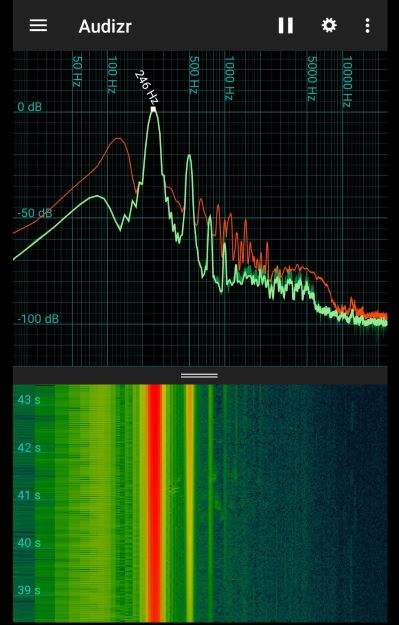
There it is: 246 Hz. Sweeping the notch filter slowly on the onboard preamp would never work to eliminate the feedback and I am not sure why. My amp head does have a semi-parametric mid, but the frequency selector knob seemed to have too wide of a bandwidth (very low Q) and would change the tone too much when cut around my bad B3.
The only fully parametric EQ (with control over Q) that I had was a filter in the Zoom B3n multi-effects bass guitar processor. So, I loaded up the ‘BassPEQ’, set frequency to 250Hz and cut the gain to -12.0.
___________Q = 0.5_____________________Q = 16
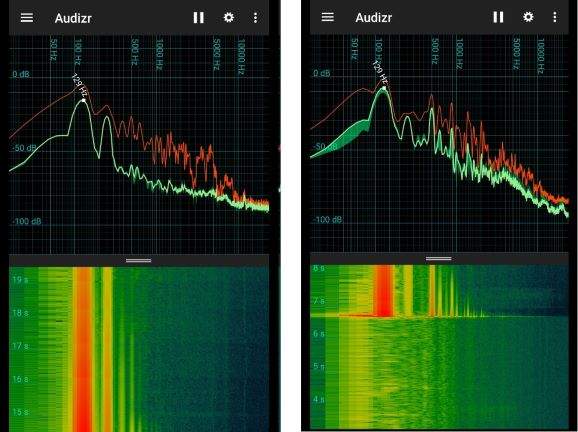
Playing a B3 after PEQ shows that it yields to the peak at 129 Hz or B2. You can see my 'bad B3', the next peak to the right of the 129 Hz peak, getting shorter with higher Q factor. And by the grace of the Sound Gods… no more feedback with either Q . There didn’t seem to be much difference in tone either. I will have to play around with the Q a little more to see if I notice anything. I also have an HPF loaded on the Zoom at 80 Hz ('LowEQ').
I am guessing that this bad “B”lood resonance is inherent to the instrument. I also wonder whether an upright bass may feedback at a lower Hz due to its more cavernous volume. Maybe someone who knows more will ‘chime-in’, but at a different frequency please .
.
Before trying to solve this problem: Whenever the lead guitarist would play a ‘screaming A’ chord, I could feel the body of the bass rumble and hear the feedback start to loop until I grabbed the strings and muted the instrument. Close enough to the ‘bad B’, I guess.
Praise the Parametric Princess of Sound: This bass sounds great with this band!
I have an acoustic 4-string Tacoma Thunderchief with the LR Baggs active preamp (with notch filter, but no phase switch). Recently, I have been gigging with it as my sole instrument in a 4-piece relatively loud honky tonk band. No matter where I stand in reference to my amp and cabinet, I can’t increase preamp gain to a reasonable level (either onboard or outboard preamp) without initiating an epic feedback drone that would put giant Malaysian cicadas to shame.
So to diagnose in the downtime, I stood directly in front of my cabinet and cranked gain on the amp until the speaker started talking back to me (careful with the ears
). Then I backed it off a little and played notes until I found where the feedback was the strongest – B3 on the 9th fret of the D-string…ok, so looking at a chart of musical note frequencies: that is… um… 246.94 Hz.I downloaded a free audio spectrum analyzer app to my phone and had it listen to my ‘bad B3’ to confirm my offending frequency. The app I used is called, “Audizr”.
Red is peak signal strength while green is real time signal strength when I took the snapshot.
There it is: 246 Hz. Sweeping the notch filter slowly on the onboard preamp would never work to eliminate the feedback and I am not sure why. My amp head does have a semi-parametric mid, but the frequency selector knob seemed to have too wide of a bandwidth (very low Q) and would change the tone too much when cut around my bad B3.
The only fully parametric EQ (with control over Q) that I had was a filter in the Zoom B3n multi-effects bass guitar processor. So, I loaded up the ‘BassPEQ’, set frequency to 250Hz and cut the gain to -12.0.
___________Q = 0.5_____________________Q = 16
Playing a B3 after PEQ shows that it yields to the peak at 129 Hz or B2. You can see my 'bad B3', the next peak to the right of the 129 Hz peak, getting shorter with higher Q factor. And by the grace of the Sound Gods… no more feedback with either Q
. There didn’t seem to be much difference in tone either. I will have to play around with the Q a little more to see if I notice anything. I also have an HPF loaded on the Zoom at 80 Hz ('LowEQ').I am guessing that this bad “B”lood resonance is inherent to the instrument. I also wonder whether an upright bass may feedback at a lower Hz due to its more cavernous volume. Maybe someone who knows more will ‘chime-in’, but at a different frequency please
.Before trying to solve this problem: Whenever the lead guitarist
would play a ‘screaming A’ chord, I could feel the body of the bass rumble and hear the feedback start to loop until I grabbed the strings and muted the instrument. Close enough to the ‘bad B’, I guess.Praise the Parametric Princess of Sound: This bass sounds great with this band!
Attachments

Last edited:


 .
.


