• TalkBass has been independent since 1998. Add your voice.
    Create a free account to reply to discussions, view embedded media, and browse with fewer display ads.
    Join freeLog in
    Want zero display ads or expanded classifieds tools? Compare plans.

(Solved) Music Man Truss Rod Modified by Previous Owner

Update:

Some of the first 11 posts contain incorrect information. See the final solution at the link below (post #12). Probably no one will ever have this same problem, but I wanted to share it just in case. Long story short, previous owner probably broke the end of the truss rod and it was replaced with a 6mm metric rod instead of the original 1/4"-28 thread. This took me a while to diagnose, but my solution was to get a new spoke wheel nut with a slightly smaller 10-32 thread, and re-drill and tap up to 6mm metric so that it fits properly on the rod.

(Solved) Music Man Truss Rod Modified by Previous Owner

Original post:


Hello,

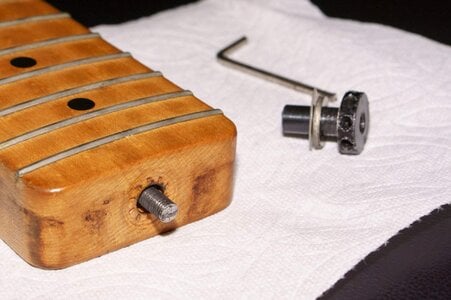
I bought a Stingray neck on ebay (that I'm going to use for my upcoming project). And something is strange with the truss rod and nut at the neck heel. The threaded rod on an EBMM normally ends inside the neck, and the wheel nut reaches about an inch inside the neck, and bottoms out on the neck heel. This one has the threaded rod sticking about 1/2" past the end of the neck, and some washers acting as a spacer between the wheel and the heel. The end of this rod appears to have been cut off by hand. Also, this neck is 20 years old, but there is tons of wear on the wheel nut - like they used pliers or something. Not sure if that indicates the neck isn't going to be stable.

The ebay seller sold the neck as-is with no returns, and the truss rod does seem to work. The neck is straight when the rod is loosened all the way (no strings on it) and then I can get some back bow when tightening it. But I would like to, if only cosmetically, restore the truss rod nut to original so that the cavity I have to route in the body is not overly large.

I have owned several EBMM guitars and basses, and I know this is a genuine EBMM neck. I have already called EBMM customer service and sent them some pictures. They were very helpful, but they said the threaded rod sticking out past the neck heel does not look original.

The neck is kind of dirty with lots of fretwear, but overall it looks to be in good shape. I don't see evidence that the fretboard so I don't think the entire truss rod has been replaced. Can anyone think of a reason why a rod would have been extended like that?

I can try to remove this threaded rod by either locking 2 nuts together and then turning the inner nut counter-clockwise - OR I think those left-handed stripped screw removal bits would work. I am just afraid of removing something that can't be reinstalled. So if I should just leave that rod in there, then I could at least cut it off flush with the neck heel.

Any input or ideas welcome! Thanks!
 

Attachments

  • DSC02505.jpg
    DSC02505.jpg
    64.9 KB · Views: 3,104
  • DSC02513.jpg
    DSC02513.jpg
    120.6 KB · Views: 2,173
Last edited:
  • Like
Reactions: Jeffrey Watts
Well, obviously, that's not original. Someone has been messing around in there. I see two possibilities for how and why:

Most likely is that the original truss rod came unthreaded from the anchor at the other end. I think those necks have a threaded anchor. The original spoke wheel nut may have locked onto the rod from corrosion, and when someone tried to loosen it, the threads broke loose at the anchor end, and the whole rod unscrewed and came out of the neck. To repair it, they found a new truss rod (which was a half inch too long) or cut a piece of threaded rod (a little too long), and then fished it in and got it rethreaded into the anchor. Then they just left it like that, sticking out, and threaded the spoke wheel nut back on.

The other possibility is that someone has severely overtightened the truss rod, crushing the wood at the anchor end and pulling the anchor forward, causing the rod to stick out. But, that's a lot. And it's weird that someone would do that, because it sounds like the neck is in pretty good condition overall. That condition would be more likely on a neck with a nasty forward bow. But maybe someone cranked on the truss rod anyway, just because.

So, the question now is whether the truss rod is anchored reasonably well, and can take some load. Can you thread the nut on there with just one washer, and will it tighten up and cause the neck to move a little bit? If so, then you are probably okay. Take the nut off and use a hacksaw to saw off the excess end of the rod, so it's only sticking out a little bit. A little less than the thickness of the head of the spoke wheel. Carefully file the burrs off of the sawn end and thread the nut back on. One thin metal washer under the head is a good idea.
 
Thanks Bruce! Problem not yet completely solved, but I got some more data.

I took out all the washers and tried to reinstall the spoke wheel. The shaft is bottoming out inside the neck before the wheel reaches the wood. And upon this bottoming out, I can feel the threaded rod acting like a torsion spring, so it's bottoming out on maybe a nut or something that is already locked onto this rod.

Also the ease of spinning the nut does not really get easier as I'm removing it. Is that normal? It doesn't require a crazy force, but it never gets loose enough to spin with my fingers.

Now that I mention it it feels kind of like it's cross threaded...goes and gets calipers...dang it! This thread is 6mm, I think it's supposed to be #10-32. :mad: I just ordered a new spoke wheel from EBMM today. Hopefully I can cancel that before it ships!

So now if I'm going to cut off the end of the rod, I'll also have to cut off the end of the shaft of the nut so that it won't bottom out. But that should be ok right? I believe in general you only really need about 1 diameter of thread engagement for the full bolt strength. I'll still be left with 2 diameters of this shaft.
 
  • Like
Reactions: Jeffrey Watts
Okay, that starts to explain some things..... You mean 5mm, right? My first suggestion was probably correct; the original truss rod got unthreaded from the anchor and taken out. Then someone unknowingly put in a metric 5mm replacement truss rod, probably cross threading and jamming it into the anchor. Which also left it sticking out, because it only threaded into the anchor partway before locking up. Then, they forcefully cross threaded the original 10-32 spoke wheel nut onto the end of the 5mm rod, which explains the pliers marks....Yup, it's fixed!

Metric M5 x 0.8 thread is what's used on most import truss rods these day, and that thread is very close to the US 10-32 thread. Close, but not the same. They can be started and jammed onto each other.
 
  • Like
Reactions: Jeffrey Watts
5mm would make more sense. But nope it's 6! I was first measuring (major thread diameter) in inches and I got 0.237, I thought that's weird so switched to mm and it was 6.01! They would have had to re-drill and tap the spoke wheel for that.

Oh well. I think I'm just going to cut off the end of the rod and cut off the end of the nut shaft so it will at least all fit in the same size body cavity. Thanks again for your help. At least I feel a little better having an idea of what happened.
 
I asked EBMM about this and their guitar spoke wheels are #10-32, basses are 1/4"-32. I've never heard of that, it's extra fine thread. Kinda explains why the previous owner resorted to the metric if 1/4"-32 was hard to find. 6mm fine is 0.75mm = 33.87 threads per inch, so yeah pretty close and it kind of works I guess. Luckily I work with a bunch of mechanical engineers so I'll ask about the longevity of the mismatched thread. I'd think once the cross threading damage is done it's done and it won't keep getting worse over time. But it probably has a lower ultimate strength.
 
Please don't tighten a truss rod to make the neck bow...that's putting a lot of strain on the rod. Please loosen the rod...apply the bow that you want / need and then tighten the rod to lock the bow in. It will extend the life of your rod immeasurably and keep the bow / rod memory working longer.
 
I asked EBMM about this and their guitar spoke wheels are #10-32, basses are 1/4"-32. I've never heard of that, it's extra fine thread. Kinda explains why the previous owner resorted to the metric if 1/4"-32 was hard to find. 6mm fine is 0.75mm = 33.87 threads per inch, so yeah pretty close and it kind of works I guess. Luckily I work with a bunch of mechanical engineers so I'll ask about the longevity of the mismatched thread. I'd think once the cross threading damage is done it's done and it won't keep getting worse over time. But it probably has a lower ultimate strength.


1/4"-32, interesting. I've seen 1/4"-24 on old Harleys but that's a new one.

I guess if the nut or bolt doesn't fit just get bigger Channellocks! That's why there's Helicoils, right?
 
That's interesting about Music Man using the 1/4-32 thread. I didn't know that. On projects where I've used 1/4" dia truss rods, I've gone with #12-24 threads.

I have an older MM Stingray 4-string neck here now, sent to me to replace a broken truss rod. It's a headstock access skunk stripe style truss rod. I haven't opened it up yet, but the nut doesn't look like a 1/4" rod. I guess I'll find out.
 
Well last night I cut off the rod flush with neck heel. The stacked washers I was trying to omit are about 1/8" thick, so I cut off about 1/4" from the end of the nut shaft. But something is still locking it before the wheel hits the wood. Same deal that when this happens I can feel the rod acting like a torsion spring, so there's some metal on metal interference. I can't really see in there so I stuck a paper clip in the side and I feel something at about 0.62" deep, and my nut shaft is only 0.52" long. I even rounded over the external end of the shaft. I am baffled, but I'll just live with the washers because I want to move on and I don't want to break something. At least the rod is no longer going through the spoke wheel so I can fit a hex key all the way through.
 
Please don't tighten a truss rod to make the neck bow...that's putting a lot of strain on the rod. Please loosen the rod...apply the bow that you want / need and then tighten the rod to lock the bow in. It will extend the life of your rod immeasurably and keep the bow / rod memory working longer.

Ok thanks :) I wasn't doing a ton, just about a quarter turn to get maybe .02" of back bow just to make sure it works. I didn't want to wait 3 months to finish my build and then find out the truss rod doesn't work!
 
  • Like
Reactions: GMC
Final Solution:

Life happened and I've been on a hiatus from this project for, WOW, has it been 8 months? Oh well I'm getting it back up and running. I wasn't going to have peace of mind with this neck as-is, so I had an idea to actually get a tap and make the nut thread match the rod (such a simple idea really) and it worked!

I first took the spoke wheel nut down to Ace Hardware and checked against some screws. It turns out the nut was UNF 1/4"-28 (not UNEF 1/4"-32). I know the rod is 6mm diameter but I can't measure the thread pitch easily. You can get a thread pitch of 1 mm (25.4 TPI) or 0.75 mm (33.87 TPI), but I don't know which to get. Fortunately, M6 0.75 is apparently very rare and Ace Hardware didn't have a single screw in that size. So I took a chance and bought an M6 1.0 mm tap, ran it through the nut, and now it goes on the truss rod perfectly. I can spin it with my fingers all the way until it hits the neck heel (which is what it's supposed to do).

This wheel looks like it's been chewed on by an alligator, so I'm going to buy a new one. The new ones come with smaller 10-32 threads, but the same outside dimensions. So I just have to bore the hole to 5mm and then I'll get a clean tap with perfect new 6mm threads. Total cost for new nut, metric drill and tap is only about $30. Awesome!

Edit: I'm now sitting here thinking how obvious this solution was. But I didn't think of it because I had never tapped a hole before. New tool under my belt. :D
 
Last edited:
I'm still a little curious how they managed to get the 6mm x 1 rod threaded into (or attached to) the anchor. Maybe they just twisted it in there until the threads locked up. And, if the old rod that they pulled out was 1/4-28, why didn't they just replace it with a 1/4-28 rod? Or a 1/4" rod threaded 1/4-28 on both ends? Oh well, I'm glad that you were able to get it back together without major surgery.

For your reference, the normal recommended tap drill size for a M6 x 1 thread is US Wire Gauge #10. A metric 5mm drill is a bit larger than optimal, but okay.
 
I'm still a little curious how they managed to get the 6mm x 1 rod threaded into (or attached to) the anchor. Maybe they just twisted it in there until the threads locked up. And, if the old rod that they pulled out was 1/4-28, why didn't they just replace it with a 1/4-28 rod? Or a 1/4" rod threaded 1/4-28 on both ends? Oh well, I'm glad that you were able to get it back together without major surgery.

For your reference, the normal recommended tap drill size for a M6 x 1 thread is US Wire Gauge #10. A metric 5mm drill is a bit larger than optimal, but okay.

Thanks Bruce. Anything I saw on the internet said 5mm, but I guess in metric they don't have as many size options as the US wire series? (Actually Ace didn't have metric bits so I bought a #9 which is 4.978 mm) I see now that the minor diameter for this thread is nominally 4.863 mm. So I see your point. Considering that the rod has already been cross threaded in the past, would I be better off with the closer fit or the looser fit? I'm willing to spend $3 for another drill bit if you think that'll make a difference.