Another factor is what kind of shape you are in. If you are a desk jockey, don't work with your hands and don't get any kind of exercise you forearm muscles may be taking a hit because of it. Your condition has a bunch to do with how gigging goes.

TalkBass has been independent since 1998. Add your voice.
Create a free account to reply to discussions, view embedded media, and browse with fewer display ads.
Join free Log in
Want zero display ads or expanded classifieds tools? Compare plans.

Load in/out is minimal. Everything runs through the PA and I have plenty of help for that.How long/heavy is your load-in and load-out? How long are gigs vs practice sessions?
Does it feel more like muscle soreness or weakness? Is there numbness? Do you notice after practice/rehersals? How do those differ from gigs? Have you noticed any neck symptoms?
Total desk jockey. I need to start exercising again.Another factor is what kind of shape you are in. If you are a desk jockey, don't work with your hands and don't get any kind of exercise you forearm muscles may be taking a hit because of it. Your condition has a bunch to do with how gigging goes.
Setting your strap so that the instrument rides in the same spot whether you are sitting or standing is pretty standard practice. From my experience approximately 80% of players do this or extremely close to it. Unsure where you are seeing the glut of people doing otherwise. Maybe if you are frequenting metal shows only? Slinging to the knees seems to be more popular in that genre.
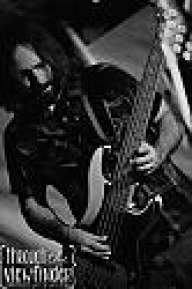
Even your own avatar shows that the instrument could not possibly be played in the same position seated, as standing.
Uh, nope, but nice try. That's precisely how I set that bass strap up. Sit down, set it, stand up.
You do you.
Well I don't know how your right thigh doesn't bump the whole instrument up in front of your face, and cause you to over extend your left arm.
Maybe your hips are down where regular folks knees are? In that case, you should definitely keep doing you.
- Maintaining muscle strength - I keep a handgrip on my desk and another in the car and I try not to overdo it.
I'm sure this advice is well intentioned, but grip gadgets have no role in bass playing. We have enough natural grip strength from an early age. Besides, the hands are supposed to be relaxed when we play...the opposite of gripping. It takes minimal strength to get a clear note. What is needed is stamina and agility. We achieve this by developing the tendons that OPEN the hands. Again..the opposite of gripping.
Grip gadgets may be OK for redeveloping strength in an injured hand, but for everyday bass playing, avoid them like the plague.
I've found the paradox of maintaining muscle strength playing bass (and guitar) is it's not for gripping the neck tighter. It's for maintaining more relaxed control, benefits of which include greater stamina, more fine-tuned touch & agility for dynamics and avoiding muscle soreness.
And I restate and elaborate from my original post: Don't overdo it or you'll risk muscle strain and other repetitive motion problems. It's not bulking up, rather the forearm equivalent of maintaining core strength.

I think it is generally accepted that gripping has no part in bass playing. So in my opinion it is pointless to develop the muscles used for gripping. "More relaxed control" comes from simply being aware of (and correcting if necessary) how relaxed or otherwise your hands are when playing.
"Fine tuned touch and agility" are best developed by (as I mentioned earlier) working on the tendons that OPEN the hand. An exercise for this is putting an elastic band around your fingers (at the finger nails) and then slowly expanding the hand and fingers against the resistance of the band. Bands of various resistances can be used, and like you said about gripping, don't over do it. For stamina and agility, the benefits of this exercise FAR outweigh grip exercises.
"Muscle soreness" is best avoided by staying hydrated, and by warming up...and down. Do some gentle hand/finger stretches that are designed for bass before you even touch the instrument. Then warm up slowly on the bass itself for a few minutes. Another couple of minutes spent doing gentle stretches AFTER playing will go a long way (far more than gripping exercises) towards avoiding muscle soreness.
I can only speak for what works for me, hence I framed it IME.
 It's all the same to me, what gadgets people use. I am not trying to convert anyone one way or the other.
That's fair enough.
I just wanted to draw other people's attention to the futility of using grip devices to help with their bass playing. I am sure they will make up their own minds, or at least do some research. There has been a lot of debate on the subject here on TB, if they care to search.
Gadgets for Technique Practice?
The idea of core strength for agility came to me years ago after snagging a low line-drive baseball that hit the webbing before smacking the dead center of the palm of my fielding glove. It inflamed a nerve causing trigger-finger, a locking of my left/fretting hand forefinger.
I saw a hand injury specialist who injected cortisone and gave instructions to get a sub for two weeks, and to stay off the field as long.
He also recommended a grip device with mild resistance once the injury was healed, not so much for PT, but to help with core strength as a way of sharpening my hand-closing response when fielding - you want the ball to stay safely in the webbing once caught.
He emphasized a couple sets with low reps of 12, and to use only light resistance. At the time, I tried multiple devices before finding an adjustable one with a dial for low-resistance training. It worked, I was able to close quicker, and I've carried that experience into playing music.
As I mentioned earlier, gripping devices do indeed have their uses in cases of building up strength in an injured hand. However, once the hand has recovered and back to normal, the advice generally is to ditch the "aid". In my opinion, it is like holding on to a crutch, once a broken leg has repaired itself and you are walking normally. It is surplus to requirements.