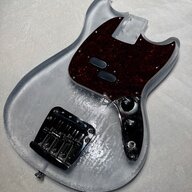
The cheap way to make a solid body instrument (with a cnc machine to make the wood parts) also happens to be the precise way to make an instrument. And the basic design of P's and J's is a good design - made pretty much anywhere, you can make a decent instrument.
The differences between levels of P'a or J'as lies in some fine details - the higher end ones sometimes have reinforced necks, but past that, it's pickups and hardware details. They should sound a lot alike, and I'm sure some folks at Fender stay up nights worrying about how to make teh higher end ones attractive enough that people will pop for the extra bucks.
Most of my basses are one off custom builds, but I also have a Squier Bronco I just bought last Christmas. It doesn't have fancy wood (it's painted), and I did a lot of detail work to get it to where it's a good playable instrument (a hum cancelling pickup and I levelled the frets). I also changed the rest of the hardware for weight reasons (some of the hardware I already had in my stock). So, my "$130 Squire" ran about $550 all in, if you assign reasonable values to the parts I already had. Broncos are short scales, and the neck joins at the body further from the bridge than most Fender necks, so the thing is really short and stiff, and has no noticeable dead spots - it is sonically, a great neck. It'll never be worth a lot (it says Squier on the headstock), but i's a very nice instrument now. I've played it at a couple of gigs, and it's only flaw is....it's not a 5 string with a wide neck that fits my hands well (what I am used to). I built the thing to develop mental plasticity - force myself to play something a bit different from time to time. For that, it's perfect. If my hands ever shrink 3 sizes, I might find it more playable than my big basses.
Can an Affinity be a good musical instrument? Of course. Out of the box, it might have some minor issues, but the playability stuff I can fix for very little money, given a few hours of detail work. If you find the demo a bit dark, I could wire that thing in parallel, and it'd be capable of being brighter than the higher priced ones - you can dial it in to wherever you want with the right loading capacitor. Then it's just the hardware questions - if you're not picky, you probably don't need to change anything, but if you are....yeah, that will cost a bit.