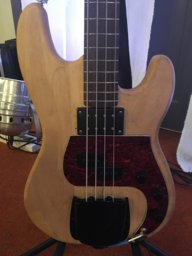
I acquired a Starcaster bass in the last few days. Fear not, it is one of the new ones and not one of the two '70s prototypes that are still known to exist. I've noticed that the original '70s basses had smaller pickups, whereas Fender incorporated their reissued Wide Range Humbuckers into these reissues.
My bass was second hand and, as such, the output jack was a bit loose and the 3-way selector was a little unreliable, with the neck pickup setting sometimes not giving me full throttle. Likewise the volume pots were a bit scratchy. As I will have the neck off for the next little while as I fix some slight roundwound chew on the frets and give them a good polish, I figured I might as well upgrade the electronics at the same time.
As a rule of thumb I tend to want to see what is under the hood on a new instrument and, with semi-hollows, I love figuring out how they got the wiring harness inside the instrument! I quickly had the three-way switch out the neck pickup route, which is a relief as I was wondering how everything got in the F-holes.
For the record this bass is wired up with 500 k 'Alpha' branded mini pots with 10mm shafts, and 0.033 uF capacitors. The switch is a generic unbranded push-to-break Les Paul-style switch of the sort that are plentiful on Ebay. The wiring scheme is Les Paul style, and in the middle switch setting both volumes can act as a master. A lot of heat shrink tubing was swallowed up wiring this up, which makes everything relatively tidy inside the instrument.
The pickups are another story. Both register 23.3 k on my multimeter. While the DC resitance doesn't tell us much on its own, the pickups are hot and dark! Even with the tone on '10' there is an insistent lower-mids fluffy pillow to the tone, like a fog.
In digging the wiring apart I discovered that both pickups have the series link exposed, and simply hidden behind heat-shrink tubing, where the hookup wires are soldered to the pots. It would be entirely possible to wire the pickups in parallel rather than series, as well as simply short out one pickup coil or have a cunning tone control setup like on a Peavey T40, whereby the tone control also shorts one of the coils incrementally.
I'm thinking of wiring the pickups with the coils in parallel, to retain the hum cancelling capabilities of the pickup, but to open up the top end. Any thoughts, or has anybody done this?
Finally, I'm not convinced everything was better in the old days. I had an original Fender WRHB for a long time. It was microphonic, surprisingly quiet and had a dark mids-heavy presence to the tone. It sounded like a fat, dark P bass pickup. These new pickups are not microphonic, and they've reproduced the design pretty closely as far as I can tell. I've not popped a cover, but given the space between the coils and the DC resistance (the original was 24 k ohms) I imagine these new pickups must be mostly the same as the originals. They even reissued the six chunky cross-head bolts holding the coils onto the baseplate. The backs of these new pickups look the same as the original I had, albeit with evidence of wax potting and an RoHS sticker. The hookup wire is shielded, but has PVC insulation rather than the coax on my original pickup.
My bass was second hand and, as such, the output jack was a bit loose and the 3-way selector was a little unreliable, with the neck pickup setting sometimes not giving me full throttle. Likewise the volume pots were a bit scratchy. As I will have the neck off for the next little while as I fix some slight roundwound chew on the frets and give them a good polish, I figured I might as well upgrade the electronics at the same time.
As a rule of thumb I tend to want to see what is under the hood on a new instrument and, with semi-hollows, I love figuring out how they got the wiring harness inside the instrument! I quickly had the three-way switch out the neck pickup route, which is a relief as I was wondering how everything got in the F-holes.
For the record this bass is wired up with 500 k 'Alpha' branded mini pots with 10mm shafts, and 0.033 uF capacitors. The switch is a generic unbranded push-to-break Les Paul-style switch of the sort that are plentiful on Ebay. The wiring scheme is Les Paul style, and in the middle switch setting both volumes can act as a master. A lot of heat shrink tubing was swallowed up wiring this up, which makes everything relatively tidy inside the instrument.
The pickups are another story. Both register 23.3 k on my multimeter. While the DC resitance doesn't tell us much on its own, the pickups are hot and dark! Even with the tone on '10' there is an insistent lower-mids fluffy pillow to the tone, like a fog.
In digging the wiring apart I discovered that both pickups have the series link exposed, and simply hidden behind heat-shrink tubing, where the hookup wires are soldered to the pots. It would be entirely possible to wire the pickups in parallel rather than series, as well as simply short out one pickup coil or have a cunning tone control setup like on a Peavey T40, whereby the tone control also shorts one of the coils incrementally.
I'm thinking of wiring the pickups with the coils in parallel, to retain the hum cancelling capabilities of the pickup, but to open up the top end. Any thoughts, or has anybody done this?
Finally, I'm not convinced everything was better in the old days. I had an original Fender WRHB for a long time. It was microphonic, surprisingly quiet and had a dark mids-heavy presence to the tone. It sounded like a fat, dark P bass pickup. These new pickups are not microphonic, and they've reproduced the design pretty closely as far as I can tell. I've not popped a cover, but given the space between the coils and the DC resistance (the original was 24 k ohms) I imagine these new pickups must be mostly the same as the originals. They even reissued the six chunky cross-head bolts holding the coils onto the baseplate. The backs of these new pickups look the same as the original I had, albeit with evidence of wax potting and an RoHS sticker. The hookup wire is shielded, but has PVC insulation rather than the coax on my original pickup.