• TalkBass has been independent since 1998. Add your voice.
    Create a free account to reply to discussions, view embedded media, and browse with fewer display ads.
    Join freeLog in
    Want zero display ads or expanded classifieds tools? Compare plans.

Stewmac/Matt Vinson Style Neck Jig

Pathetic stuff after Bruce's incredible jigs, but for the schlubs and noobs like me, my impressions on using the jig:
IMG_5578_zpscmsatn3i.jpg

All the parts for this were available either as scrap lumber, hardware store standard, or Harbor Freight, EXCEPT the headstock jack. The Vinson build docs recommend a mini-jack that Stewmac no longer sells. I tried a few things that didn't work well, then happened to glance at my Delta tenoning jig, which has a big, solid screw clamp with a swiveling head. Bam! Borrowed it and put some cork on the swivel pad. A PITA because it's metric thread, so I had to find a metric thread rod connector I could sink down into the wood beam. It worked perfectly, but I need to find a permanent solution that doesn't cannabalize parts from other tools. I also realized the dimension given on the Vinson docs are optimized for guitar, not bass, so I ended up re-drilling a few holes to line things up better for a bass.

The 2x4 as beam is simply not stiff enough, so I glued and screwed a piece of 3/4" plywood to one side, which made it a lot more rigid. Anybody building one would do well to use a 4x4 or even a cast-off piece of LVL beam, which can often be scrounged from a construction site dumpster.
IMG_5567_zpso7nlpjwy.jpg


Here's the bass in the jig in playing position. I decided to clamp it to my table saw, heaviest/flattest thing I own. Tuned to pitch, truss rod adjusted to make neck dead flat under string tension, confirmed with a slotted straightedge, dial guages zero'd.
IMG_5572_zpsjrunnzkr.jpg


Rotated back to playing position, gravity sucks! Got the predictable deviation from zero on the guages. I never realized how much deviation occurs just by position. The Vinson docs have you bending the 1/4" threaded rods supporting the dial guages, which is completely unnecessary. I just rotated the guages on the rods until the plungers lined up with neck centerline. Duh!
IMG_5576_zpspjelxj2e.jpg


Using the headstock jack, got the guages back to zero on the one at third fret, and within .001" at the 8th fret. I found the nut pulldown strap unnecessary, it just increased deviation on both dials. Just bringing the support rods up into contact with the neck killed the last .001" of deviation.
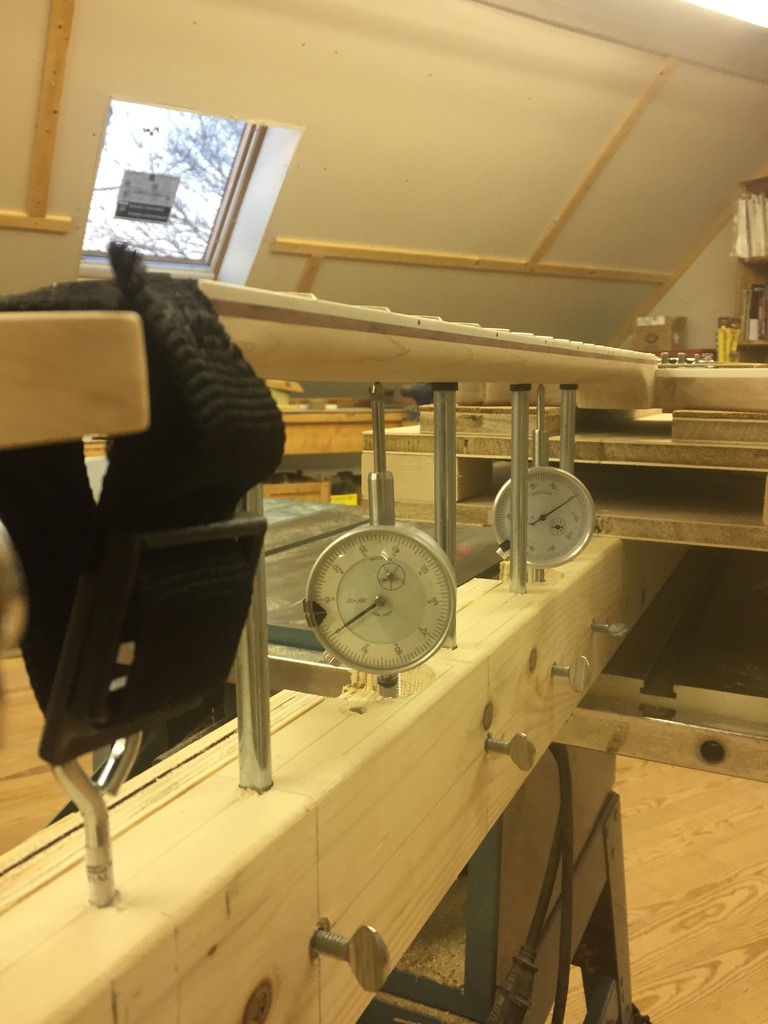
IMG_5577_zpstsjkldge.jpg


With a known flat fingerboard under simulated string tension, I felt confident using a sanding beam to level frets, so it was worth the build for peace of mind alone.
IMG_5579_zpszj3y8mbd.jpg


Frets leveled up nicely, though I think I probably took off more metal than I needed to chasing the last bit of marker on the fret ends, the price of inexperience. I'll call this one a solid win.
IMG_5579_zpszj3y8mbd.jpg

IMG_5585_zpsrxwlmypq.jpg

IMG_5587_zpsfv6govlb.jpg
 
Last edited:
  • Like
Reactions: afa3 and Means2nEnd
My neck jig rarely gets used, and only then because I figure I should be using it rather than have it sit unused. When I made the jig I was convinced I needed the degree of precision it facilitated. To that point I had not considered the effects of gravity in the process of truing up fret work.

After using the jig for a number of years I came to the conclusion that it was a lot of effort to set up and, though the results of using it were excellent, I could get comparable results without the hassle of fiddling with dials, straps and jacks. Rather than simulating string tension, I decided to do the fret levelling under real string tension. As I was working out how to do this I discovered that someone else had the same idea and had developed the method (if I could remember who that was, I would credit him here).

This method uses a trued U channel, or L or I beam with grit attached to the trued surface. A false nut is installed over the existing nut - like the kind you use to raise the strings on slide guitars. This allows for more clearance under the string for the beam. The instrument is tuned up and the board is levelled as closely as possible using the truss rod. With the neck supported sufficiently to avoid deflection under sanding load, the beam is slipped under each string in turn and run along the spring path until all frets are touched. I rely entirely on string tension to introduce an appropriate degree of relief in conjunction with the truss rod and that has proven to be very workable.

I do not try to compensate for the effects of gravity. In my opinion it's a fruitless endeavour. It's like trying to compensate for the effects of inertia as the player moves about. I also feel that chasing "dead level" is pointless. Wood changes dimension with fluctuations in humidity. Those changes may be tiny, but chasing tolerances that are even tinier is overkill IMO. There is a point where good enough is right. After that it's not righter, just fussier.
 
  • Like
Reactions: zuma and Means2nEnd
@Turnaround comnents are sobering, I don’t have the experience to know if the jig really delivered results better than more traditional techniques. There are layers of finesse that can only come with experience I don’t have yet, maybe never given my glacial output. The wood movement issue may explain why I ended up with three slightly high frets months after the original leveling, very minor, but enough to cause some fret buzz. I’ll use the jig again on my build in progress, at least I understand the basic issues now, if nothing else it relieves some anxiety in the process!
 
  • Like
Reactions: zuma
I think the system you are describing is called “Katana”, it’s a more sophisticated version of the U channel, adjustable for camber.
Invalid Link Removed
Yikes $285+ $35 shipping! I think I spent around $40 building the Vinson jig.
The system I was describing pre-dates the Katana thing any at least a decade. The difference is that the Katana device allows you to level the frets with the relief you want already dialled in. That sounds like it might be a good idea but we are talking relief as a deviation from flat by few thousandths of an inch - maybe up to 20. If you level the frets flat then tweak the truss rod to give that tiny amount of relief it's pretty well guaranteed that it will give a pretty even amount of bow. If it doesn't, you've got a really wonky neck, and trying to make it perfect is an utter waste of time.

If the Katana device was $50 I might give it a try, though I fail to see the advantage. But at the asking price ..... well I have some other ways to spend my cash that will be more effective.
 
  • Like
Reactions: Gilmourisgod
Expanding on my comment earlier in the thread:

What I learned from several years of playing around with these string-tension fixtures is that they are very helpful for correcting necks that bend into uneven shapes under load.

But necks which are designed and built well will reliably pull into an even true relief curve as you adjust the truss rod. For those necks, this process isn't necessary. And it doesn't make the fretwork any truer or more precise.

There's a similar thing with the PLEK machines. A major feature of the PLEK machine is its ability to correct for uneven neck movement. It does a similar thing to these string tension fixtures, but it approaches it in a different way. It uses a precision sensing head to measure the movement of the neck, creates a corrective map in its little computer brain, then uses a small CNC grinding head to correctively grind the frets. If all its little calculations are correct, when the neck is back under load, the frets are true.

The string tension fixtures and PLEK are doing the same thing: correcting lumpy necks, without all the trial and error that an experienced Luthier would do during an old-fashioned fret leveling job. But they all achieve the same result, and the same level of accuracy in the "levelness" of the frets.

And, if the neck doesn't have any unusual lumps and dips, a normal fret leveling will achieve the same result, and the same level of accuracy.

String tension fixtures and PLEK machines are for fixing the difficult ones.

Whether you need it or not depends on what you are working on, and whether you require that high level of accuracy.
 
This thread is very interesting, of course having just stumbled upon it today -- several months after having developed my own variant of jig!

When building mine I went very basic and ditched all the fixed gauges entirely. I figured if I came across a neck that was hard to correct I could manually and recursively measure/adjust each "jack" until it was as flat. I created several jack points along the neck, but so far have mainly used these as supports when working on the neck horizontally rather than to correct any curvature problems.

I even got a strap to apply tension at the nut to work out any "S" type curve problems should the need arise but so far have never needed it.

So... the questions I have for people that have done many more necks than I have:

Assuming a neck is a good one (i.e.,: there are no major abnormalities that need to be corrected) is there any reason not to continue using the jig as I have been: flatten the neck using the headstock jack, and then just bring the others snug to the neck before starting leveling?

To me that brings all the benefits of simulating string tension plus better neck support while working on it horizontally without the arduous part of dialing things down to the thousandth.
 
  • Like
Reactions: D-Smith
So... the questions I have for people that have done many more necks than I have:

Assuming a neck is a good one (i.e.,: there are no major abnormalities that need to be corrected) is there any reason not to continue using the jig as I have been: flatten the neck using the headstock jack, and then just bring the others snug to the neck before starting leveling?

To me that brings all the benefits of simulating string tension plus better neck support while working on it horizontally without the arduous part of dialing things down to the thousandth.

Well, sort of....Using the fixture like that, you aren't truly simulating the loaded condition of string tension. You are using it as a rigid holding fixture while you level the frets, and using the headstock jack to bend the neck, in place of using the truss rod. And that's all fine and good technique...as long as the neck doesn't have any abnormal bending problems. If it bends to a nice even curve by itself, then your technique will work fine.

The important thing is to carefully test the neck first, so you can decide whether it has problems that will require the use of the full string tension jig process. Look at it real carefully with a straightedge while it's up to tune, and then with the strings slack. Compare the difference in the shape of the neck between loaded and unloaded. Does it become uneven and lumpy as it changes from unloaded to loaded? That's what you are looking for.

That's how experienced old-school Luthiers without tension jigs or PLEK machines do it. They look for uneven spots and correct for it by filing a little more here and there. Creating low areas that will pull up to level under load. A manual version of what the PLEK machine does. Careful precise work with a straightedge.

But, if the neck doesn't have any funny lumps or dips, then you can take a shortcut like you are doing. A simple leveling job works fine in most cases.
 
Well, sort of....Using the fixture like that, you aren't truly simulating the loaded condition of string tension. You are using it as a rigid holding fixture while you level the frets, and using the headstock jack to bend the neck, in place of using the truss rod. And that's all fine and good technique...as long as the neck doesn't have any abnormal bending problems. If it bends to a nice even curve by itself, then your technique will work fine.

Thanks Bruce, really appreciate the insight.

However, you post makes me think I may not be doing this the same as others. Specifically your statement: "you aren't truly simulating the loaded condition of string tension". I think, at least the way I am doing it, I am effectively simulating string tension. Here's my process and logic:

1. Start with the bass setup as ideal as possible (ignoring any fret buzz issues), including truss rod adjusted to provide the desired relief, strings in typical tuning etc.
2. Strap the bass to the jig and snug the headstock jack so it contacts the headstock but does not bend the neck
3. Remove strings, but do not change any of the other setup
4. Adjust the headstock jack until the neck is flat and snug the rest of the jacks to the neck, again so they contact but do not change the shape. In this case the neck doesn't exactly have normal string tension because it has zero relief -- somewhat like the bass has been drop tuned such that the string tension is reduced enough to just eliminate the relief.
5. Complete the leveling with the neck in this shape and then re-string with the same gauge strings and tuning as in step 1 and remove from the jig.

Through all this the neck should be in almost the exact same shape as with strings, again the main difference being the 0.010 or whatever of relief that will exist once the strings are installed and tuned.

The other difference between the jig and strings is due to the nut acting as a fulcrum with strings, and the headstock forces coming from multiple places (tuning machines) spread around the headstock. Still, the net effect is the back of the neck is in tension and the top/fretboard is in compresson until the start of the trussrod. After that the forces should be essentially the same. If there is a pronounced S-shape then the nut strap can be used to restore the shape of the neck to that when the strung up. I do tend to adjust the jacks along the neck to a small gap to the neck in step 2, perhaps 0.050", so I can see if the shape of the neck has changed when in the jig.

I can't see that the difference in the neck stresses due to a small amount of neck relief, and the difference in exactly where the headstock and nut forces are applied, would be enough to substantially change the shape of the neck and thus the effectiveness of the jig for leveling purposes. Again, the purpose of the jig here is not to actually make the neck flat, but rather make it as flat as it would be strung up with zero relief. The rest of the neck unevenness will be fixed, from a fret perspective, with the leveling.

Certainly it should be much better to use the jig for leveling than using the truss rod to flatten the neck where there are no forces on the headstock and, in some cases with dual action truss rods, opposite forces encountered on the rest of the neck. However, maybe there is something else I am missing here too.

Let me know if this makes sense.
 
Last edited:
  • Like
Reactions: zuma
I had to read that several times to get it....:D, easier to do than talk about! If nothing else, leveling the frets In the jig with support rods below felt a lot more rigid than some techniques I’ve seen. Knowing how easy it is for just gravity alone to alter the profile a few thou (as evidenced by the change in dial indicators tilting bass from horizontal to vertical), I don’t know how people level frets accurately just in a neck cradle, or by hand support only. Practice, I guess! It’s hard to exert NO downward pressure given the mechanics of the human body, and even a tiny pressure down makes a difference. I suppose if you had a neck jigged up during play, you’d see the dial indicators move all over the place.
 

Latest posts