Friends,I've got a SX sjb75 jazz bass,which has a original 20mm spacing bridge.Recently I found that if I install the 20mm strings spacing bridge,the strings will almost perfectly located in the center of the magnetic column while the 19mm bridge cannot do that.Then I just found a lot of fender jazz bass photos,they all got the same problem.It seems like the pickups are build for 20mm spacing but their original bridges are always 19mm.What's going on here?

Enjoy the benefits of a premium membership!
Upgrade Account
-
TalkBass has been independent since 1998. Add your voice.
Create a free account to reply to discussions, view embedded media, and browse with fewer display ads.
Join free Log in
Want zero display ads or expanded classifieds tools? Compare plans.
You are using an out of date browser. It may not display this or other websites correctly.
You should upgrade or use an alternative browser.
You should upgrade or use an alternative browser.
sth about fender jazz bass strings spacing
- Thread starter funkybass1705
- Start date
More options
Who Replied?
Pickup pole spacing was designed when fender used threaded saddle bridges which you could adjust spacing easily. Then they switched to single groove saddles. The worst decision they ever made on their basses.


Not only that, and I have no historical information to confirm this, but Leo probably used a mule neck with a 1 3/4 inch nut to develop the J-bass. So when the common nut width became 1 1/2 inches, this also narrowed the strings slightly.Pickup pole spacing was designed when fender used threaded saddle bridges which you could adjust spacing easily. Then they switched to single groove saddles. The worst decision they ever made on their basses.
I prefer the bolt-stock bridge, not just for adjusting string spacing, but for tone and sustain as well. In the late 1970's, the age of brass everything, and before Bass Player Magazine split off from Guitar Player Magazine, the editors did a shoot-out of all the then-available bridges. For the best tone and sustain, which included all the brass bridges such as the original BadAss, and others, was the simple bolt-stock saddles plate bridge.
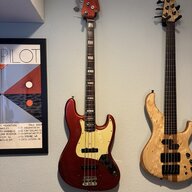
Pulled out the digital calipers because I was interested. On my '64 Jazz (original pickups), dead center between the pole pieces is right around 19.1mm, definitely not 20mm string spacing.
I see basses with strings not hitting the pole pieces dead center all the time. It can be a variety of reasons. Neck needs to be aligned in the pocket. Nut cut just a hair off. Bridge installed just a hair off. Can usually be aligned with an adjustable string spacing bridge.
One thing to remember is it's all cosmetic. You have both of those pole pieces creating a stronger magnetic field that covers a wide area. You'd never hear a slight misalignment. Doesn't mean it won't bother your brain staring at it though.
Strings on the 64 hit dead center but that's mainly due to the threaded saddles allowing the string to line up perfectly.
I see basses with strings not hitting the pole pieces dead center all the time. It can be a variety of reasons. Neck needs to be aligned in the pocket. Nut cut just a hair off. Bridge installed just a hair off. Can usually be aligned with an adjustable string spacing bridge.
One thing to remember is it's all cosmetic. You have both of those pole pieces creating a stronger magnetic field that covers a wide area. You'd never hear a slight misalignment. Doesn't mean it won't bother your brain staring at it though.
Strings on the 64 hit dead center but that's mainly due to the threaded saddles allowing the string to line up perfectly.

That’s amazing about the bridges. The Badass bridge was so popular then too.Not only that, and I have no historical information to confirm this, but Leo probably used a mule neck with a 1 3/4 inch nut to develop the J-bass. So when the common nut width became 1 1/2 inches, this also narrowed the strings slightly.
I prefer the bolt-stock bridge, not just for adjusting string spacing, but for tone and sustain as well. In the late 1970's, the age of brass everything, and before Bass Player Magazine split off from Guitar Player Magazine, the editors did a shoot-out of all the then-available bridges. For the best tone and sustain, which included all the brass bridges such as the original BadAss, and others, was the simple bolt-stock saddles plate bridge.

Fender took the cheaper, easier approach to making instruments. Looks like you found one of the corners that was cut.
One of my Jazz basses has single groove saddles. I just checked and thankfully it has good spacing.Pickup pole spacing was designed when fender used threaded saddle bridges which you could adjust spacing easily. Then they switched to single groove saddles. The worst decision they ever made on their basses.

Pickup pole spacing was designed when fender used threaded saddle bridges which you could adjust spacing easily. Then they switched to single groove saddles. The worst decision they ever made on their basses.
I completely see your point, but I prefer the single-groove saddles. To me there is less to think about when stringing and playing the bass, and I've never let it bother me if the string is not dead-center perfect between the pole pieces. It seems to make good sounds either way. Plus I prefer the look.
Also what is "sth" in the thread title

It doesn't effect the sound or tone. Not really a problem.
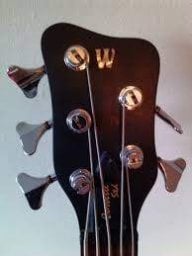
Strings passing directly over the center of the poles is just a visual thing, the pickups still work fine. Ive got a 19mm spaced sadowsky j pickup, in a 17mm spaced Franken-bass i slapped together and it works without issue. Which is probably why fender never bothered to tweak the pole piece spacing.
Maybe there's a technical reason it isn't, but IMO being able to tweak the spacing at the saddles should be a standard on bridges. Even the slightest bit of wiggle-room makes a difference for picky players (like myself). For example on my G&L JB5 the spec is 17mm but if I loosen the saddle lock screw all the way I can spread 'em out and it measures about 18mm. It is noticeable. Glad I can do that little hack, because 17 is too tight for me (I prefer 19mm like on my Sadowsky). Seems crazy to me it's not more common to have some degree of adjustable string spacing at the bridgePickup pole spacing was designed when fender used threaded saddle bridges which you could adjust spacing easily. Then they switched to single groove saddles. The worst decision they ever made on their basses.
The distance between strings decreases gradually from the bridge to the neck, which is wrong in theoryPulled out the digital calipers because I was interested. On my '64 Jazz (original pickups), dead center between the pole pieces is right around 19.1mm, definitely not 20mm string spacing.
I see basses with strings not hitting the pole pieces dead center all the time. It can be a variety of reasons. Neck needs to be aligned in the pocket. Nut cut just a hair off. Bridge installed just a hair off. Can usually be aligned with an adjustable string spacing bridge.
One thing to remember is it's all cosmetic. You have both of those pole pieces creating a stronger magnetic field that covers a wide area. You'd never hear a slight misalignment. Doesn't mean it won't bother your brain staring at it though.
Strings on the 64 hit dead center but that's mainly due to the threaded saddles allowing the string to line up perfectly.
Yes, it has little effect on the sound.琴弦直接从杆子中心穿过只是视觉上的东西,拾音器仍然工作得很好。我有一个19毫米间距的Sadowsky J拾音器,在一个17毫米间距的Franken-Bass中,我把它拼接在一起,它工作起来没有问题。这可能就是为什么Fender从不费心调整杆件间距的原因。
''sth.'' means something,In China, we usually abbreviate like this. Maybe I missed a period.我完全理解你的意思,但我更喜欢单槽马鞍。对我来说,在拉弦和弹奏贝斯时需要考虑的东西更少,而且如果琴弦在杆子之间不完美,我也从不让它困扰我。无论哪种方式,它似乎都能发出很好的声音。而且我更喜欢这种外观。
还有线程标题中的“某物”是什么
these are my basses,they are all good bargain basses.the ramp of the cort I made it by 3d printing in the material called pla

I was told / shown by a reputable luthier that the slight differences in string to pickup pole alignment makes no noticeable difference in performance or tone from a magnetic pickup and that as long as the string is in close range to the magnet it will pickup the vibration of a metal string. String thru bridge or not, slotted or un-slotted saddles etc. I've tried this on my 5 string with threaded saddles and heard no difference moving the strings noticeably in either direction while trying out different comfort positions. He had a Jazz bass that had an E string right over the left magnet only and I couldn't tell the difference from the other strings that were dead center. It sure looked funky though and he might have worked the neck pocket for the owner.

Not only that, and I have no historical information to confirm this, but Leo probably used a mule neck with a 1 3/4 inch nut to develop the J-bass. So when the common nut width became 1 1/2 inches, this also narrowed the strings slightly.
I prefer the bolt-stock bridge, not just for adjusting string spacing, but for tone and sustain as well. In the late 1970's, the age of brass everything, and before Bass Player Magazine split off from Guitar Player Magazine, the editors did a shoot-out of all the then-available bridges. For the best tone and sustain, which included all the brass bridges such as the original BadAss, and others, was the simple bolt-stock saddles plate bridge.
The first Jazz Basses including the prototypes had even narrower nuts at 1 7/16 inch.
I share your preference for the original stock bridges.
Yes. Before many understood grain, metals, and other aspects of the interaction of hardware and woods, it was the age of, "Heavier is better," not only thinking that only added mass would damp spurious vibrations that lessened sustain, but with all the marketing hype you can imagine. So you had Strats with northern ash bodies that weighed half-again more than swamp ash, Les Paul bodies with dense mahogany that weighed over ten pounds, everybody selling brass bridges, brass nuts, etc., for both guitars and basses, and so forth. All it really took was proper construction, alignment, and the replacing of corroded parts with quality fresh ones. I have a custom fanned fret PJ-style bass that has a modified "antique-style" bolt stock bridge for narrowed string spacing and the fanning of the frets, having sawn it into two parts to account for the fanning. That bass has more sustain, clarity, tone, and rocks the house when I put Roto's on it than most people can get on any bass with any hardware, all using "obsolete" parts.That’s amazing about the bridges. The Badass bridge was so popular then too.
Yes, after Leo used the mule to develop the pickups. Thanks for confirming the original bolt-stock bridges, which were, in fact, actually made out of long stock with the bolt threads, cut to saddle length and drilled for the height adjustment screws.The first Jazz Basses including the prototypes had even narrower nuts at 1 7/16 inch.
I share your preference for the original stock bridges.
I have a Road Worn J that had the threaded bridge saddles. The strings just couldn't line up to be equally spaced. I switched saddles around, turned them upside down, and there was always one space a bit larger than the rest. I finally just bought a Fender 70s bridge, single slots, and the strings are perfectly spaced now.


