Well...
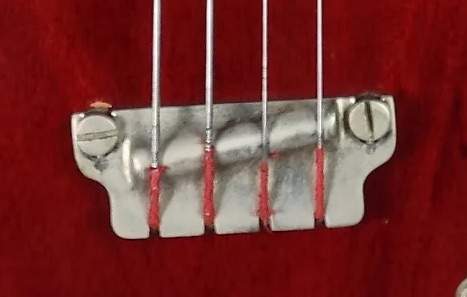
About the only thing I can think of, is find some flats in the same gauges as the strings you have - or, at least as close as you can get. That might work - or it might not. I have several basses with... simple... bridges like that. I was working on one of them this morning, in fact. A violin bass, with a bridge that's a floating wooden base, supporting a knife-edged piece of wood with 4 notches cut in it. Finding strings that tune up is easy. Finding ones that will intonate? A whole 'nother ball game... La Bella medium scale 760FL's (43-104) work the best, of all the strings I've tried on the thing. And I've tried a lot of strings... The E and G strings will intonate with a minimum of skootching the bridge around, but... the A and D strings? Not so much. But, given the bridge I have to work with? I just have to live with it - and like it. Which brings me to another point...
I've been playing bass since the late 1960s. A lot of the time, I played basses with bridges that weren't much better than that violin bass - or the bridge you have there. And, the thing is... back then? Most of us didn't pay much attention to intonation. For one thing, there wasn't much we could do about it with bridges like that; and for another? Most of the music we played really didn't require it, anyway. I honestly can't remember
ever playing anything that required me to get anywhere near the 12th fret then - and I don't play anything that does, even now. Jefferson Airplane's
White Rabbit, for instance, only gets to the 8th fret once - for 4 beats; you can play the whole song with only the E, A, & D strings. None of the bass players I knew back then, ever worried about intonation; most of the music that we played didn't need the bass to be intonated. If your bass was in tune? You might check the intonation - for form's sake. If your bass actually was intonated? Great. If not? Well, doesn't really matter, anyway...
But, today's music does require an intonated bass. Which means; a bass with a bridge that can be intonated. Which means that, unless you get lucky and have an old style bass that will intonate, you'll have to modify that old bass - or play something else. I have 4 basses with "primitive" bridges, and only one will intonate properly with the strings it's wearing now. Took a lot of trying to achieve that, and I don't intend to try other kinds of strings on it - ever. 2 of the others are... pretty close to intonated - which suits me fine; the other one? It's "sort of" intonated, and for what I play on it? Good enough... I also have 3 basses with "Nashville Tune-O-Matic" bridges. A little more intonatable - but not much. One is properly intonated - after several string changes, and the other 2 are... pretty close. The properly intonated one only managed it with round wounds, which I'd rather it didn't have to wear. But, they solved a couple other problems, too, so... I live with them.
So... bottom line? Try strings with the same gauges as the ones that it wears now. Hell, try rounds, even... If that doesn't work? Either stop worrying about proper intonation, and pretend it's 1968; or, grit your teeth and install a replacement bridge that you
can intonate. They're available for those basses; you aren't the first person to have this problem. But, if you go that route? For God's sake;
do not throw that original bridge away! Those things are rare, now - and collector's will just about kill for one...