• TalkBass has been independent since 1998. Add your voice.
    Create a free account to reply to discussions, view embedded media, and browse with fewer display ads.
    Join freeLog in
    Want zero display ads or expanded classifieds tools? Compare plans.

Double Bass String installation question

Gaolee

Official leathers tester and crash dummy
Jan 13, 2010
24,752
172,160
Seattle, Great North Wet
This is perhaps a dumb question, but I didn't find any answer by searching. Being brand new to this kind of instrument, I'm completely ignorant about its care and feeding, so here it goes.

Is there anything that is peculiar that I should know before restringing my bass? I plan to try several different kinds of strings, including putting them on, taking them off, putting them back on again, etc. With any luck, the whole thing will happen once and I'll be happy with a set of strings and leave them alone. But, I have never restrung a doghouse, so I'm a little worried about screwing things up. Any advice anybody can give would be very much appreciated.
 
Thank you very much. The instructions from Gollihur are great. Since I'm just learning my way around this instrument, there are a lot of things like this that are second nature on the bass guitar that are completely different on an upright. I won't be removing all the strings at once, just one at a time. Putting a sound post back in isn't my idea of a good time.
 
Sorry to have to say it depends on how much thinner. Like a BG thinner at the nut can cause a buzz. Thinner at the bridge can make a string more prone to rolling around in the slot. Bigger is more of a problem as they simply don't fit the slot. This can cause tuning problems, action problems and can damage the winding.
 
Kinda` curious were the term "piano style" came from... The fattest bass string on a piano is always the biggest PITA to string LOL, then they get longer... on a piano I think they just don`t care that much about the first few (no-body plays those anyway). But your point is taken... plus I want to see if I can figure out how to put a pic-in-a-post
 

Attachments

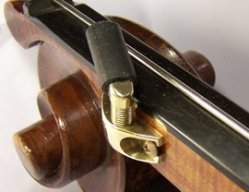
  • DSC00206.jpg
    DSC00206.jpg
    180.5 KB · Views: 70
  • DSC00207.jpg
    DSC00207.jpg
    124.6 KB · Views: 56
I often wonder, why don't more people string their bass what I call piano style? That is, E string to D peg, A to A, D to G peg, and G to E peg. The lower the string, the greater the distance from the nut to its winding post. Kind of a compensated pegbox in a way. Tried this a half decade ago, never looked back.

This is a good way to string a bass, although I don't find that changing the D and G strings makes much of a difference on most basses.

However, I almost always string them with the E and A pegs swapped because the extra tension on the E string really makes a big difference. I can usually get the E string height lower this way, too - the extra tension helps to keep it from rattling on the board. ;)
 
From a physics point of view, increasing the non-speaking length of the string does not increase string tension. String tension is determined only by the speaking length, the string's mass per unit length, and the pitch to which it is tuned.

Increasing the non-speaking length will make the string feel "softer" under the left hand fingers, though. Shortening the non-speaking length will have the opposite effect.
 
From a physics point of view, increasing the non-speaking length of the string does not increase string tension. String tension is determined only by the speaking length, the string's mass per unit length, and the pitch to which it is tuned.

Increasing the non-speaking length will make the string feel "softer" under the left hand fingers, though. Shortening the non-speaking length will have the opposite effect.

So if the nonspeaking length (which does vibrate) doesn't change string tension, what do you think makes the string feel softer? Isn't that tension?
IME stringing this way causes the E string to feel like its really moving the whole bass in a stronger way, opens up the low end tremendously on my bass, with how I play. Miles vary but I'm curious how others fare and interpret the physics.
 
So if the nonspeaking length (which does vibrate) doesn't change string tension, what do you think makes the string feel softer? Isn't that tension?

When you deflect a string sideways, as in stopping it, you stretch it, and the whole string stretches, from tuning pin to tailpiece. A long string is "stretchier" than a short one, or, in technical terms, has a lower spring rate. So increasing the non-speaking length at the peg end results in the string being a tiny bit easier to press down to the fingerboard. It's a very small change, but we're very sensitive to such small changes.
 
When you deflect a string sideways, as in stopping it, you stretch it, and the whole string stretches, from tuning pin to tailpiece. A long string is "stretchier" than a short one, or, in technical terms, has a lower spring rate. So increasing the non-speaking length at the peg end results in the string being a tiny bit easier to press down to the fingerboard. It's a very small change, but we're very sensitive to such small changes.

Interesting. I suppose this effect would be more pronounced with synthetic and gut strings, which are more elastic. Could this be why many players claim increased resonance when they get an extension? Another question is how does this string configuration affect the A string? If the A becomes tighter in feel then perhaps this isn't such a good idea. You use the A much more than the E after all, and on most basses it's the A which is most problematic in terms of getting good tone and response.