• TalkBass has been independent since 1998. Add your voice.
    Create a free account to reply to discussions, view embedded media, and browse with fewer display ads.
    Join freeLog in
    Want zero display ads or expanded classifieds tools? Compare plans.

Subwoofer Placement/configuration

So switching phase on the back of one sub isn’t going to make such difference then? It’s more about the actual placement?

Clever! "Switching phase" has its applications for the more complex configurations...not necessary for the Saturday nite dance at the American Legion. If space is limited, I've been known to stack the 18" subs to stage left or right. Otherwise, I stick 'em both dead-center, side by side.

Riis
 
  • Like
Reactions: 4Mal and Jig Man
There was a good thread on the Link Removed forum on sub placement that may or may not still be there that I think would really benefit the OP.
Short summary, having the subs split under the mains like you have in the photo causes very uneven bass response across a room due to interference between the 2 subs. [Invalid or Expired Link Removed] describes it in fairly high detail.
In an open space locating the subs in the centre of stage may work well but not look that good.
Both subs together near 1 main often works quite well and improves the look factor.
Reflections from walls can also interfere with your low end depending on how far from the wall the subs are located. Placing the subs against a wall will increase the volume you get for a given power and a corner will boost it even more. search corner loading or 1/2 space for more info.

Personally I find I can usually get a more even bass response across the room by placing the sub against the back wall or in a corner than by putting it out near the mains. I usually walk the room while playing background music before the gig to get a feel for the spread through the room.

Real world example here:
IMG20220730211929.jpg
This photo is taken next to one of the FOH speakers and that closest edge of the stage is about 3m(10ft) from the wall behind me. The sub is in the corner of the wall behind the photo and behind the stage and gave full even bass all the way out into the bar area in the background of the photo. The Mains where pointed into the room not out there so the rest of the frequency spectrum wasn't great but the bass was there. A 3rd main pointed out there would have made perfect sound out there as well but probably wouldn't have helped the bar staff hear orders.
If you want to hear a recording taken on the edge of the dance floor in front of the stage it is in this thread
 
There is no perfect solution. Consider the consequences and choose the best compromise...the choice can vary from venue to venue.

Having the subs separated will result in lobing or comb filtering. They are essentially just different ways to describe the same problem.

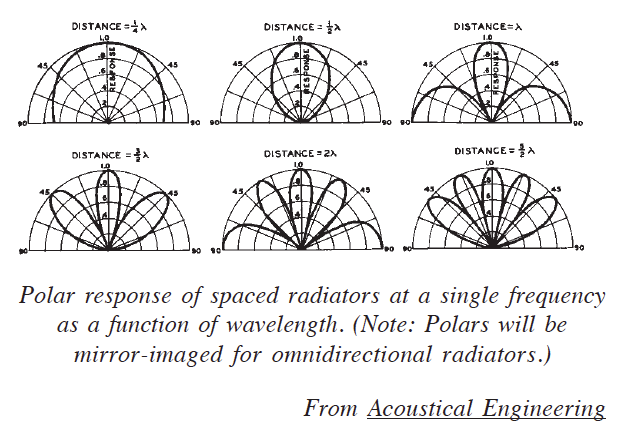
The resultant pattern is based on the ratio between the wavelength (Lambda) and the spacing or distance between the subs.

While reading this post, try to remember that Lambda
upload_2022-8-14_21-20-47.png
is just a fancy name for wavelength.


Low_Directivity-polars1.png


Let's consider the ratio for this image
screen-shot-2022-08-14-at-3-34-55-pm-png.4782282


Spacing is 26.2 ft
Lambda of 100hz is 11.25 ft

26.1/11.35 = 2.33

So the distance is 2.33 Lambda.

That puts it about midway between these two patterns
upload_2022-8-14_19-50-56.png


Same images rotated 90 degrees
upload_2022-8-14_19-51-10.png


Since the wavelength gets longer as the frequency goes down, you want the max spacing between subs to be no more than 1/4 Lambda for the highest frequency in the passband.

The resulting dispersion as spacing increases from 1/4 Lambda to 1/2 Lambda to 1 Lamda.
upload_2022-8-14_19-54-39.png


If the upper cutoff of your subs is 80hz, Lamda is 14.07 ft and 1/4 Lambda is 14.07/4=3.5 ft. The higher the cutoff the closer the subs need to be to each other to avoid this problem.

Unfortunately if you put the subs in the center, they behave as a dipole.

So you get patterns something like this:
upload_2022-8-14_20-6-48.png


upload_2022-8-14_20-10-52.png


So while the dispersion is nice and even on the audience side, it also causes excessive bass to travel back to the band, and this can be extremely problematic.

A different idea that I don't think has been suggested yet, is to place both subs on one side of the stage. I have done this and it worked pretty well.

AFAIK, subs should be set to the same polarity unless you are trying to create some sort of directional array, such as a gradient array. If you are interested, you may find this article informative: Link Removed
 
it also causes excessive bass to travel back to the band, and this can be extremely problematic.

A different idea that I don't think has been suggested yet, is to place both subs on one side of the stage. I have done this and it worked pretty well.

All putting the subs on one side does is make the excessive bass be skewed to that side of the stage a bit. :cool:

Given the omnidirectional nature of low frequencies bass on the stage from the subs is always going to be a problem without some fancy arrays and processing far beyond weekend warrior gigs budgets.
 
If anyone wants to try a gradient subwoofer array, here is the basic setup. I found this procedure in multiple places. I developed my notes from: How do you calculate cardioid subwoofer spacing? (gradient array) - YouTube

upload_2022-8-15_2-7-42.png

This image is slightly modified and here is the location of the original: Microsoft Word - wp - Subwoofer Arrays v04 .doc (electrovoice.com)

Gradient Sub Array Setup

λ (Lambda = wavelength)

Take average of the upper and lower limits of the subs operating range.

Determine ¼ λ for the result.

Set spacing between subs to ¼ λ.

Set delay of rear sub to ¼ λ and reverse the polarity

The subs are usually placed back-to-back, but that is not strictly necessary.

Important info from the article linked above:
Element Spacing, Output, and Bandwidth. When constructing a gradient pair, it is important to understand the role of element spacing. By “element spacing”, we mean the distance between front and rear loudspeaker cones. Larger element spacing increases subbass output, but decreases maximum operating frequency. Smaller element spacing decreases output but increases maximum operating frequency.

Pattern Options. For a given gradient pair, the pattern can be varied by changing the rear-element delay. Available patterns are similar to those of microphones: cardioid, hypercardioid (various types), and figure-8.
Let's work through a setup.

Assume our subs operate from 40hz to 100hz

The average is (40+100)/2 which is 70

Use this figure (70hz) to determine spacing and delay. Remember, both are set to 1/4 λ

To get λ divide the speed of sound 1,125 ft/sec by 70

1,125/70 = 16.07' = (λ for 70hz)

(For metric, use 343m/sec for the speed of sound)​

Multiple λ by 0.25 for 1/4 λ.

1/4 λ = 16.07 x 0.25 = 4.02' = (spacing between subs)

New we need how long it take sounds to travel 1/4 λ. The is the amount of delay required for the rear subwoofer.

Divide 1/4 λ by the speed of sound 1.125 ft per mS.

4.02/1.125 = 3.6mS = (delay of 1/4 λ)

Some of you may have caught that I changed the units of the speed of sound. You could also do the calculation using 1,125 feet per second.

4.02/1,125 = 0.0036S which = 3.6mS.

Remember to reverse the polarity of the rear sub.

This is the first time I have done this, so please double check my work and offer corrections.


Last edited:
I would recommend trying something like your second drawing. Except, put the subs on their sides, head to head, between both monitors. So, the only change to your drawing would be to have both subs in the middle with the monitors on each side of the subs.
 
  • Like
Reactions: jacobrownoly
The phase cancellation between subs is frequency dependent. Most subs are crossed over to the tops somewhere between 100-120 hz so focus the comb filtering plots below this range.

Assuming proper sun polarity, the space halfway between subs on each side is a “power alley” where the waves from each sun reinforce each other since they are always arriving at the same time. As you move closer to one side or the other you’ll hear the effect of phase cancellation at different frequencies at different areas—which is when those plots are useful.

You can avoid the phase cancellation pretty much entirely by placing the subs centered.

However, if you’re experiencing a “power valley” centered between two subs spread apart, then one of them is out of phase and that should be corrected before centering the subs, otherwise you’ll have very poor bass response everywhere from a center cluster of subs.
 
Thanks for all the replies guys. A lot of great advice here.


Does having people on the dance floor not help the bass cancellation? I definitely noticed it more during sound check. But if I go out in the crowd during the gig it doesn’t seem as bad.
 
  • Like
Reactions: 31HZ
So switching phase on the back of one sub isn’t going to make such difference then? It’s more about the actual placement?
Correct.

EDIT: this is the short answer without getting into broadside arrays, cardioid setup, etc. However, those setups also require specific sub placement relative to each other.

The quick and correct answer: forward-facing phase-aligned subs go together, always.
 
Last edited:
Subs together, always.

People don't absorb bass frequencies enough to cancel the filtering problems created by separated subs.

Compare typical room plots of separated subs (first image) to a center-array of subs (second), below. Images from this online article.

PSW2014SubsFigure_2.jpg PSW2014SubsFigure_4.jpg
 

Attachments

  • PSW2014SubsFigure_4.jpg
    PSW2014SubsFigure_4.jpg
    41.3 KB · Views: 53
Do not place subs to each side - you will get phase cancellation. Not only from the subs cancelling each other due to out of phase wavelengths, but due to out of phase room bounce - the lows coming from 2 sources. Or worse - summing reinforcement out in the audience. Remember a low B wavelength is 30 feet. You will also get some PC in the upper end, but it is much less noticeable. Further, when you place the subs together, you get an additional 2db (summing), because they subs will work as a single unit. Plus, the two subs together give you a spot to put the center stage floor monitors.
 
Subs together, always.

People don't absorb bass frequencies enough to cancel the filtering problems created by separated subs.

Compare typical room plots of separated subs (first image) to a center-array of subs (second), below. Images from this online article.

View attachment 4782840 View attachment 4782839
Or worse - a wall opposite teh stage that happens to be a multiple of certain wavelengths. I played a venue where teh wall was 60 feet away from the back line. so every low B I played was magnified. The audience seems to like getting their eyeballs rattled..
 
As a bass player and live sound engineer I can confirm from both a technical perspective and a bass players experience that much of the information in this thread is correct. In my experience I would summerize it this way. Center sub clusters yield the most even bass response across the audience, especially indoors when walls and ceilings tend to also add acoustic interferences that cause additional anomalies in bass response throughout the room. The flipside of this is substantially increased low bass onstage. So if I'm working a show for a band that is happy with lots of low bass on the stage, I'll center cluster the subs. In this set up be sure to have a fairly extreme low cut on your monitors since the band is already hearing a ton of bass from the house mix. Also be aware that your monitors will need to be loud enough to match the low end content coming from the subs. This usually works great with bass heavy music like Reggae, R&B/Soul, Pop etc. If it's a band that needs a lot of clarity in the low mids and bass like jazz, bluegrass, singer songwriter, some rock bands, all that extra low end from the house mix subs makes them feel like everything is muddy. Additionally, bands in this genre are usually happier with lower volume stage monitor wedges, so there is a second advantage to getting the subs farther away in this scenario. This allows for having less stage volume, and thus less potential feedback with sensitive microphones and out phase stuff bouncing off the back wall. In-ears are a total game changer, and I almost always would opt for center clustered subs if the band has in-ears. LAstly for outdoor gigs in parking lots, venue permitting, I'll sometimes cluster the subs against a building on one side of the band... this has been my all time favorite sound scenario.