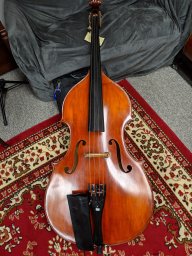
I wonder what if any consensus there is regarding the main types of tailpieces for bass, those that show the cable in the front (dont know how to refer to them) and the violin style tailpiece with the holes underneath. How does the effect of the tension on the bridge/belly differ between these two types?
I have been having problems with my bass which suffers from excessive tension, and at times can become very hard to play (requires more strenght to initiate notes etc.)
I had a rather cheap tailpiece (doesnt seem like real ebony the wood is dyed black) with the cable showing in the front attached with some rather stiff metal wire.
Now I wanted to change the tailpiece because I always figured that the violin style seems better since the cord is attached in a straight line to the tailipiece without diverting any force downward (i am sure this assumption will generate some debate). Now I am not a physicist or luthier but seems obvious to me that the simpler the structural design the better it tends to function in string instruments.
So I decided to change the tailpiece, bought an inexpensive but nice rosewood tailpiece from Dov schmidt and some of the kevlar tailgut to go with it.
After the change the bass seems to resonate better and the response has become easier, the difference is clear. The how or why, I can speculate but is not as clear but I am sure that the instrument is easier to play and is more open.
aside from the change in tailpiece (the new tailpiece is a bit larger with more mass and density in the wood), tailgut (heavy wire vs. kevlar cord) the only other difference is the fact that the string length from bridge to tailpiece is a bit longer than before though this was not planned, just the tailgut was not as long as the wire it replaced.
So I would love to know any insight that might be offered as to how such a simple change can have such a noticeable positive effect.
Regards,
Luis
I have been having problems with my bass which suffers from excessive tension, and at times can become very hard to play (requires more strenght to initiate notes etc.)
I had a rather cheap tailpiece (doesnt seem like real ebony the wood is dyed black) with the cable showing in the front attached with some rather stiff metal wire.
Now I wanted to change the tailpiece because I always figured that the violin style seems better since the cord is attached in a straight line to the tailipiece without diverting any force downward (i am sure this assumption will generate some debate). Now I am not a physicist or luthier but seems obvious to me that the simpler the structural design the better it tends to function in string instruments.
So I decided to change the tailpiece, bought an inexpensive but nice rosewood tailpiece from Dov schmidt and some of the kevlar tailgut to go with it.
After the change the bass seems to resonate better and the response has become easier, the difference is clear. The how or why, I can speculate but is not as clear but I am sure that the instrument is easier to play and is more open.
aside from the change in tailpiece (the new tailpiece is a bit larger with more mass and density in the wood), tailgut (heavy wire vs. kevlar cord) the only other difference is the fact that the string length from bridge to tailpiece is a bit longer than before though this was not planned, just the tailgut was not as long as the wire it replaced.
So I would love to know any insight that might be offered as to how such a simple change can have such a noticeable positive effect.
Regards,
Luis