• TalkBass has been independent since 1998. Add your voice.
    Create a free account to reply to discussions, view embedded media, and browse with fewer display ads.
    Join freeLog in
    Want zero display ads or expanded classifieds tools? Compare plans.

TERRIBLE Squealing

I agree - that is an "acoustic- level" setup - push it too hard and it will feed back - Munji ought to know that you need at least 1,000 watts for a decent, rock-level PA!! :p
The problem is that people see the name Fender and figure it must be good. They may make great instuments and guitar amps but they have never made great PAs. The problem with the passport series is that a band will outgrow it. For rehearsals it is fine but it leaves alot to be desired as a gigging PA.
 
I don't think you're wrong.

To the OP, how have you got the mics situated with respect to the speakers? You should have the mics behind the speakers. You should never orient the mics so speaker output would go into the mics.

If you're using stage monitors, their arrangement will depend on the pattern of your mics. If you're using cardioid mics (which yours probably are) the heel of the mic should point directly along the axis of the monitor cabinet. For super- or hyper-cardioid mics, the monitor should be placed off to one side, so they project off-axis to the mic at about 60 degrees.

In small rooms, you won't be able to get a lot of GBF (gain before feedback), so you can't crank up the volume.

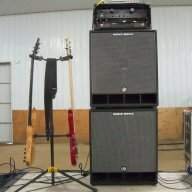
Our stage setup is like this. Drums in the back, amps to the sides of the drums. Mikes are about 5 feet in front of the drums/amps. The speakers are another 7 or 8 feet in front of the mikes. The mixer itself is placed in between the mikes in front of the drums about 6 feet away.
 
Can you please explain how gates will give you more gain before feeback?

I already did. ;) You have to look at the PA as a system, the more open mics on that system the sooner it will feedback. A gate automagically 'turns off' any mic where the input signal is below the threshold. So for example mics for backing singers are effectively off when the singers are not actually singing. I've found gates particularly useful on cramped stages where the mic picks up reflections from the walls & ceiling no matter where you point it. If you have several mics for say a horn section you not only reduce the chances of feedback with gates but you clean up the mix because you reduce the bleed. Gates are not a cure all but they are a very useful tool in some situations. Even the cheap ones in budget compressors.
 
I think you will find the limited eq on those units not to be very helpful in controling feedback. If you have the PA set up ok then the best way to combat feedback in a confined space with very limited tools is for everyone to play quieter so you can turn it down. When you get right down to it, the room eventually has the final say on what's possible and what isn't. Have you used other PAs sucessfully in that room at the same volume? Using the reverb will tend to make things worse. Only other thing I can think of is to borrow/hire some better mics to see if they are the issue. Likewise you could hire an eq and see how that goes.
 
On a vocals-only PA, try peeling down the low end if you're on a loud stage. You'll cut through better (and so need less gain) if you aren't inadvertently pumping a lot of low end from the stage sound through the vocal mics.

Similarly, if you're playing with a bass-boosted guitarist or keyboard (ack!), get them to fix their eq for a more band-appropriate sound. If the instruments are leaving some frequencies for vocals, you won't need to rely on gobs o' gain to make the vocals intelligible.
 
...The feedback frequencies usually are in the range 2,5 - 5 kHz, so dampening frequencies slightly should help.
...

Ok, what EQ changes should i make? And any other suggestions?

Think I already answered this...

+1 to not boosting the bass on the vocals. You might think you sound powerful then, but it only makes it difficult to hear what what words you actually sing. In Swedish, I'd say it "sounds like a porridge" when the bass is too boosted on the mic... :p
 
there are ways to improve your sound, while avoiding feedback:

-control you stage volume, the lower the better
-correct placement of mics in relation to speakers (monitors in the mics null spots, FOH speakers behind and away from mics)
-quality mics with true polar patterns
-quality amps and speakers (I prefer Nexo, EAW, Radian etc.)
-if absolutely necessary, corrective EQ from a dedicated EQ unit (i.e. not desk EQ, but a graphic 1/3oct. or a parametric EQ)

that´s a few, there are many more
 
Our stage setup is like this. Drums in the back, amps to the sides of the drums. Mikes are about 5 feet in front of the drums/amps. The speakers are another 7 or 8 feet in front of the mikes. The mixer itself is placed in between the mikes in front of the drums about 6 feet away.

I suspect your backline in causing the feedback.
 
Our stage setup is like this. Drums in the back, amps to the sides of the drums. Mikes are about 5 feet in front of the drums/amps. The speakers are another 7 or 8 feet in front of the mikes.

Only 5 feet. That's really close. As pointed out previously a 31 band e.q. would probably help.

I also suggest that you setup the microphones about 2 feet behind the p.a. speakers so you'll be standing about 11 feet away from your backline, including the drums. The drums may also be causing part of the problem.

We set up like that for years and had very few problems.

How wide are the p.a. speakers placed apart?
 
Im sorry i dont understand the kHz frequency stuff, umm...the bass isnt boosted.

Find a cheap used 15 or 31 band graphic EQ, play around with it a little and you'll figure it out pretty quickly. Or an even easier thing to do is to open a media player on your computer, activate the EQ and play around with the frequency sliders.

Btw, an important word - "these" - were missing in my post about which frequencies you should cut (2,5-5 kHz). These frequencies are very harsh sounding when boosted, but when cut they remove a lot of clarity so there's a balance you have to find.

I didn't assume the bass was boosted on the mic (You said you had it flat IIRC)- it is just a pet peeve of mine when people turn it up too much. It's very common that people do this, and I made that mistake myself for many years until I realized how bad it makes the vocals sound....
 
Only 5 feet. That's really close. As pointed out previously a 31 band e.q. would probably help.

I also suggest that you setup the microphones about 2 feet behind the p.a. speakers so you'll be standing about 11 feet away from your backline, including the drums. The drums may also be causing part of the problem.

We set up like that for years and had very few problems.

How wide are the p.a. speakers placed apart?

First off, i dont really understand the need for a 8200 watt PA, are you playing an ampitheater?

Anywho, yeah, we think the closeness has a huge part in it. Its almost like if the mics get too close to the speakers, it causes feedback too, so we dont have a lot to work with, haha

The speakers themselves, are placed around 15 feet apart.
 
It sounds like you don't have more rehearsal space than I used to have. Didn't get feedback very easily though we played quite loud with a ~2 kW PA. I guess it was thanks to good mics, the placement of the speakers and mics and the use of an EQ to dampen problematic frequencies with.
 
One word :

Headroom!! :p

Headroooom.....agghhhhhghghgh

homer-drool.gif
 
You don't need a gate or a feedback eliminator, those are junk you don't need if you have a graphic eq and know how to use it. O and if it's a high pitched squeal you don't just turn down the high eq, it could very well be low frequency causeing a high pitch squeal.

Do you have a graphic eq on your pa?

If so, turn them all down. Turn the pa all the way up. Then take the sliders one by one and bring them up. If the frequency squeals bring it down or cut it alltogether. After doing this you have found the frequencies causing feedback in the room. You will likely have to do this each practice.

If you dont have an EQ, and just your basic high low mid knows, you can do the same but with not so much precision. Just use the knobs. Turn them all down first then raise them one at time.

Effects. If you have onboard effects like reverb. Just turn them off they are a nightmare for causing feedback in small practice space.

Mic position. When you have more than one mic in a pa. The mic has to be about double the distance apart from each other as they are from the pa. If the one mic is just for backup my adise is ditch it if you are that loud and just share the one on backups. Two mics in cramped space is a nightmare.

Also, mic technique. Kiss the mic for best gain before feedback. Point it straight up to avoid bouceback from the walls and speaker noise. Don't cup the capsule like a dufus.

Get a mic good at feedback rejection. For louder rock you need this. Try something like an audix 0m7. A lot of mics are crap for loud rock bands in tight areas because they pick up too much. You need a mic that if you back off it it won't pick hardly anything off. I believe you already mentioned that the mic you have picks up the drums very much, this is going to be problem.

Monitor position. If you can mount your monitors on the side at or above ear level. This will really help with both feedback rejection and being able to hear yourself singing over the band. When I used a regular PA I had to have mine kitty corner from each other and facing toward the walls, not the opposite corners. This got me easily over two half stacks and acoustic drums. And this was in garage.