• TalkBass has been independent since 1998. Add your voice.
    Create a free account to reply to discussions, view embedded media, and browse with fewer display ads.
    Join freeLog in
    Want zero display ads or expanded classifieds tools? Compare plans.

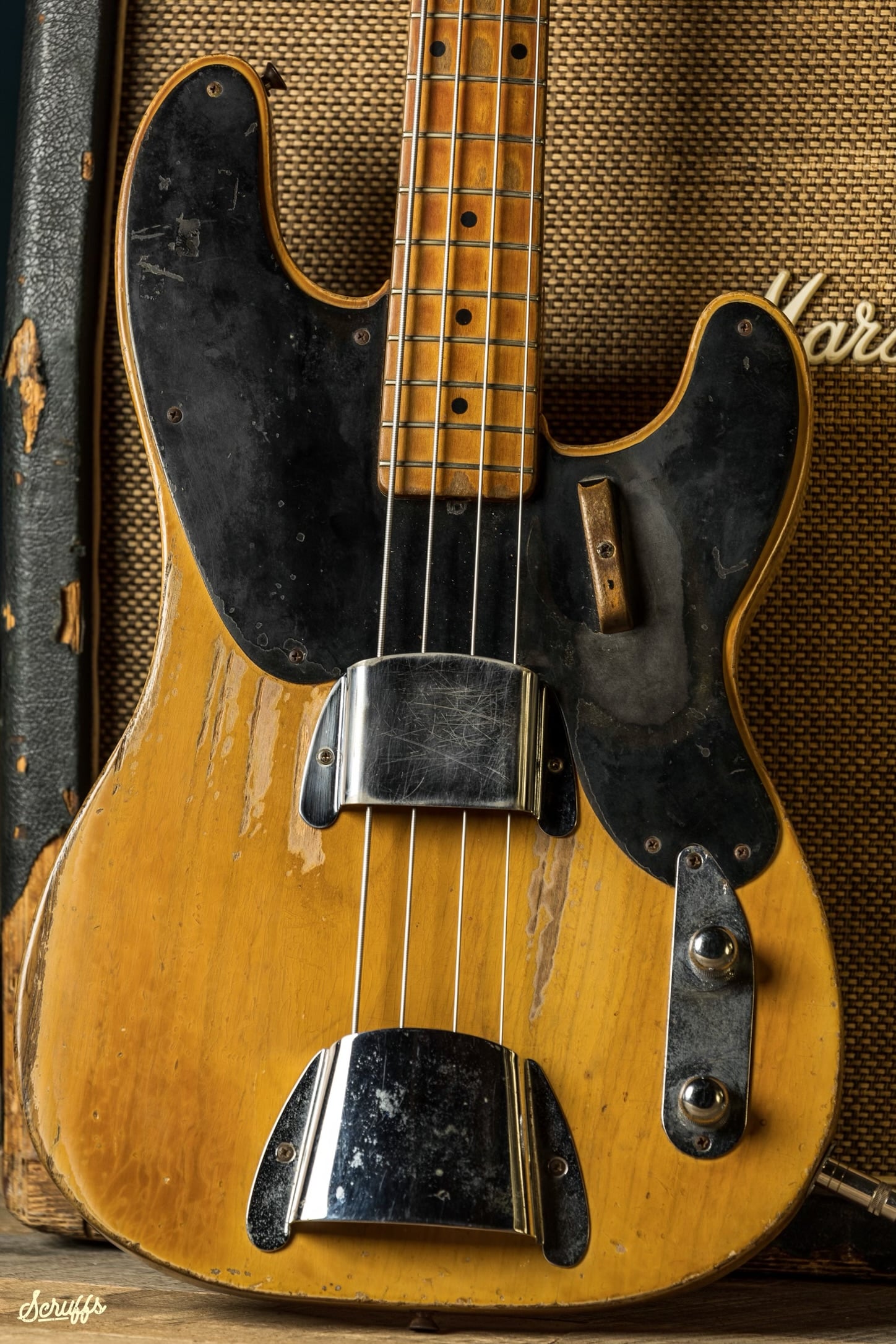
The first Fender precision bass !

Back in the mid 80's I ran across a very early P-bass with a 49 as the neck date and found it pretty well unplayable compared to my 68 Jazz, I was playing at the time. The neck felt like a club.
 
It's funny how...well, it looks like someone named bubba put it together in his shed - much like so many things from that era. The same can be said for the early NASA space capsules - John Glenn's looks like someone literally had some spare corrugated metal and decided he was gonna build him a spaceship.

Meanwhile today you can get a Glarry P-Bass for $99. That's the equivalent of $8.97 in 1951. For the price that Fender charged back then ($199.50 is the figure I found), the modern equivalent would be paying $2,225.

We've come so far in terms of the ability to manufacture objects with greater precision at a lower cost...although some of that comes from finding inexpensive sources of labor.
Actually his name was Eddie Miller.
Diary of a 1951 Fender Bass

I get your point but what's considered rather crude rustic design today, which ironically had to seem like lightyears into the future for it's time, is a big part of the charm of these early slabs.
 
I have an appreciation for old slab body P Basses but I would never play one....For the exact reason why I wouldnt trade a smartphone for one of these, even if its worth more as a collectable:

IMG-1656.jpg
 
I have an appreciation for old slab body P Basses but I would never play one....For the exact reason why I wouldnt trade a smartphone for one of these, even if its worth more as a collectable:

IMG-1656.jpg

Of course not. Those headset caps aren’t original - the original ones would have been color matched.

I know this, because my grandmother had a rotary phone in green.
 
I am still interested of #1.
As others have mentioned, determining/authenticating the true #1 may prove to be almost impossible.
It wasn't even a thought to Leo or anyone at Fender back then it would have any significance years down the road. Their biggest concern was just trying to sell product to keep their doors open at the time.

I don't know if you could source this book in Europe, but you and others might find it of interest.
It's one of few resources out there. It won't answer your question, but gives some great insight into those early basses, including a list of known basses, matching their date with the serial numbers, showing the somewhat randomness of sequence. (literally likely pulling random parts out of a coffee can).
(my old pal Tony's '52 is on page 84)
https://www.amazon.com/Fender-Precision-Basses-Detlef-Schmidt/dp/1574242547/ref=sr_1_1?crid=X3B5AX52X1TJ&keywords=precision+1951+book&qid=1669571886&sprefix=precision+1951+boo,aps,194&sr=8-1
 
As an Amazon Associate, TalkBass may receive commissions from qualifying purchases made via links on this site.
  • Like
Reactions: Headless horse
I just found this thread! I'm a guitar player who's heavily into early Fender Telecasters and Strats. I have owned a bunch of "blackguard" Teles, but I just got my first blackguard bass, a '53.

The pickguard on the bass is a bit warped, which surprised me. The "bakelite" material of the early Tele guards is pretty stiff and inert, and typically does not warp.

So upon further examination, I found the pickguard materials between this bass and my '53 Tele to be different stuff. The bass guard is in fact made out of the old "fish paper" black fiber board old Fender amp circuit boards are made of, painted with clear lacquer on the front, but thinner and more flexible that the "bakelite" Tele guard.

I had a chance to examine another early bass, a '51, just recently. It, too, has the circuit board material pickguard.

Never seen this mentioned anywhere before, so for those of us who geek out on early Fender history minutia, this is really interesting.

gxMWXGV.jpg