
Enjoy the benefits of a premium membership!
Upgrade Account
-
TalkBass has been independent since 1998. Add your voice.
Create a free account to reply to discussions, view embedded media, and browse with fewer display ads.
Join free Log in
Want zero display ads or expanded classifieds tools? Compare plans.
You are using an out of date browser. It may not display this or other websites correctly.
You should upgrade or use an alternative browser.
You should upgrade or use an alternative browser.
More options
Who Replied?

Anyone here have a quick reference to the “old” setting for dip switches on the BMT preamp? I wave the classic Smith tone.
Attachments


Anyone here have a quick reference to the “old” setting for dip switches on the BMT preamp? I wave the classic Smith tone.
Sorry to be posting so much, I just recently got two amazing BT6s, a 2018 White Tiger and a 2010 Ebony Top Wide Neck Elite. Haven’t had a Smith in 15 years and I’m so happy to be back.
That said, back to the DIP switches, what’s everyone liking the best? The “old” setting or the “new”? My 2018 WT I have setup as it came from the factory and it punches like crazy. Last night I changed the DIPs on the Ebony top to the “Old” setting and played a gig this morning. It of course sounded amazing as well. The tonal difference between Basses is naturally different with the Ebony top being “drier” and less upper mid, and the WT being more lively with extended top and bottom. I really play more Worship music, Gospel, and of course I make my living in the Country Music biz. I’ve spent years away from a Smith because Nashville producers gear with their eyes, but since we’ve been doing more remote sessions this year, I’ve been able to sneak things in. The Series mode favoring the Neck pickup and a NordyMute can get a killer Pbass Type tone and is very musical in the mix. Don’t really need 6 strings in Country Music but I do believe the more wood, the more tone....
That said, back to the DIP switches, what’s everyone liking the best? The “old” setting or the “new”? My 2018 WT I have setup as it came from the factory and it punches like crazy. Last night I changed the DIPs on the Ebony top to the “Old” setting and played a gig this morning. It of course sounded amazing as well. The tonal difference between Basses is naturally different with the Ebony top being “drier” and less upper mid, and the WT being more lively with extended top and bottom. I really play more Worship music, Gospel, and of course I make my living in the Country Music biz. I’ve spent years away from a Smith because Nashville producers gear with their eyes, but since we’ve been doing more remote sessions this year, I’ve been able to sneak things in. The Series mode favoring the Neck pickup and a NordyMute can get a killer Pbass Type tone and is very musical in the mix. Don’t really need 6 strings in Country Music but I do believe the more wood, the more tone....

Does anyone on here have this bass right now? I owned it back around 2007 and I’d really love to get it back. 85 Dovetail 4 PJ Fodera made.
Looks like you're not the only one
Is search of a Smith
Not sure if its the same bass, but pretty sure it was located overseas and is staying there for the time being
View attachment 4135124 Try again
Personally, I use the old settings. I’ve been under the impression that each bass preamp is “tuned” at the factory before release, based on the ear of the tech. Mine was originally a mix between old and new settings that I changed to old to tame the treble a bit.Sorry to be posting so much, I just recently got two amazing BT6s, a 2018 White Tiger and a 2010 Ebony Top Wide Neck Elite. Haven’t had a Smith in 15 years and I’m so happy to be back.
That said, back to the DIP switches, what’s everyone liking the best? The “old” setting or the “new”? My 2018 WT I have setup as it came from the factory and it punches like crazy. Last night I changed the DIPs on the Ebony top to the “Old” setting and played a gig this morning. It of course sounded amazing as well. The tonal difference between Basses is naturally different with the Ebony top being “drier” and less upper mid, and the WT being more lively with extended top and bottom. I really play more Worship music, Gospel, and of course I make my living in the Country Music biz. I’ve spent years away from a Smith because Nashville producers gear with their eyes, but since we’ve been doing more remote sessions this year, I’ve been able to sneak things in. The Series mode favoring the Neck pickup and a NordyMute can get a killer Pbass Type tone and is very musical in the mix. Don’t really need 6 strings in Country Music but I do believe the more wood, the more tone....
Smart move, I also did that. If there's anything to improve on a KS, this is it. That, and probably the output jack.Also for those wondering the Gotoh Resolite GB350s are a direct replacement and will shave about 2 tuning keys of weight off of your headstock.


BT has a shorter upper horn and is more symmetrical. The BSR has an extended upper horn and is more... shapely.What is the difference between a BT and a BSR? Please forgive my ignorance. I've been to the Ken Smith web site and the photos show apparently one model with the caption "BT or BSR." I can't find a definition of the model names.
Thanks, I will take a closer look.BT has a shorter upper horn and is more symmetrical. The BSR has an extended upper horn and is more... shapely.
Hi guys - I picked up a couple of BSR “Elite” 5 basses (both from 2000) last summer when I decided to get back into five stringers - see attached.
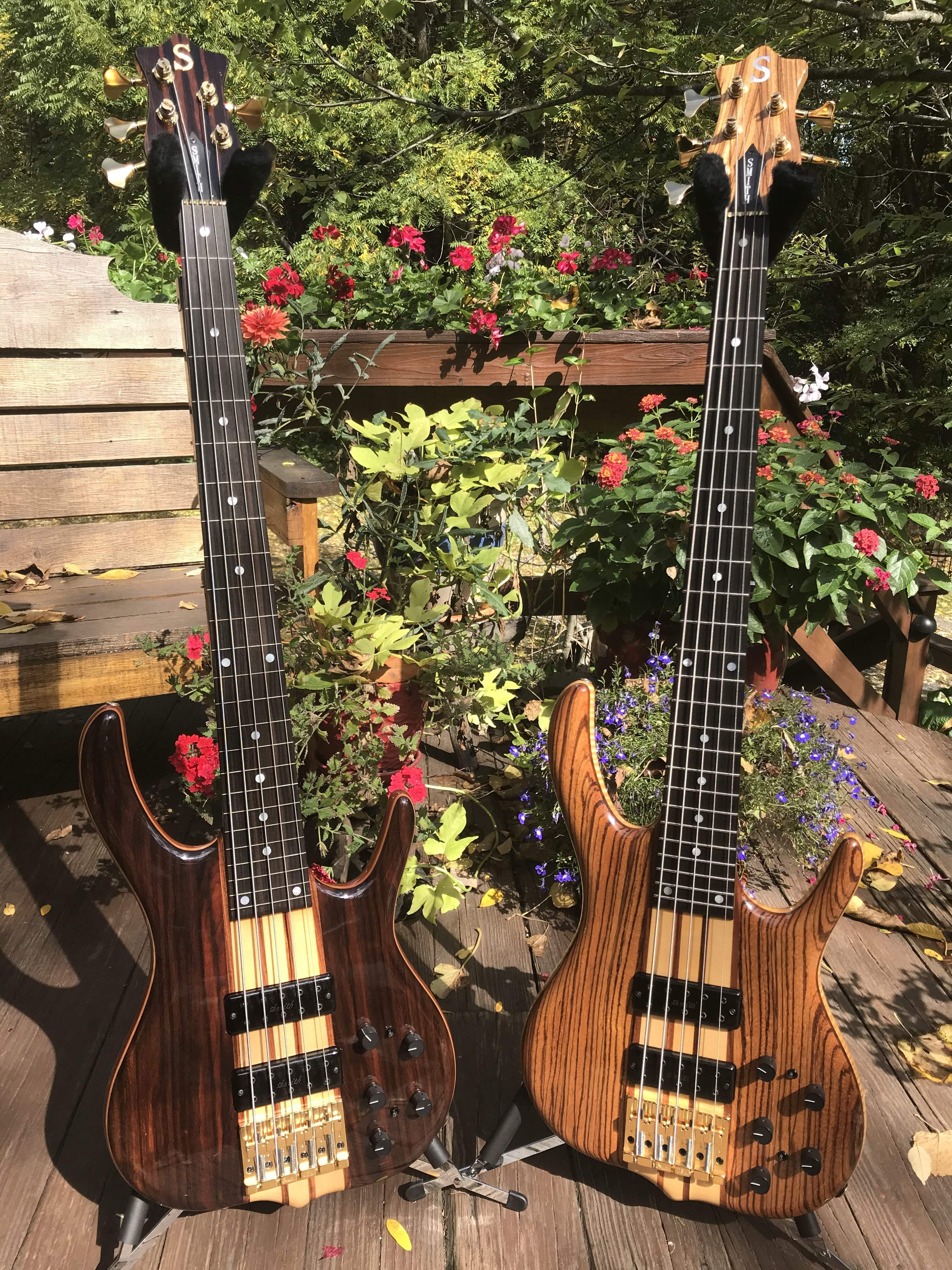
Fretless with Macassar Ebony top and Mahogany core on the left, fretted with Zebrano facings and a Flame Maple core on the right (both strung with high C strings).
I upgraded the fretless with Ken’s “new” BMT circuit with DIP switches (and added Gotoh GB350 tuners while I was at it) and plan to do the same with the fretted in the near future.
My question for the group is whether anyone has experimented with swapping out the two-way Series/Parallel p/u switches with three-way switches to add a single coil option? If so, how complicated was the operation?
Any help/tips/suggestions appreciated.
Cheers!
David
Fretless with Macassar Ebony top and Mahogany core on the left, fretted with Zebrano facings and a Flame Maple core on the right (both strung with high C strings).
I upgraded the fretless with Ken’s “new” BMT circuit with DIP switches (and added Gotoh GB350 tuners while I was at it) and plan to do the same with the fretted in the near future.
My question for the group is whether anyone has experimented with swapping out the two-way Series/Parallel p/u switches with three-way switches to add a single coil option? If so, how complicated was the operation?
Any help/tips/suggestions appreciated.
Cheers!
David
My question for the group is whether anyone has experimented with swapping out the two-way Series/Parallel p/u switches with three-way switches to add a single coil option? If so, how complicated was the operation?
Never mind - I’ve found the answer to my Ken Smith pick-up coil-splitting question (see page 2, fig. 1):
https://www.wdmusic.com/media/images/diagrams/KA_WIRING.pdf
I’ll have my luthier try this wiring (DPDT on/on/on = series/split/parallel) when I add the new BMT circuit to my fretted BSR.
If you find the exact switch brand Ken Smith uses (only on-on-on type) please let us know.Never mind - I’ve found the answer to my Ken Smith pick-up coil-splitting question (see page 2, fig. 1):
https://www.wdmusic.com/media/images/diagrams/KA_WIRING.pdf
I’ll have my luthier try this wiring (DPDT on/on/on = series/split/parallel) when I add the new BMT circuit to my fretted BSR.
If you find the exact switch brand Ken Smith uses (only on-on-on type) please let us know.
The original two-way DPDT (on/on) is C&K part #7201, the equivalent three-way DPDT (on/on/on) is C&K part #7211.
In case you’re simply being snarky, I’m not afraid to modify a non-vintage instrument if doing so increases it’s overall utility and/or my enjoyment whilst playing it.
Not sure what you mean by "snarky" (not an English native speaker) but I'm totally serious about using the exact brand as the original switches as they're much higher quality than what you find online. I'll look into C&K, Thanks.The original two-way DPDT (on/on) is C&K part #7201, the equivalent three-way DPDT (on/on/on) is C&K part #7211.
In case you’re simply being snarky, I’m not afraid to modify a non-vintage instrument if doing so increases it’s overall utility and/or my enjoyment whilst playing it.
Last edited:
Its just a total different animal then any ken Smith I tried before
I had a cr5m, 95 bt5 and tried several TN and bSR after 2000
This one get me 1994 KS BMT5

I had a cr5m, 95 bt5 and tried several TN and bSR after 2000
This one get me 1994 KS BMT5

I have a 93 Chuck Rainey 5 (pictured in my avatar) and a 95 BT 5 neck through listed for sale.
For Sale - 1995 Ken Smith BT 5
I just like the feel of a heel as opposed to neck through.
Attachments

Last edited:
Latest posts
-

-
 Curious what the percentage of bass players use rounds vs flats is.
- Latest: Swamp_Ronin
-

-

