
If he/she does, the first thing I'd do is to scoop my mids a bit.Glad we settled that.
Anyhow, then the Sound Engineer asks you to turn down, because your stage volume is interfering with the FoH mix.

Enjoy the benefits of a premium membership!
Upgrade Account
-
TalkBass has been independent since 1998. Add your voice.
Create a free account to reply to discussions, view embedded media, and browse with fewer display ads.
Join free Log in
Want zero display ads or expanded classifieds tools? Compare plans.
You are using an out of date browser. It may not display this or other websites correctly.
You should upgrade or use an alternative browser.
You should upgrade or use an alternative browser.
The mathematics of amplifiers
- Thread starter Greenman72
- Start date
More options
Who Replied?I think I'm convinced. I realized as I was typing my previous comment that the phase difference of a 1 kHz sound is sampled 500 times more frequently than the phase difference of a 20 Hz signal, so sampling resolution is going to be significantly better.I'm totally willing to be proved wrong here, but given what the math says, I'm going to need data. If that's actually true, then it shouldn't be hard for you to show me empirical data that shows accurate localization for a 20Hz pure tone.
No, this is a mistake. THERE IS ONLY ONE CUE. The only thing your brain has to work with is the phase differential. Since the math shows that cue is non-predictive at 20Hz, you can sample it as many times as you want—it still won't actually tell you anything.
Considering that I never did a controlled experiment, I'm going to assume I was wrong in my conclusions and that it was harmonic content (or additional sounds) what actually cued me to the location of low-frequency sources.
I'm just going to assume my memory is playing tricks on me.
But what is the limit? I often use Szynalski's Online Tone Generator to quickly tune my guitar and I just tried it. Using pure sine wave, I'm able to tell which speaker the sound is coming from down to the 50 Hz that my speakers are capable of, although the speakers are positioned at ±30° in front of me. If my calculations are not wrong, the phase difference between left and right ear cannot be greater than 10.5°, and yet it's clearly audible.

I am by no means any sort of expert on localization. My recollection is phase is one part of the localization process and differences in SPL is another part of the process. For example when we build a stereo IEM mix, we are relying purely on SPL differences for localization. On a related note, IMHO panning low frequencies tends to sound pretty unnatural to me (YMMV of course).
AFAIK the SPL aspect of localization also breaks down at low frequencies.
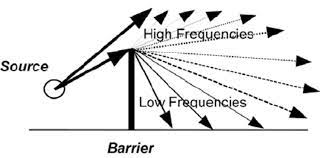
Higher frequencies do not wrap around you head, so if a sound source is to one side, the other side of your head is in an acoustic shadow. My understanding is low frequencies wrap around curved surfaces such as your head. As a result both ears hear pretty much receive the same SPL even if the sound source is to one side.
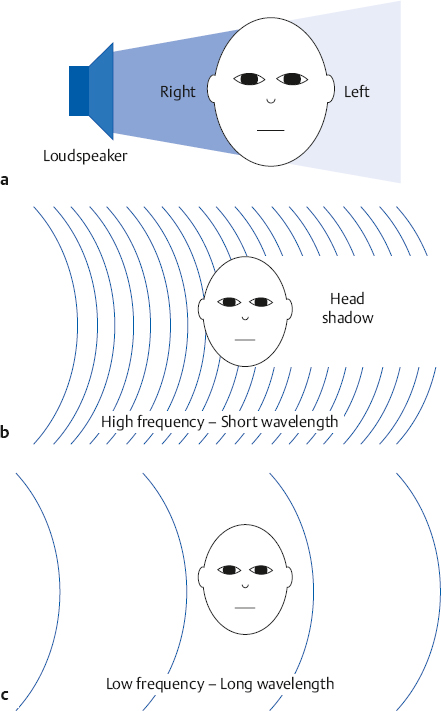
AFAIK the SPL aspect of localization also breaks down at low frequencies.
Higher frequencies do not wrap around you head, so if a sound source is to one side, the other side of your head is in an acoustic shadow. My understanding is low frequencies wrap around curved surfaces such as your head. As a result both ears hear pretty much receive the same SPL even if the sound source is to one side.
The more I read about it, the more I'm surprised that I can locate a 55 Hz source without any problem. I tried with the subwoofer in the living room and it can go down to about 35 Hz, but with some rattling. I found a nice and clean frequency (42 Hz) which is way below Schroeder's frequency for that room and it's possible to locate the node points for waves in room modes, the sound is omnidirectional for all practical purposes. This got me curious and I'm seriously considering taking the subwoofer outside to listen to it play as low as possible and try to see if it's possible to tell where the sound is coming from.
The more I read about it, the more I'm surprised that I can locate a 55 Hz source without any problem.
Keep in mind the subwoofer is not necessarily producing a pure tone. Even if you have the ability to feed it a pure 55hz tone, it may actually be producing significant energy an octave higher.
Exactly. Harmonic distortion of speakers is often ignored, but it's there.Keep in mind the subwoofer is not necessarily producing a pure tone. Even if you have the ability to feed it a pure 55hz tone, it may actually be producing significant energy an octave higher.


- Feb 12, 2006
- 61,092
- 5
- 221,221
- Disclosures
- Development Engineer-Mesa Boogie, Development Engineer-Genzler (pedals), Product Support-Genz Benz
Yet there's some good on topic educational content for the curious too.This thread should get an award for the most off topic.

Al Kraft
Supporting Member
- May 2, 2016
- 10,780
- 40,484
- Disclosures
- Mesa Boogie beta product tester and player support
I copied the OP word for word with the actual question in bold print...This thread should get an award for the most off topic.
Forgive me if this is a stupid question. I'm a CPA/CFP, not a sound engineer.
I was talking to somebody far smarter than me over the weekend. She said that 2x10 is better (louder) than 1x15.
I assume that bigger = louder, at least to some degree. And the formula for the area of a circle is Pi x R-squared. Since Pi is constant, let's ignore it and just compare R-squared.
1/2 of 15 is 7.5. 7.5 x 7.5 = 56.25 square inches for the 15-inch speaker.
1/2 of 10 = 5. 5 x 5 = 25. So a 10-inch speaker has 25 square inches, which logically means that two of them has 50 square inches.
56.25 > 50, I think.
So why is 2x10 louder than 1x15?
I think the discussion naturally leads to human hearing and sound propagation as at least one element of a multi-factor answer, which admittedly took an excursion into sound localization. Now if we were to use the phrase "most off-topic" from the title which is "The mathematics of amplifiers", I would absolutely have to agree with you. But in fairness, the OP started it!





That has surely got to be at best a simplification though. The real world situation must be more complex. Maybe in an anechoic chamber, (and maybe not even then) but otherwise this must be all confused by reflections, diffraction, goodness knows what else.
- Feb 12, 2006
- 61,092
- 5
- 221,221
- Disclosures
- Development Engineer-Mesa Boogie, Development Engineer-Genzler (pedals), Product Support-Genz Benz
2x10=20, 1x15=15. 20>15. Math!
Edit:
As inaccurate as this might be.
Yep. Consider that if you are in room with really strong reverberation, then it becomes harder to localize mid range frequencies as well.The real world situation must be more complex. Maybe in an anechoic chamber, (and maybe not even then) but otherwise this must be all confused by reflections, diffraction, goodness knows what else.

This thread should get an award for the most off topic.
Proud to be a part of it.

Latest posts
-

-

-

-

-
 Selling a member that is not new, but only has 1 post?
- Latest: buldog5151bass