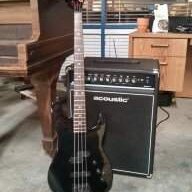
I searched, but I didn't see any threads with anyone who had any experience with the Monoprice bass guitars, so I decided to write-up and post my own experiences with my Monoprice P-bass clone. Hopefully this is the correct forum to post this in.
I've been playing bass guitar only for a few months now, but I'm really enjoying it and I wanted to pick up a second bass that I could haul around, toss in the back of my station wagon, etc, and not really worry about it. My first bass is a black Charvel 3B that looks and sounds amazing, and I get a little bit nervous every time I have to transport it somewhere.
The Monoprice "California Classic" guitars have developed a reputation in my circles for being a solid choice for beginners. When I saw that Monoprice had begun selling bass guitars, I decided to go ahead and order one. I chose the white P-bass clone, or "Pub" model as Monoprice calls it.
When I received it, I went over it and noted several problems with it. Most obviously, the pickups were both angled forwards at a sharp angle.
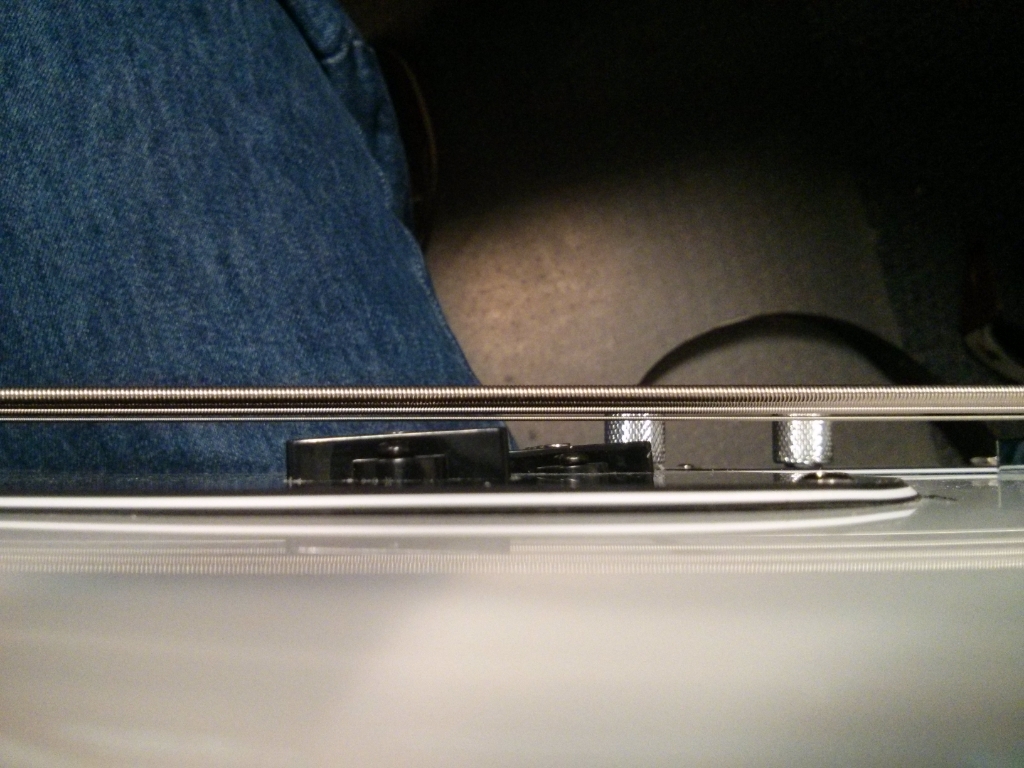
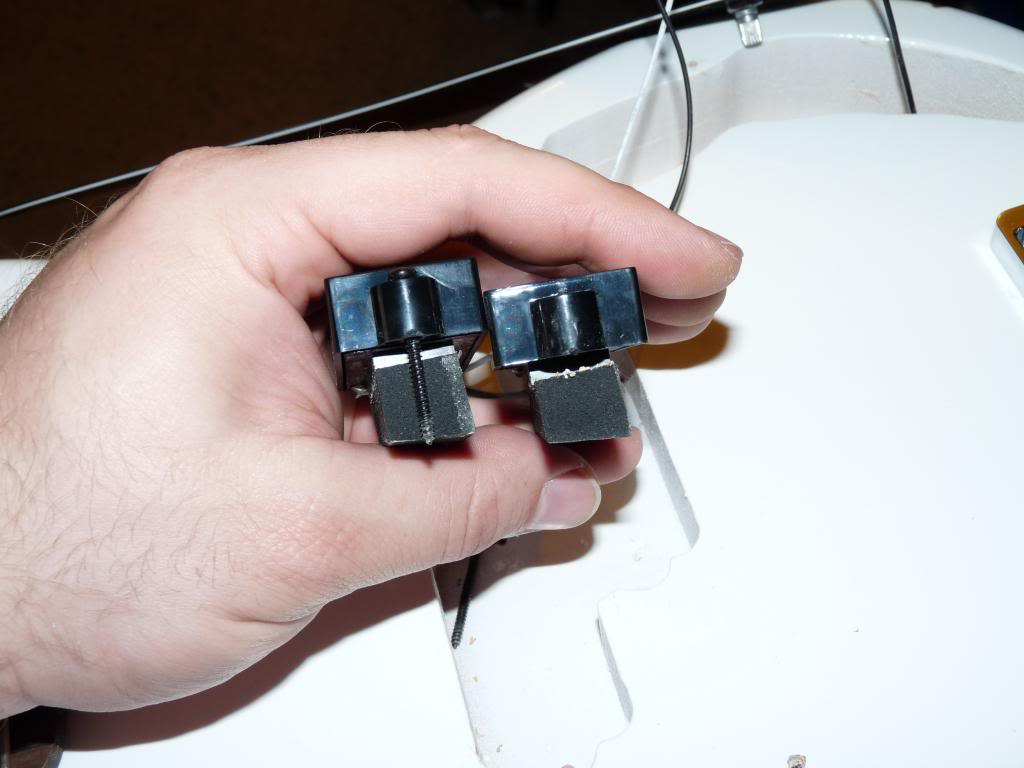
The foam underneath is angled as well. I don't know if the pickups are angled because the foam is angled, or if the foam is angled because the pickups weren't installed straight.
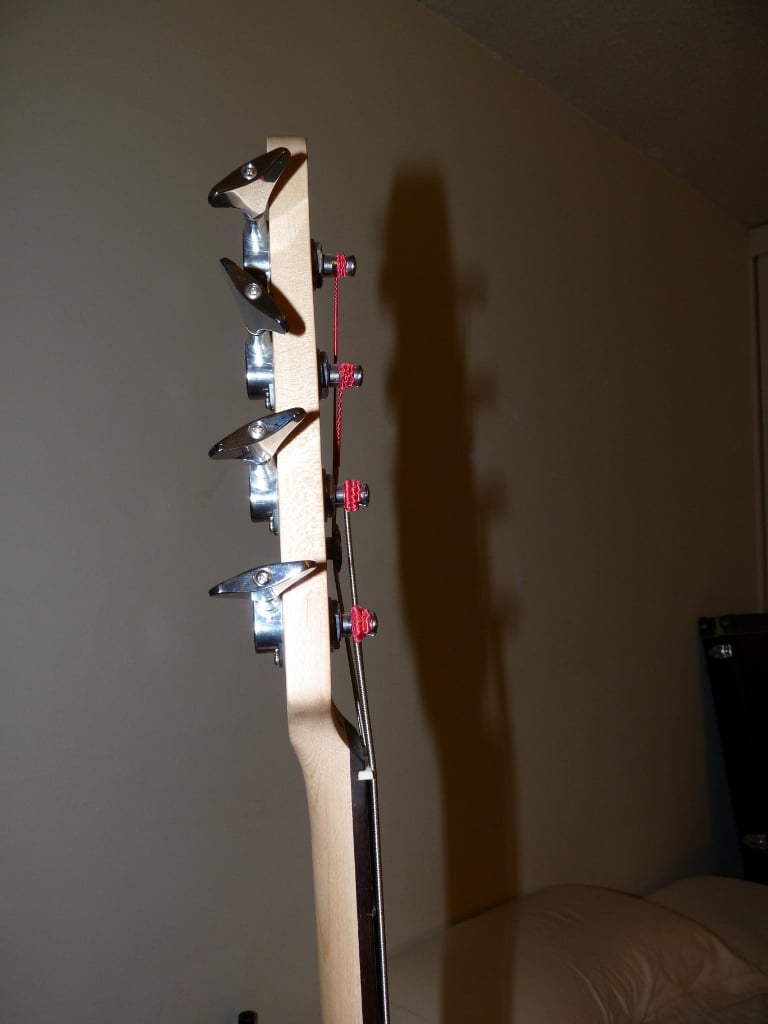
The second thing I noticed was that the E and A strings were would around the tuners (the tuners themselves are cheap Gotoh knockoffs) such that the lowest wrap was clearly out of the recessed area of the tuning peg. Yes, the stock strings have red silk wrapped ends.
But what really matters is how it sounds, right? I plugged it in and did a little playing. The intonation was spot on, but the action felt extremely high, despite the nut being cut lower than I'm accustomed to. The sound wasn't great - it sounded cheap, although I can't put my finger on what aspect of it's tone made it sound cheap, other than a lack of punch on the low notes. The pickups are not humbucking, and easily picked up the fluorescent light in my office. The tone knob did not change the tone in any perceivable way.
All that said, it still sounded better and played easier than the department store Christmas "bass starter kit" basses I've seen. Which I'm not sure is a compliment or not.
Not ideal, but part of the appeal to me for having a cheap bass was that I could play "Jr. Luthier" on it without worrying about screwing up a nice instrument.
The first step was to change the stock strings out. I put a set of D'Addario Balanced Lights on it for an immediate improvement in tone.
Next I turned my attention to the bridge to lower the action.
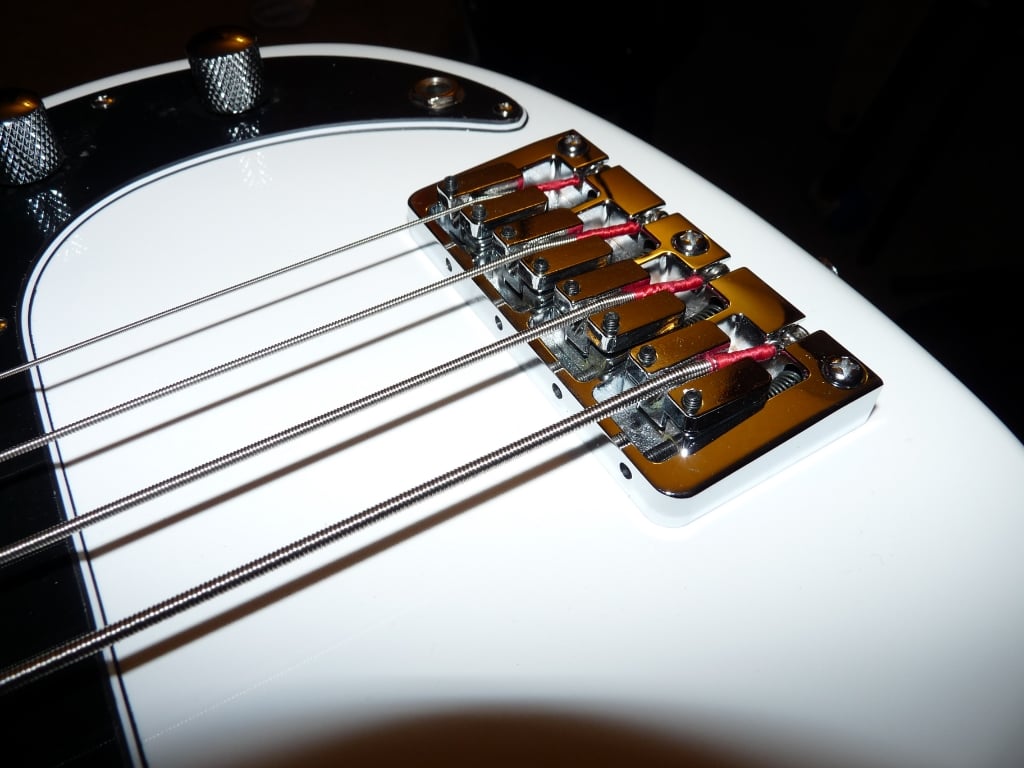
The bridge is easily the biggest flaw I found with the Monoprice bass. With all the adjustment screws at their lowest possible adjustment (one of the adjustment screws on the D saddle had the threads stripped out when I got it), all 4 strings were still at 10/64ths at the 12th fret.
As I went to retune the guitar after the adjustment, the A string started buzzing terribly above the nut. Apparently the A string needs to be wound as far down the tuner as possible to get an acceptable angle from the nut, and I hadn't left enough extra when I cut the D'Addarios.
I picked up a Hipshot 3-string retainer and replaced the stock "button" with it, which completely fixed my buzzing issue.

While I had the bass apart, I also picked up a used bridge off a Fender Squier J-bass. Of course the Monoprice bridge didn't have the appropriate screw locations for the Fender bridge, so after a bit of measure twice, drill once...

Next I turned my attention to the stock tuning machines. They are functional, but have too much slop for my taste. I replaced them with a well-used set of Gotoh tuners. The Gotoh tuners were a direct bolt on, and are much nicer to use.
With these parts installed, I was able to get a really good setup on the bass, and it became a nice practice instrument.
But I decided, in for a penny, in for a pound.
I picked up a pair of CTS 250k audio taper pots to replace the mini-pots the Monoprice came with, found an assortment of capacitors in the bottom of my electronic parts bin, and picked up a lightly used DiMarzio Split P pickup.
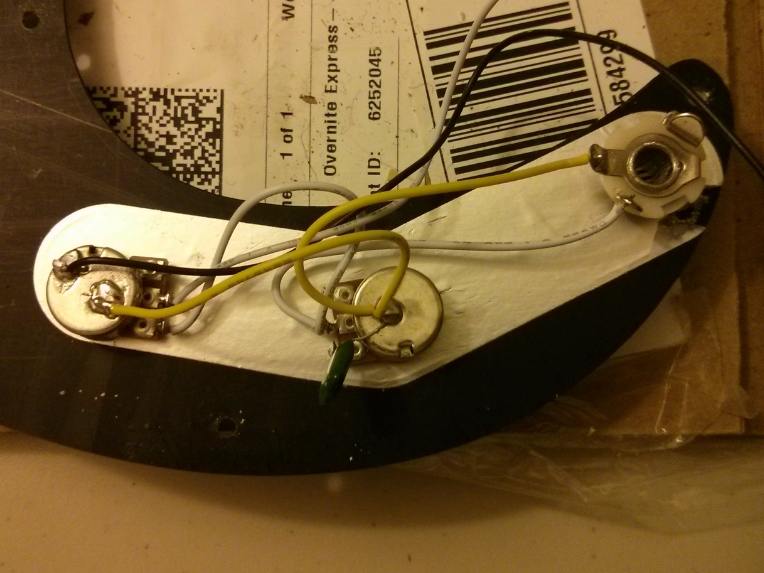
Here's a shot of the backside of the stock pots; I haven't traced the circuit yet, but it didn't match the P-bass schematics I had. The stock tone capacitor is a .047uF.
I used a hand reamer to enlarge the holes in the pickguard for the new pots, soldered everything up, installed the new-to-me pickups, and put everything back together.
And wow, I'll be darned if this isn't now a great sounding, great playing bass.

Of course, the only parts that are original are the body and the neck. But I had fun, learned a lot, and now have a killer bass that I have less than $250 into. Plus, it has the Monoprice logo on the headstock for that extra "stealth" factor.
I've been playing bass guitar only for a few months now, but I'm really enjoying it and I wanted to pick up a second bass that I could haul around, toss in the back of my station wagon, etc, and not really worry about it. My first bass is a black Charvel 3B that looks and sounds amazing, and I get a little bit nervous every time I have to transport it somewhere.
The Monoprice "California Classic" guitars have developed a reputation in my circles for being a solid choice for beginners. When I saw that Monoprice had begun selling bass guitars, I decided to go ahead and order one. I chose the white P-bass clone, or "Pub" model as Monoprice calls it.
When I received it, I went over it and noted several problems with it. Most obviously, the pickups were both angled forwards at a sharp angle.
The foam underneath is angled as well. I don't know if the pickups are angled because the foam is angled, or if the foam is angled because the pickups weren't installed straight.
The second thing I noticed was that the E and A strings were would around the tuners (the tuners themselves are cheap Gotoh knockoffs) such that the lowest wrap was clearly out of the recessed area of the tuning peg. Yes, the stock strings have red silk wrapped ends.
But what really matters is how it sounds, right? I plugged it in and did a little playing. The intonation was spot on, but the action felt extremely high, despite the nut being cut lower than I'm accustomed to. The sound wasn't great - it sounded cheap, although I can't put my finger on what aspect of it's tone made it sound cheap, other than a lack of punch on the low notes. The pickups are not humbucking, and easily picked up the fluorescent light in my office. The tone knob did not change the tone in any perceivable way.
All that said, it still sounded better and played easier than the department store Christmas "bass starter kit" basses I've seen. Which I'm not sure is a compliment or not.
Not ideal, but part of the appeal to me for having a cheap bass was that I could play "Jr. Luthier" on it without worrying about screwing up a nice instrument.
The first step was to change the stock strings out. I put a set of D'Addario Balanced Lights on it for an immediate improvement in tone.
Next I turned my attention to the bridge to lower the action.
The bridge is easily the biggest flaw I found with the Monoprice bass. With all the adjustment screws at their lowest possible adjustment (one of the adjustment screws on the D saddle had the threads stripped out when I got it), all 4 strings were still at 10/64ths at the 12th fret.
As I went to retune the guitar after the adjustment, the A string started buzzing terribly above the nut. Apparently the A string needs to be wound as far down the tuner as possible to get an acceptable angle from the nut, and I hadn't left enough extra when I cut the D'Addarios.
I picked up a Hipshot 3-string retainer and replaced the stock "button" with it, which completely fixed my buzzing issue.
While I had the bass apart, I also picked up a used bridge off a Fender Squier J-bass. Of course the Monoprice bridge didn't have the appropriate screw locations for the Fender bridge, so after a bit of measure twice, drill once...
Next I turned my attention to the stock tuning machines. They are functional, but have too much slop for my taste. I replaced them with a well-used set of Gotoh tuners. The Gotoh tuners were a direct bolt on, and are much nicer to use.
With these parts installed, I was able to get a really good setup on the bass, and it became a nice practice instrument.
But I decided, in for a penny, in for a pound.
I picked up a pair of CTS 250k audio taper pots to replace the mini-pots the Monoprice came with, found an assortment of capacitors in the bottom of my electronic parts bin, and picked up a lightly used DiMarzio Split P pickup.
Here's a shot of the backside of the stock pots; I haven't traced the circuit yet, but it didn't match the P-bass schematics I had. The stock tone capacitor is a .047uF.
I used a hand reamer to enlarge the holes in the pickguard for the new pots, soldered everything up, installed the new-to-me pickups, and put everything back together.
And wow, I'll be darned if this isn't now a great sounding, great playing bass.
Of course, the only parts that are original are the body and the neck. But I had fun, learned a lot, and now have a killer bass that I have less than $250 into. Plus, it has the Monoprice logo on the headstock for that extra "stealth" factor.