

Enjoy the benefits of a premium membership!
Upgrade Account
-
TalkBass has been independent since 1998. Add your voice.
Create a free account to reply to discussions, view embedded media, and browse with fewer display ads.
Join free Log in
Want zero display ads or expanded classifieds tools? Compare plans.
You are using an out of date browser. It may not display this or other websites correctly.
You should upgrade or use an alternative browser.
You should upgrade or use an alternative browser.
The "Trace Elliot" sound
- Thread starter iampoor1
- Start date
More options
Who Replied?
No ringing in mine.
GP7SM may be older than GP12SMX or a cheaper model of same times. After the SMX the wheels fell off in all the corporate music dealings. I'm not aware of any really dud products so why the brand fell away is something of a mystery.
The GP7 preamp has a 7-band EQ and the GP12 has a 12-band EQ. The SM was the lower priced line, and the SMX was the higher priced line, but the quality level was identical. The GP7SM and GP12SMX superceded the earlier Series 6 GP7 and GP12 lines.
In addition to the famed "Pre-Shape" EQ curves and the well-built power supplies with the toroidal transformers that put out massive amounts of steady power, part of the magic of the Trace Elliot sound is also the tunable multi-ported cabinets, the custom Celestion drivers for them, and the fact that the cabinets were made from MDF, rather than plywood. Each cabinet had two 4" ports, which could be selectively plugged. If I remember correctly, with both ports unplugged, they were tuned at 45 Hz, with one plugged 35 Hz, and then you could plug both and play them as sealed cabinets. If you can't find original TE plugs, 4" plumbing drain test plugs work just fine. thought they are kind of ugly to look at onstage.
As well, Trace Elliot offered a very wide range of cabinet options, from 4x5" Bright Box to 2x10, 4x10, 1x15 in two different sizes, 1x18, 2x15, and 8x10 models available, with and without treble horns, all of which were made to common dimensions, so they could be stacked in various patterns and still be aesthetically pleasing and tonally compatible.
And that doesn't even get into the tube amps, the Twin/Quatra/Hexa or the V-Type, all of which are classic Trace Elliot in their own ways. If anyone would like, I have Trace Elliot catalogues from the mid 1990s which show the SM/SMX/V-Type lines, as well as the tube guitar amps, the Trident/Bonneville/Velocette amps.
Last edited:
The brand "fell away" because of mismanagement during the late 1990s, essentially, which caused some of their key personnel (Mark Gooday, Clive Button, Clive Roberts) to bail out/be fired in 1997 and start Ashdown Engineering. After that, they were bought out by Gibson, which completely neglected the brand aside from reissuing some of the Velocette guitar amps under the Gibson Goldtone branding and then eventually shut the whole division down. The golden years of Trace Elliot were around 1995, when they had the SM/SMX series amps, the V-Type, and the tube guitar amps. They hung on for a few years with that stellar product line, and then collapsed.
Last edited:
From Clive Button's website:
Trace Elliot
My association with TRACE ELLIOT started late in 1985 when I was engaged on a consultancy basis by Fred Friedlein (the sole owner of the company) to design the MP11 MIDI Programmable Graphic preamplifier.
From that first meeting I was to become the sole designer of all TRACE ELLIOT products for the next 12 years. These include such well known products as:
Bass - Series 6 range, SMX range, SMC range, 7 Band range, 12 Band range, GP7 Pre-Amp, GP12 Pre-Amp, AH150, AH200, AH300, AH350, AH500, AH1000-12, Valve Series, VA350, VA400, VR400, Twin, Quatra, Hexa, Commando range, Boxer range, PPA power amplifiers, Powered Sub 15, Bass effects pedal range, MP11 etc:
Acoustic - TA100R, TA50R, TA200R, TA Concert range, TA60, TA35, TA30, Acoustic Cube, TAB100 (Acoustic Bass), Acoustic PA 16 channel powered mixer system, Acoustic PA 12 channel powered mixer system, TAP1 acoustic pre-amp pedal, in fact everything that came out of Trace Elliot all the way through to 1997.
Prior to the involvement with Trace Elliot I had carried out freelance design and consultancy for a number of companies and continued some of these after 1985 but for the years 1988 to 1997 I designed exclusively for TRACE ELLIOT at their request.
From the top 25 best selling TRACE ELLIOT products of 1996, 5 were speaker cabinets, 1 was a foot switch (to go with top of the range Bass amplifiers I designed) and out of the remaining 19 products, 18 were designed by me.
Ashdown Engineering
In early 1997 I was approached by Mark Gooday (Trace Elliot CEO) and Clive Roberts (in charge of Trace Elliot sales worldwide) who were concerned that Kaman, the American company who then owned the company were going to close it down as part of the re-structuring of their music division. They asked me to design a product or range of products that they could use as the basis of a new company should this ever happen. I came up with the idea of the Klystron Bass Magnifier and produced a drawing of the proposed amplifier. The name I got from thinking of Flash Gordon saying something like �turn up the klystron bass magnifier Mr Zarkov�. I thought this had a suitably retro feel to it and also totally different to the Trace Elliot products. The amplifier (of which I still have the original drawing - see below) featured the VU meter, the Sub-Harmonics and the now familiar EQ control layout, all of which have since become very recognisable �Ashdown� features.
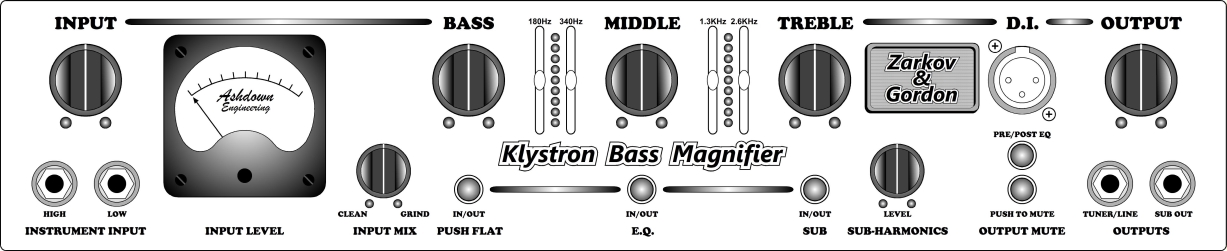
Mark Gooday left Trace Elliot in March of that year and started Ashdown with a range developed from that amplifier; this became the ABM or Ashdown Bass Magnifier range. Clive Roberts stayed on at Trace Elliot. I continued as a consultant for Trace Elliot until April 2001.
Mark Gooday's perspective:
I sold Trace Elliot, with my partner Fred, to an American company. I had a five-year contract with them and that was coming to an end in `97. The Americans and I did not see eye to eye in the slightest on the direction of the company, we were at loggerheads as to what we were both doing. They were closing down a lot of their music sections and intending to sell Trace Elliot and I was in the midst of trying to buy it back. This didn’t work out particularly well and it got a little bit politically difficult between us to the point where they thought it was better that I went and I thought it was better that I went, so that was it.
Then I wasn’t allowed to do anything in the music industry for six months, which gave me time to decide what I wanted to do. Trace made some fantastic achievements over the years, ones I’m very proud of and I miss the company today.
From the SM7EQ manual:
PRE SHAPE 1 is the classic TRACE ELLIOT EQ as found on Series 6 units the SMX and the SM range of amplifiers, it adds a boost at both the low end (50Hz) and the high end (2 to 5kHz) of the frequency spectrum as well as a cut at mid frequencies (400Hz). PRE SHAPE 2 is more rock orientated equalisation providing a wider bandwidth boost at low frequencies, less of a mid cut and a slight boost at higher frequencies. This is a less extreme EQ than PRE SHAPE 1.
PRE SHAPE 1 is the classic TRACE ELLIOT EQ as found on Series 6 units the SMX and the SM range of amplifiers, it adds a boost at both the low end (50Hz) and the high end (2 to 5kHz) of the frequency spectrum as well as a cut at mid frequencies (400Hz). PRE SHAPE 2 is more rock orientated equalisation providing a wider bandwidth boost at low frequencies, less of a mid cut and a slight boost at higher frequencies. This is a less extreme EQ than PRE SHAPE 1.
- Jan 12, 2011
- 4,578
- 2,460
- Disclosures
- Artist, Trickfish Amplification Bartolini Emerging Artist, MTD Kingston Emerging Artist. Artist, Tsunami Cables
Louder than you would think. Punch. And can get HiFi. A more Modern than warm round sound. I like it and still have a Made in England GPSM 7 300 that still works. I'd gig it any day of the week if I had to.
I have an AH350, got it in trade a few years back and keep it at a rehearsal space. Sounds fantastic; I always use the valve rather than the solid state input stage, though it's fun to compare the sound of the two. Love the look with the black light. Also, I ditched the case and built the head into a 4-space SKB - saved a lot of weight, and protects the amp better.
Only issue I've found is that the input does not have a lot of gain on tap. Even with an active bass, I have to turn the gain up to 3 o'clock to register in the middle segment of the input meter. Can't get into the red at all no matter how much I crank the gain. Not really a problem, the amp gets plenty loud but if I was looking for overdrive from the input stage I'd have to use an external boost pedal. Maybe that's why someone commented that the amps don't do 'gritty'.
Worth noting that I never use the trademark Trace pre-shape. Also don't care much for the sound of the onboard compressor, seems to leave my sound rather dull and lifeless - this coming from a compressor junkie btw.
Only issue I've found is that the input does not have a lot of gain on tap. Even with an active bass, I have to turn the gain up to 3 o'clock to register in the middle segment of the input meter. Can't get into the red at all no matter how much I crank the gain. Not really a problem, the amp gets plenty loud but if I was looking for overdrive from the input stage I'd have to use an external boost pedal. Maybe that's why someone commented that the amps don't do 'gritty'.
Worth noting that I never use the trademark Trace pre-shape. Also don't care much for the sound of the onboard compressor, seems to leave my sound rather dull and lifeless - this coming from a compressor junkie btw.
I'v run trace's for years, always loud always heavy.. as people have said already the preshape is whats known as the trace tone.. bit mid scoopy but very defined.. trace amps are very flexible, you can pull a lot of different sounds out, always run best with the preamp set a little high.. everyone raves about the older gear, and with good cause, but to be honest having run the newest ah1200 12 for the last three years its an incredible amp, huge power lovely natural delivery and without a doubt the most flexible and rewarding amp I'v ever owned.. i hope it never terminally breaks because they are no longer available.. and i would never replace it.. all 3 1/2 tons of it.. 
I had a trace back in the 90s. I bought it for smaller gigs then. It had no tone to me. Sounded like a brick. Went back to dragging my SVT pro 2and 8X10 cab. Really hated that Trace .
Latest posts
-

-
 I didn't need it but I bought it anyway new (to me) cab day...
- Latest: Element Zero
-

