• TalkBass has been independent since 1998. Add your voice.
    Create a free account to reply to discussions, view embedded media, and browse with fewer display ads.
    Join freeLog in
    Want zero display ads or expanded classifieds tools? Compare plans.

This thread is for the birds

Jon Clegg

Fueled by caffeine and snark.
Feb 9, 2015
5,777
22,013
Northern Virginia
I had ordered a 5 string bass neck to play around with, never having owned a 5-er. Was thinking about what kind of body to mate it with, when @JIO started posting about building a Fender-Bird. I now had a plan! I also happened to have on hand, an Epiphone 6 string neck from GFS -- matching birds! (well sorta)
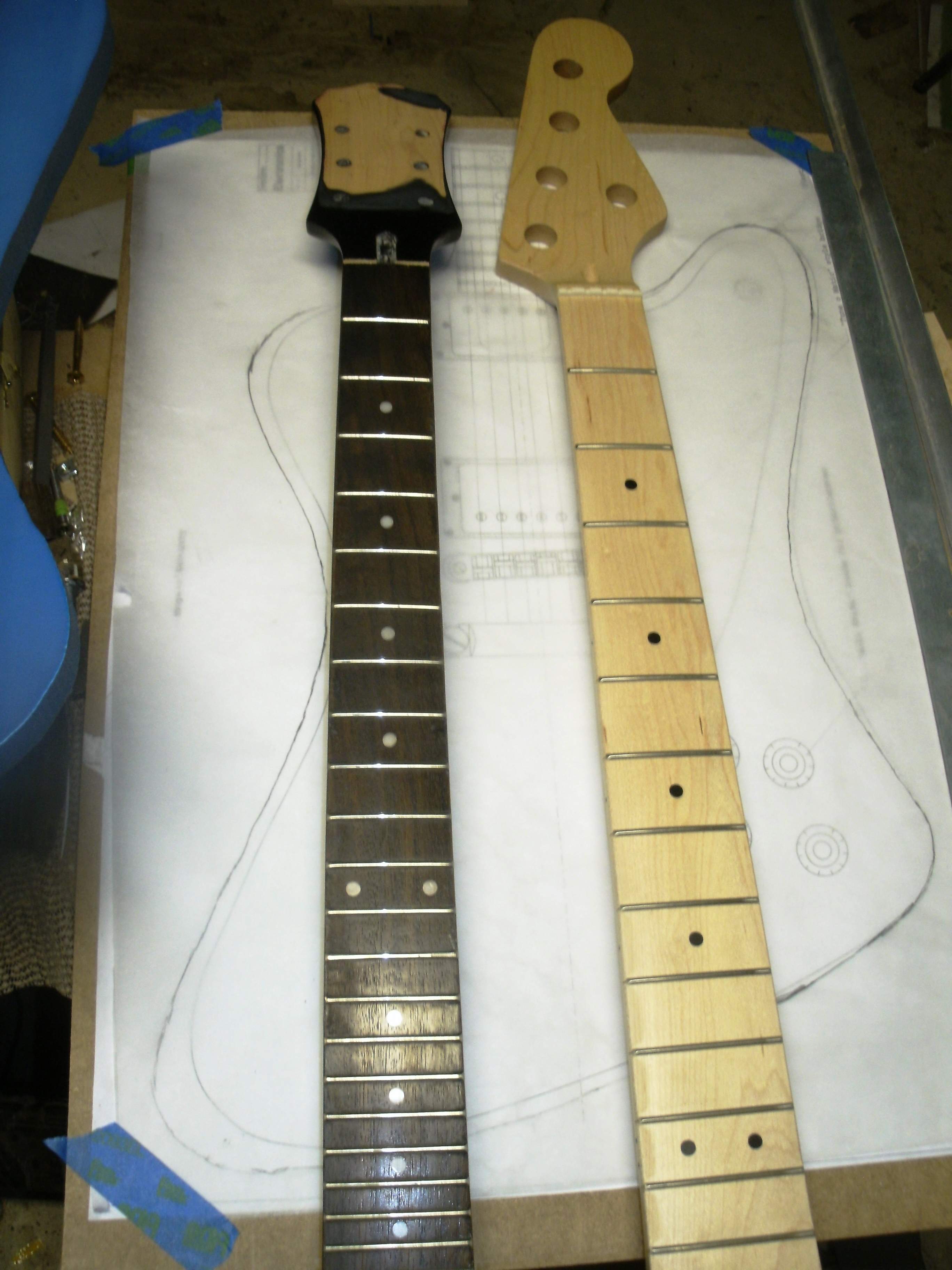
GEDC1287.JPG

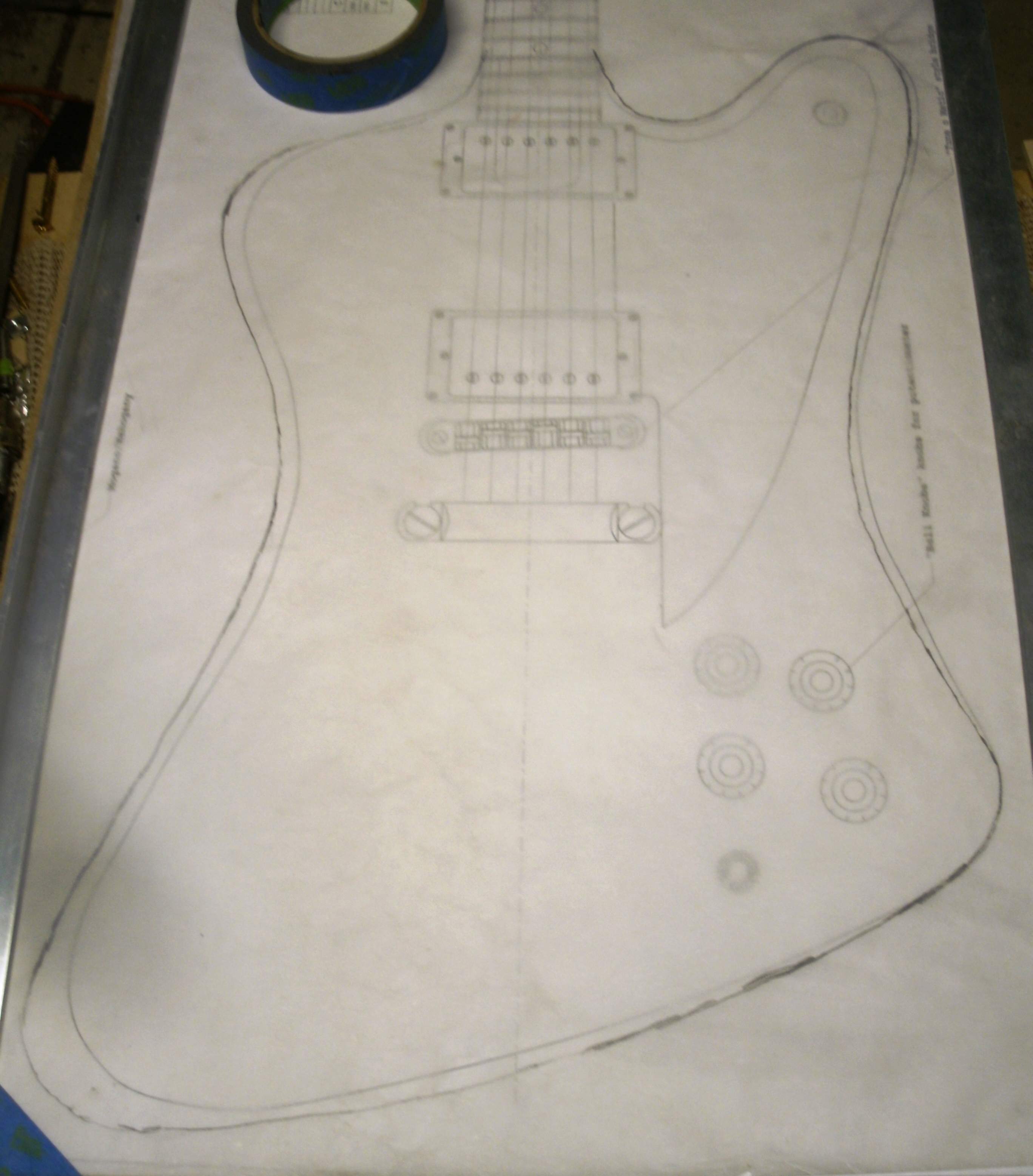
My original plan was to use a drawing for a Firebird Studio that I had downloaded for the body shape. I noticed however that there were a few differences from pics of JIO's 63 bird. He graciously offered to trace the '63 for me. A few days later the tracing was here. Copied the outline on engineering vellum; here you can see the difference from the Firebird studio; the '63 is a bit larger. I'll use that outline for both.
GEDC1276.JPG

The T-Bird will be getting Epiphone T-bird Pro active pickups I picked up off of ebay, and a narrow (16.5 mm) spaced bridge. The Firebird will get 3 P-90's and I'm thinking a Wilkinson wrap-around bridge. Both bodies will be made from some 6/4 yellow poplar I picked up locally.
 
One of the things I want to experiment with is using DupliColor MetalCast for the finish. I'm using a piece of an old prototype here as a test piece. I'm looking at two different base coats: the neck end is based with DupliColor Chrome, the bridge end with the MetalCast base coat. The MetalCast has a lot more sparkle. Unfortunately, I'm going to need to wait a few days for the humidity to drop to something reasonable before I can spray the blue top coat.
GEDC1290.JPG
 
  • Like
Reactions: JIO
One of the things I want to experiment with is using DupliColor MetalCast for the finish. I'm using a piece of an old prototype here as a test piece. I'm looking at two different base coats: the neck end is based with DupliColor Chrome, the bridge end with the MetalCast base coat. The MetalCast has a lot more sparkle. Unfortunately, I'm going to need to wait a few days for the humidity to drop to something reasonable before I can spray the blue top coat.
View attachment 3143933

Translucent blue?
 
  • Like
Reactions: Jon Clegg
Have you tried blending colours by alternating them between coats? And does it eventually go opaque if you build it up or does it get deeper translucent?
This will be my first experiment. I might pickup another color to try some different blending. As for build up, I'll need to play with it a bit. Might try to do the inverse-burst you talked about.
 
  • Like
Reactions: JIO
I noticed however that there were a few differences from pics of JIO's 63 bird. He graciously offered to trace the '63 for me. A few days later the tracing was here. Copied the outline on engineering vellum; here you can see the difference from the Firebird studio; the '63 is a bit larger.

It's a '64 Jon - the 1st T-bird I owned (bought for $150 in 1974) that was stollen in '78 was a '63, the rarest of all Thunderbirds. I knew it was a '63 because I sent a letter to Gibson with the serial # and they sent a postcard back stating it was a '63. I was just interested in knowing and had no idea how valuable it was or would become. You never see a '63 for sale or otherwise, 64's are the most common, followed by 65's that I've also seen out there. The "reverse" was only made for those 3 years and due to the long neck, thin nut and huge hs - many broke at the nut. Some were repaired (I've seen a number of them with the repair over the years) and some were parted out and the bass discarded. (neck-thru) This was done before the whole "vintage worth" hysteria started - if someone broke it and didn't have access to a luthier or funds to repair it then it was simply parted out and the rest thrown out. I once saw a '64 T-bird on eBay (from Florida) that someone cut off the whole neck and routed in a neck pocket for a Fender neck. The seller said Jaco played it (maybe he did being from Florida) I considered buying it (for $800 I think), but didn't - so the early birds have many stories. When I got my '64 in '78 a month after the '63 was stollen, it was most likely briefly played and spent most of its life up to then in its case as it was in nearly new condition when I bought it. (for $700)
 
It's a '64 Jon - the 1st T-bird I owned (bought for $150 in 1974) that was stollen in '78 was a '63, the rarest of all Thunderbirds. I knew it was a '63 because I sent a letter to Gibson with the serial # and they sent a postcard back stating it was a '63. I was just interested in knowing and had no idea how valuable it was or would become. You never see a '63 for sale or otherwise, 64's are the most common, followed by 65's that I've also seen out there. The "reverse" was only made for those 3 years and due to the long neck, thin nut and huge hs - many broke at the nut. Some were repaired (I've seen a number of them with the repair over the years) and some were parted out and the bass discarded. (neck-thru) This was done before the whole "vintage worth" hysteria started - if someone broke it and didn't have access to a luthier or funds to repair it then it was simply parted out and the rest thrown out. I once saw a '64 T-bird on eBay (from Florida) that someone cut off the whole neck and routed in a neck pocket for a Fender neck. The seller said Jaco played it (maybe he did being from Florida) I considered buying it (for $800 I think), but didn't - so the early birds have many stories. When I got my '64 in '78 a month after the '63 was stollen, it was most likely briefly played and spent most of its life up to then in its case as it was in nearly new condition when I bought it. (for $700)
My apologies. '64 (two years younger than myself) A lovely shape to emulate, thank you for tracing it for me.
 
  • Like
Reactions: JIO
Got a chance to spray the blue: The MetalCast base coat yielded a much more vibrant color, while the chrome base coat yielded a bit more ability to fade the coat. I did spray a bit of an extra shade coat along the inner edge. I probably should have used a template about 1.5" above to get a fade... decisions decisions.

GEDC1291.JPG

GEDC1293.JPG

In any event, I love the shade-- My wife had an '87 Trans Am (yeah, a Firebird!) about this color. Hah! found a picture of one just like hers:
428301d1501499907-blue-firebird-trans-am-86ta.jpg
 
Last edited:
They both look good - I'm not generally a blue person although I do like blue as a colour - it's just certain blues I'm not drawn to but the Pelham Blue TeiscoBluebird I just completed is growing on me. Now I see cars close to that colour and notice them. Blues look good with black, and as I've learned - with dark brown also. But blue and red together... :rollno:
 
They both look good - I'm not generally a blue person although I do like blue as a colour - it's just certain blues I'm not drawn to but the Pelham Blue TeiscoBluebird I just completed is growing on me. Now I see cars close to that colour and notice them. Blues look good with black, and as I've learned - with dark brown also. But blue and red together... :rollno:
Currently looking at Chrome hardware, Black pickups, and black speed knobs. What color for the pickguard? Thinking white pearloid. I'd welcome your thoughts.
 
Currently looking at Chrome hardware, Black pickups, and black speed knobs. What color for the pickguard? Thinking white pearloid. I'd welcome your thoughts.

I'd wait until it's complete - it would be easier to imagine/visualize one or the other that way. There's also at the no-pg option which you don't see often on T-birds.
 
Last edited:
I'd wait until it's complete - it would be easier to imagine/visualize one or the other that way. There's also at the no-pg option which you don't see often on T-birds.
That is a good option as well. I'd go with a raised center section for that option to make wiring easier. The firebird would probably need a pickguard for wiring the toggle switch.