• TalkBass has been independent since 1998. Add your voice.
    Create a free account to reply to discussions, view embedded media, and browse with fewer display ads.
    Join freeLog in
    Want zero display ads or expanded classifieds tools? Compare plans.

Thoughts on K42Y2 capacitor (in a bass)

isky

Supporting Member
Jul 6, 2008
334
456
Madison, WI
I was told once by a custom amp / guitar builder in Russia that the K42Y2 capacitor "behaves" a lot better than most stock ones in a guitar, and I have previously installed those in electric guitars with a result being more "room" in the tone as well as clarity.
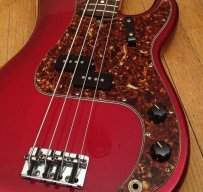
I had a Peavey Milestone II P bass as a guinea pig for various upgrade ideas. Stock pickup was swapped for a Bartolini P passive and it was a noticeable difference. But, surprisingly, what made a HUGE difference, was installing a .022uF version of K42Y2.
The tone got round and bouncy, steady mids and highs, smooth and deep lows and the general "3D" feel to it. If anybody's is considering a little tonal makeover - I recommend these caps.

!B8gqcq!!Wk~$(KGrHqN,!hUEyrvBoq1LBM3QFZwKGQ~~0_12.jpg
 
Yup. So far as their use in a bass goes, these are paper-in-snake-oil. They are +-10%, which beats the +-20% that I'll bet came in your Milestone. If there is an audible difference, you are probably hearing a difference in capacitance, and not the pretty green paper.
 
Of all the capacitor types out there, the only one I would not use is paper-in-oil. This is because over time, the oil dries out and the value of the capacitor drifts. If you want a good, relatively inexpensive capacitor that has a good reputation for reliability and consistency, I like Sprague Orange Drops. Others on the forum can give you other inexpensive, yet good quality, brands and models. What made the bass "bouncy" was using a lesser value, .022, the typical guitar value, which let more mids and articulation come through, especially when rolled off, compared to the typical .047. I get some of the same effect on my passive basses using a .033, and by contrast, also get rid of the "ice pick" treble on my passive guitars using the same capacitor in a guitar tone circuit.

Capacitance is capacitance. The only reason I would use an esoteric capacitor would be if there were a vintage or collectible reason. Yes, if I had a real '59 Les Paul, and one of its bumblebee caps went down, I would put in another expensive bumblebee cap; or if I had a real minty '59 P-bass I would look for a period correct cap, because the value of those two instruments with period correct components means substantially more money at resale. But for garden variety instruments, garden variety caps do just fine, even including Radio Shack for $0.99 for a pair of .01's .022's, .047's, or .1's. And you can always wire two of them together in parallel to get the next intermediate values, .033 and .068, if you can't get them singly, which you can in an Orange Drop.
 
the ugly truth is that not only does cap type not matter in a guitar, but within the normal range of tone caps, capacitance value doesn't matter either until you roll the tone pot below like "5"!

above that, you can literally use a bit of straight wire instead of a tone cap in the circuit and the tone pot will act and sound the same.