Is there any advantage to using a through the body bass neck as opposed to bolt on ? Asking for opinions. Thank you!

Enjoy the benefits of a premium membership!
Upgrade Account
-
TalkBass has been independent since 1998. Add your voice.
Create a free account to reply to discussions, view embedded media, and browse with fewer display ads.
Join free Log in
Want zero display ads or expanded classifieds tools? Compare plans.
You are using an out of date browser. It may not display this or other websites correctly.
You should upgrade or use an alternative browser.
You should upgrade or use an alternative browser.
Through the body neck versus bolt on.
- Thread starter Hairycary
- Start date
More options
Who Replied?

I’m going to stay away from the subjective sound differences of a bolt on vs thru body, and stick to more objective differences.
Bolt on neck is easier to repair and modify.
Especially if the heel is the same dimension of a Fender bass.
If the neck warps or cracks you can just remove 4 screws and replace.
Want to convert it to fretless just replace the neck.
Thru body is a more robust build but not as convenient as a bolt on neck.
Bolt on neck is easier to repair and modify.
Especially if the heel is the same dimension of a Fender bass.
If the neck warps or cracks you can just remove 4 screws and replace.
Want to convert it to fretless just replace the neck.
Thru body is a more robust build but not as convenient as a bolt on neck.

If you want benefits of extra neck reinforcement from a "whale hump" body design, or spend a lot of time in the upper part of the neck and find the neck heel joint gets in the way, a neck-through might be advantageous.
A neck-through allows for the potential of a more slender (front to back) bass body and more variety in body shapes because there's no more neck joint to worry about.
I couldn't find where I'd read it but Bruce Johnson's written in the Luthier's Corner about the tonal differences between neck-through and bolt-on and one advantage I recall is a neck-through can allow greater sustain and some differences in tone because there's a more rigid, massive connection of neck to body. My personal suspicion is that can depend a lot on wood and construction technique as well, but we're talking about how one specific factor affect something that's the product of many different factors. I'd trust Bruce not to speak his mind on it if he didn't have the experience to back it up though.
A neck-through allows for the potential of a more slender (front to back) bass body and more variety in body shapes because there's no more neck joint to worry about.
I couldn't find where I'd read it but Bruce Johnson's written in the Luthier's Corner about the tonal differences between neck-through and bolt-on and one advantage I recall is a neck-through can allow greater sustain and some differences in tone because there's a more rigid, massive connection of neck to body. My personal suspicion is that can depend a lot on wood and construction technique as well, but we're talking about how one specific factor affect something that's the product of many different factors. I'd trust Bruce not to speak his mind on it if he didn't have the experience to back it up though.



At a much younger age, I couldn't have cared less, kind of a "shut up and play" attitude. Then I developed a preference. Now and for the last 40 plus years I don't really care, so much so that I cannot say for certain which construction my current bass is.


My preference is bolt-on. I have one neck through and it's a nice bass but I like the possibilities that a removable neck allows. I had to shim one neck and right now I'm considering building a couple of different bodies to suit the necks I have.

If you search threads, there a a few thousand on this topic. I have experience playing both for a long time. I agree with @ardgedee above last paragraph. The Rickenbacker 4001/3 is an example of a neck-thru since 1960 that at one time attempted a set neck design only to revert back to neck-thru. Theres a yt video " brief history of Rickenbacker Bass" that at one point explains why the Ric Bass has its sound and one of those factors is the anchoring of the strings completely end to end in one consistent section of wood. I can tell you that my Ric and Pedulla neck-thru basses have this quality that my Fenders and other bolt ons do not. Also, note sustain is much longer. I dont play either type exclusively.
Last edited:

By robust are you referring to stability? The only two basses I've ever owned that had neck issues (ski jump and twisted neck respectively) were both neckthru, and higher end instruments at that. The luthier I brought them to said next time get a bolt-on, with a look in his eyes that suggested he's said this to a few warped neck(thru) customers.Thru body is a more robust build but not as convenient as a bolt on neck.
I always find it interesting how professional builders that have been in the business for decades like Dingwall and F Bass always have strong takes on this, sometimes even contradictory to one another. I recall reading somewhere that George Furlanetto focused exclusively on bolt-ons because they offered more sustain than the neckthrus he used to build.I couldn't find where I'd read it but Bruce Johnson's written in the Luthier's Corner about the tonal differences between neck-through and bolt-on and one advantage I recall is a neck-through can allow greater sustain and some differences in tone because there's a more rigid, massive connection of neck to body. My personal suspicion is that can depend a lot on wood and construction technique as well, but we're talking about how one specific factor affect something that's the product of many different factors. I'd trust Bruce not to speak his mind on it if he didn't have the experience to back it up though.
I meant to say Bruce believed bolt-ons have greater sustain. That's my error, whoops!I always find it interesting how professional builders that have been in the business for decades like Dingwall and F Bass always have strong takes on this, sometimes even contradictory to one another. I recall reading somewhere that George Furlanetto focused exclusively on bolt-ons because they offered more sustain than the neckthrus he used to build.


It's not really something I think about with basses. Im headlining my bedroom every night and my cats think my tone and sustain are awesome. Lol


Whatever the advantages or disadvantages, real or perceived, I've not bought or compared a bass solely or primarily on that question.Is there any advantage to using a through the body bass neck as opposed to bolt on ? Asking for opinions. Thank you!
That said, I have an old 1982 Ibanez Musician MC920 (tired long day) bass and its tone, punch and resonance and consistency of note is excellent. Whether that is due to the neck-through aspect or that it has ebony fingerboard, a 5-piece neck, walnut wings, weighs 35 pounds, been played for 40 years, or some combination of all of those factors having something, very little or everything to do with it also being neck-through, I'll never know and probably nobody else will either.
Buy the bass with the features you want that produces a sound you like. If it's bolt on, or glued-in or one piece neck, let that not be the singular decision point for purchase. Don't pass up a bass that checks most of the boxes for you, but has a bolt-on neck. But if you find a bass that does it for you and is also neck-through, just consider that feature an added bonus.
Good luck.

All that matters is, you like the bass.
Nothing is promised with either version regardless of what the ideas may be.
Nothing is promised with either version regardless of what the ideas may be.

In the Spector world, there is a definite difference between neck-thru & bolt-on models. My advice: try both and see what your ears tell you. One is not better than the other.
Keep in mind that EACH bass company is not going to sound consistent between neck-thru and bolt-on models. You cannot take information from one company and apply it to everyone else. For example, the Schecter neck-thru models sound nothing likely the Spector neck-thru models.
Keep in mind that EACH bass company is not going to sound consistent between neck-thru and bolt-on models. You cannot take information from one company and apply it to everyone else. For example, the Schecter neck-thru models sound nothing likely the Spector neck-thru models.
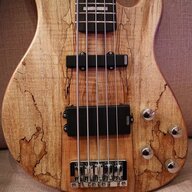
Great discussion here! I’ve played both neck-through and bolt-on basses, and each has its own vibe. Neck-throughs often have a smoother feel and more sustain, making them great for long, fluid lines. Bolt-ons, on the other hand, are easier to adjust or repair if needed.Is there any advantage to using a through the body bass neck as opposed to bolt on ? Asking for opinions. Thank you!
It really comes down to personal preference and what suits your playing style best.

Does the "whale hump" (never heard that term, but it is a good descriptor) actually improve stability? I had wondered this, but never heard anybody say one way or the other.If you want benefits of extra neck reinforcement from a "whale hump" body design, or spend a lot of time in the upper part of the neck and find the neck heel joint gets in the way, a neck-through might be advantageous.
A neck-through allows for the potential of a more slender (front to back) bass body and more variety in body shapes because there's no more neck joint to worry about.
I couldn't find where I'd read it but Bruce Johnson's written in the Luthier's Corner about the tonal differences between neck-through and bolt-on and one advantage I recall is a neck-through can allow greater sustain and some differences in tone because there's a more rigid, massive connection of neck to body. My personal suspicion is that can depend a lot on wood and construction technique as well, but we're talking about how one specific factor affect something that's the product of many different factors. I'd trust Bruce not to speak his mind on it if he didn't have the experience to back it up though.

For the most part, a given bass is available as one or the other. Many other characteristics of the bass to me are far more important than the neck type.
For example, if I were deciding between a Fender Jazz and a Rickenbacker 4003, the neck type wouldn't be part of the criteria I used to choose between the two.
For example, if I were deciding between a Fender Jazz and a Rickenbacker 4003, the neck type wouldn't be part of the criteria I used to choose between the two.
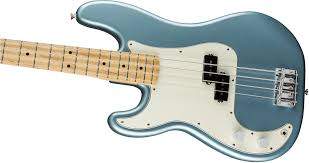

When I was just a lad and discovering the wonderful world of bass I concluded that basses were better as bolt-ons. Guitars were fine as either bolt-on (Fender et al) or set neck (Gibson et al). Basses just sounded better if they were bolt-on. Some years later I came to realize it was far more about pickups, strings, and electronics. I basically had P-bass, J-bass, EB-0, EB-3, and Ric 4001 for comparison. There is absolutely no way to judge one from the other based on neck attachment method alone. Even round wound strings were a pretty new-fangled notion! My fretless is a neck-thru. My go-to fretteds are bolt-on at the moment, and predominate, but I have set necks and neck-thrus as well, and they all make my ears happy!
BBB
BBB

Having owned both types, I can't say I've ever heard anything that makes me think the bolt/thru is sonically superior, or even identifiable. To be fair, I've never owned or played two basses which were identical except for the bolt/thru.
From a comfort perspective, I do like the thru when noodling up high where my hand contacts the join. However, several builders have nicely figured bolt joins.
From a comfort perspective, I do like the thru when noodling up high where my hand contacts the join. However, several builders have nicely figured bolt joins.


