• TalkBass has been independent since 1998. Add your voice.
    Create a free account to reply to discussions, view embedded media, and browse with fewer display ads.
    Join freeLog in
    Want zero display ads or expanded classifieds tools? Compare plans.

Double Bass Tourte Mute Torture

The error is not what your doing, but that IMO those mutes rarily work. or rather they dont do what you would expect them to unless you change your stroke to notice it. I used those rubber mutes for more years than i'll admit but i never heard a differecne when i played my bass but others have claimed to know the difference. on smaller instruments they work just not the bass. if you wanna hear a difference get an ebony mute.

And i am asuming your putting it on the bridge right,lol.
 
Don't know about the tourte-style mutes but I own the big rubber mute and also an ebony one.

The ebony one doesn't damp the sound so much but it is probably better for performance.

The rubber one is just a practice tool. It dampens the sound a lot. But the low (sub) tones still sound quite loud. So for late night practice it is not sufficient. I use a pillow under the endpin sometimes in combination with the rubber mute. But that still is not soft enough not to annoy my neighbors when they are sleeping.

I noticed a strange thing. After playing with the mute my bass sounds really different (more choked) when I take the mute of. After a while the normal sound comes back. Maybe it is psychological and my ears have to adjust again but I really think it sounds different. Does anyone has that same experience?
 
I noticed a strange thing. After playing with the mute my bass sounds really different (more choked) when I take the mute of. After a while the normal sound comes back. Maybe it is psychological and my ears have to adjust gain but I really think it sounds different. Does anyone has that same experience?

Most likely it's just psychological. A mute doesn't introduce anything that would adversely affect an instrument after it is removed. You won't see a difference like you would if you put your bass in a hot or very humid room all day.
 
I use a big rubber mute for practicing sometimes. It does mute and works real well for that purpose.
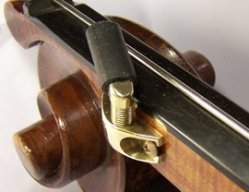
As far as my experience with the Tourte mute. I think that it makes very little difference, although as long as the whole section has it on at the right time, and the Conductor sees that you put it on and take it off at the right time, you're good.
those passages are normally p,pp, or ppp. people have been using that mute for a long time, and it might be more because of a certain kind of quality that changes about the sound, than the effect of actually muting.
In my opinion they are easy to use as opposed to the other choices, and also sometimes you'll go an entire season without ever needing one.
 
yes you are going nuts.

also, the tourte mutes work just fine. they make plenty difference to the listener, and i can hear a substantial difference from behind the bass as well. they cut some volume, but mainly they dampen the overtones and alter the color of the sound. i used to not hear the difference either, but now i hear a major difference. i'm surprised at how many people say they can't hear the difference.
 
... as long as the whole section has it on at the right time, and the Conductor sees that you put it on and take it off at the right time, you're good...

+1. You look unprofessional if you don't use it at the proper times. As far as sound, the acoustical effect is more pronounced on upscale basses. On a student plywood there may be no discernable difference.
 
yes you are going nuts.

also, the tourte mutes work just fine. they make plenty difference to the listener, and i can hear a substantial difference from behind the bass as well. they cut some volume, but mainly they dampen the overtones and alter the color of the sound. i used to not hear the difference either, but now i hear a major difference. i'm surprised at how many people say they can't hear the difference.

It's been my experience that the mute doesn't make the bass much quieter, but it does dampen some of the overtones. The effect is more pronounced when the entire string section of the orchestra has them on for a passage. If you're expecting to be able to practice quietly using a mute, you'll be disappointed.
 
I found the Tourte style doesn't do anything either. And it rattles around when not in use. The ebony ones are too noisy to use. There is always a clatter when it touches the bridge or stand and if you drop it it makes quite a noise!

I now use an Ultra practice mute. I took a hack saw and removed the end parts so it is just the middle three prongs. I used some sandpaper to round the edges. If you push it all the way down, it still acts as a practice mute. If you put about half way on, it has a nice muting effect on the bass's sound. Also, the rubber provides enough friction so you can place it on the edge of your stand and not worry about it sliding off or making a clatter when it touches the metal.
 
yes you are going nuts.

also, the tourte mutes work just fine. they make plenty difference to the listener, and i can hear a substantial difference from behind the bass as well. they cut some volume, but mainly they dampen the overtones and alter the color of the sound. i used to not hear the difference either, but now i hear a major difference. i'm surprised at how many people say they can't hear the difference.

I agree with Square Bear. The main affect that a tourte mute has is on the overtones. It works best with thinner bridges. I also think that if your playing is at a level where you can bring out a lot of overtones then a mute will make more of a difference.

An interesting side note: The Vienna Philharmonic bass section doesn't use mutes. At least note tourte mutes. I think if they absolutely need to use a mute they'll use an ebony mute or something along those lines.
 
The term mute for these things is a bit of a misnomer because it makes you think of something much, much quieter, which is not the point of these mutes (aside from the aforementioned Practice mutes, which is little more than a reformed hockey puck ;) ).
These mutes do exactly what Square Bear was saying, which is to dampen some of the overtones in the series, creating a mellower sound that is slightly quieter. Ebony mutes, and Tourte mutes also tend to create a different "mute" sound, because they dampen different harmonics in the series. When they're called for in music, it's usually for the colour change (bass solo in Lt. Kije Suite), not necessarily for volume, though the effect does work better when you play p, pp, or ppp.

regards,

Alex
 
I agree Les Fret my bass sounds different after having mute on to. but its not a choked sound. i like it. I have to tested out that theory on quality of basses and the rubber tourte vs ebony. ebony sounds better to me. but as stated, conducters just wanna see you doing it. I did have one experience though when the principal told everybody in the section that those things(rubber) dont work and we needed to get real mutes. I got 3 on ebay that all were great and provided different sounds.
 
The Tourte is quite a standard piece of hardware that I have been using for several years. It's mass (albeit not much) dampens a spectrum of vibrations on the bridge. A practice mute (mine looks like a giant rubber comb) has much more mass and therefore less vibration is transferred to the belly of the instrument. The Tourte does work. Perhaps you are hoping to get the same results as you would with a practice mute.

Remember: the Tourte is only supposed to take some of the brightness out of the tone where the practice mute is meant to drastically reduce volume in settings where you just don't want to be heard all that much.