• TalkBass has been independent since 1998. Add your voice.
    Create a free account to reply to discussions, view embedded media, and browse with fewer display ads.
    Join freeLog in
    Want zero display ads or expanded classifieds tools? Compare plans.

tru-oil help please!

I use a lot of Tru-Oil myself (On Wishbassess/Wishnevsky axes) but have switched to the aerosol spray form. I like to apply 2 or more coats and then sand back, but never with anything rougher than 600 grit or 800 grit. (I haven't tried the 0000 steel wool actually) After I've applied several coats I only use micro sanding pads and they start at about 1300 grit. I also use denatured alcohol to wipe down the surface after any sanding. The closer I get to my final coats, the finer the sanding pad. Since T-O does not burn into itself, one must exercise caution in the sanding so using finer grits is key. I also make sure that the bass has been sanded out to at least 600 grit before even applying my first coat of sealer. I have read that it is recommended to use 800 grit before your first finish coat, unlike a lacquer finish but that may be excessive. For drying times, sometimes I will let a coat cure for 24 - 48 hours before proceeding, but that is after about coat 7 or 8. After the final coat, a 15 day (or more) cure window is my preference and then polish & wax.

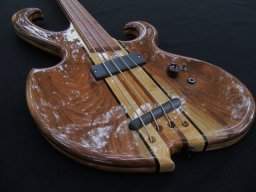
Here's some photos of some of Steve's basses I refinished, all of which had at least a dozen coats. It's hard to keep exact track of all the coats, but about 12 - 15 gives me these results.

IMG_3290_zps477519e9.jpg

Wishnevsky MandoBass (one of four built) ...
IMG_9192.jpg

Wishbass Peanut #903 ...
IMG_0096.jpg

Wishbass J-K Lobe #1180 ...
IMG_1270.jpg

Wishbass Stude #1291 ...

I apologize for the excessive glare in these photos - I haven't yet figured out how to tone that down! Three of these photos were taken outside, right at dusk, on a black cloth. (I did not grain fill these basses either.) They are all untouched.
 
See that's why I was putting on a coat then sanding with 1000 putting on a coat sanding with 1000.....I figured any if the imperfections would get trapped under the layers and wouldn't be able to sand out. I think that's where my problem was. I wasn't putting on enough and sanding it all off pretty much to make it perfectly smooth with no scratches. I only had the problem once the layers started building up to the gloss level.

I am getting some scrap different woods from a guitar maker I know and going to practice. I bought another bottle for practice. After sanding the wood to 800 I am going to try putting on a few coats them sand it down.
 
Some of it may depend on the humidity levels in your area too. I know for me, sometimes it's better if I give it more drying time for the coats I will be sanding on. In other words, instead of applying twice a day, I wait 24 to 48 hours as I mentioned earlier, then sand, wipe clean and re-coat. It's important to fill any sanding micro grooves and usually one coat won't quite do it, so two or maybe even three come into play. Mostly what I fight in the later coats is dust particles and since I am spraying; sags/runs.
 
Yeah I kept it in a very warm dry place and the coats were drying in 6-8 hours. You could tell if you sanded early....little hard specs of TO would break off and scratch it....but after 7 hours or so that didn't happen.
Now it's summer here and very humid usually so I will probably only be able to do 2 coats a day if I am lucky.
 
I finally have truoil figured out. For anyone who doesn't know this answer. Keep putting on coats and build it up sand or wool every 3 coats or so. I was sanding it all off every coat. Even if there's streaks and you put it on with papertowel it doesn't matter. When there's enough coats on lightly sand with 1500 then polish kinda hard with mcquires scratch x and it comes out looking like glass! I practiced on a piece of ash and mahogany. Now I am doing a Birdseye board just for the heck of it. I will post a pic when it dries and I polish.
 
Danish oil I am pretty sure just makes like a shiny satin finish. Where the truoil effect we were going for here was building up layers to make a gloss like you just sprayed lacquer on it. Tru oil. Also when dry has this really thin hard as a rock feeling that makes necks really fast.

Truoil has driers in it so thin coats dry in like a couple hours. Danish oil you need 24 hour between coats. But you can't really build up a super high gloss so you only do like a week worth or coats. And it's a satin protected finish.

Truoil is cheap enough on eBay it's like $10 a bottle. There's no gun stores in MA to buy that stuff! Even our Walmart doesn't sell guns! I had to get mine on eBay.
 
Just because a product has the word "oil" in it does not mean it will be like something else that also uses the word. Basically, Tru-Oil (& Tung oil) lay on TOP of your wood and can be built up in thickness as you apply more and more of it. Danish oil and other true oils, are absorbed INTO the wood and cannot build in thickness - they can only reach a certain saturation point before it doesn't make sense to apply any more. Typically, you use a finish that can be built up on top of the surface (such as lacquer, Tru-Oil, poly, etc) for bodies and necks while fret and finger boards receive an actual oil (lemon, mineral, etc) that will be absorbed into the wood, and not lay on top of it.