
Enjoy the benefits of a premium membership!
Upgrade Account
-
TalkBass has been independent since 1998. Add your voice.
Create a free account to reply to discussions, view embedded media, and browse with fewer display ads.
Join free Log in
Want zero display ads or expanded classifieds tools? Compare plans.
You are using an out of date browser. It may not display this or other websites correctly.
You should upgrade or use an alternative browser.
You should upgrade or use an alternative browser.
true bypass?
- Thread starter slaphappychappy
- Start date
More options
Who Replied?
'True bypass' means that when you turn a pedal off, your signal no longer goes through any active electronics - it goes straight from the input, through the on/off switch, and out to the output.
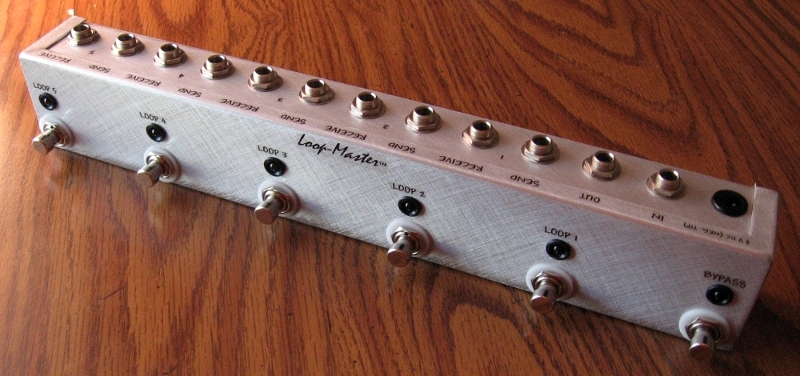
If you want to bypass several effects with one pedal, you want a 'bypass looper'
If you want to bypass several effects with one pedal, you want a 'bypass looper'

Whenever questions of TBP comes up I always like to link this Stinkfoot article.
True bypass?
True Bypass is just a method of switching and it can generate some hype,...but like other bypass types,...it has it's pros and cons.
True bypass myths debunked
If you wanna bypass all you pedals all together you'll need; as Kevtop says a bypass looper,...which can be composed of TBP switches.
True bypass?
True Bypass is just a method of switching and it can generate some hype,...but like other bypass types,...it has it's pros and cons.
True bypass myths debunked
If you wanna bypass all you pedals all together you'll need; as Kevtop says a bypass looper,...which can be composed of TBP switches.
Okay. So I could probably make one if I wanted. I want a simplified version that is one pedal. Hit switch, signal goes thru effects, hit it again, goes around it. Hmmmm....
Okay. So I could probably make one if I wanted. I want a simplified version that is one pedal. Hit switch, signal goes thru effects, hit it again, goes around it. Hmmmm....
I suppose you COULD make one, or you could just buy one of these:
Radial BigShot EFX true bypass effects loop switcher
I have one of these, very handy--as with all things Radial, excellent quality, mega bang-for-buck.
Okay. 2 Stomp boxes. 1 With 1 input and 2 outputs. The other with 2 inputs and one output.
Guitar plugs into first box with switch that will go either to a bypass lead or through the effects loop. The other box has both plugged in, and one output to the amp.
Why does this seem too easy??
What am I missing?
Guitar plugs into first box with switch that will go either to a bypass lead or through the effects loop. The other box has both plugged in, and one output to the amp.
Why does this seem too easy??
What am I missing?

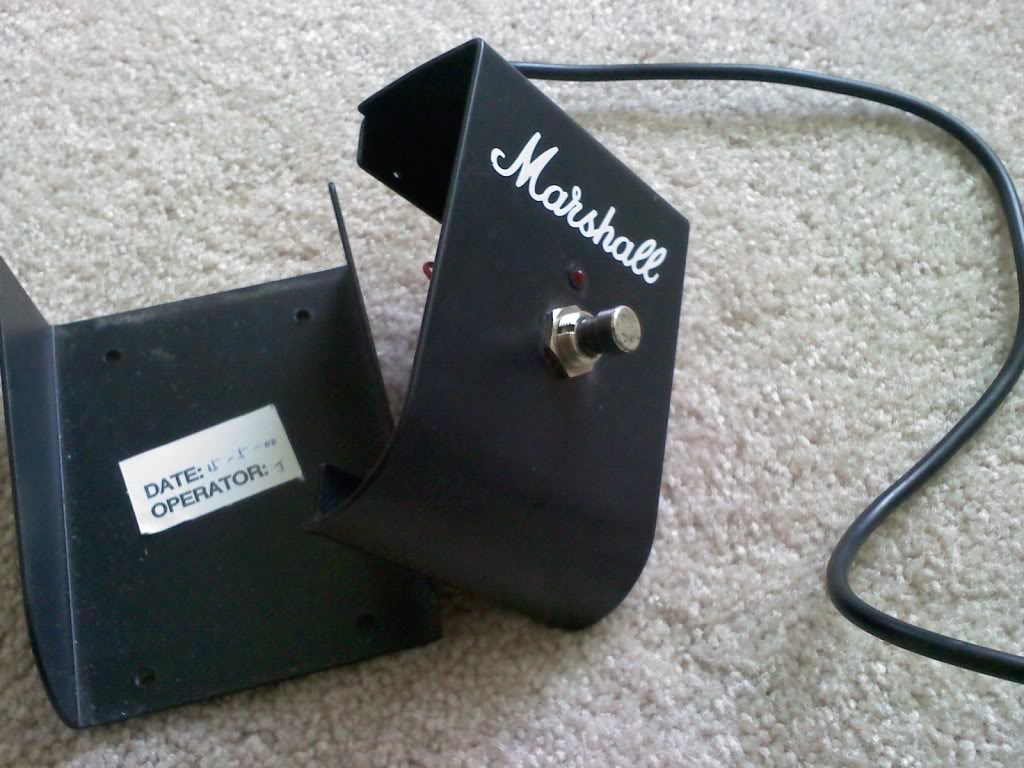
Funny that you ask about this. I'm actually almost done making a two-looper out of an old Marshall amp's distortion footswitch. I've never owned a proper guitar amp, so I'm really not sure where I got it.
It's not quite done. Still gotta wire it up, and by golly those buttons sure are close together. I'm going to move one the one in the center to the left as soon as I figure a way to plug the hole from the original design:
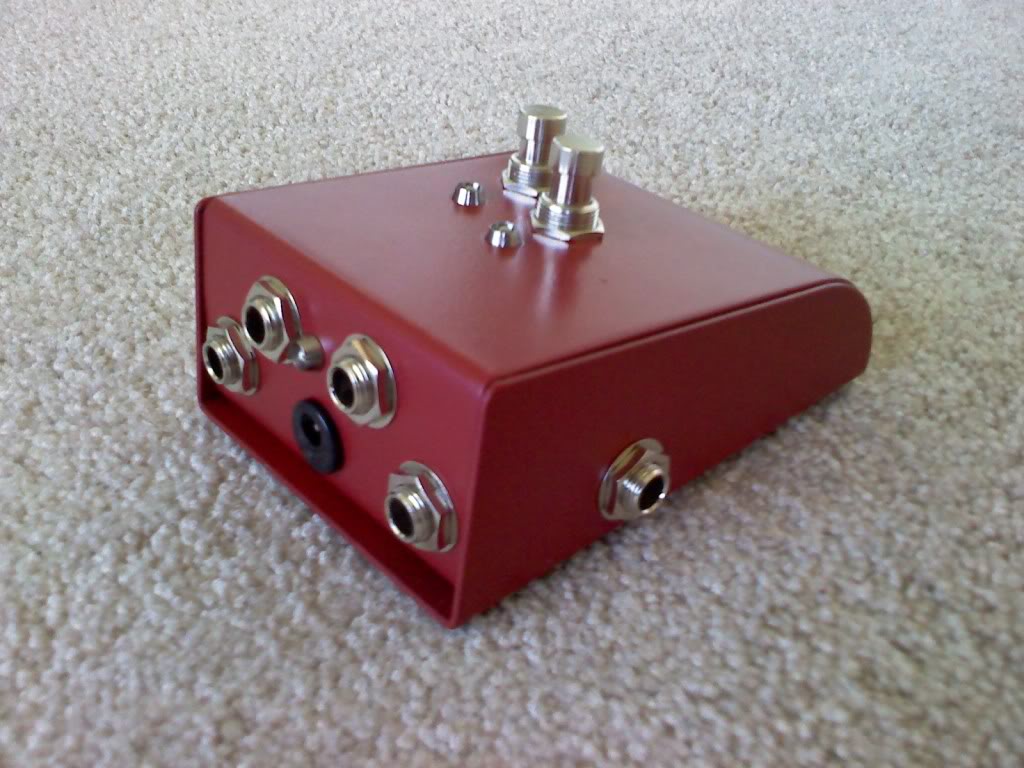
It's based off of this design, modified to omit the tuner-out and third loop:Invalid Link Removed
It's not quite done. Still gotta wire it up, and by golly those buttons sure are close together. I'm going to move one the one in the center to the left as soon as I figure a way to plug the hole from the original design:
It's based off of this design, modified to omit the tuner-out and third loop:Invalid Link Removed
The power is only for the lights - has nothing to do with the instrument signal. It'll function without being plugged in. The main difference (LEDs and electrical circuitry accounted for) would be in having a 3PDT switch instead of a DPDT, to have the LEDs switch on/off with the loop.
I thought about making a non-lit looper and leaving out the 9VDC parts of the circuitry, but then figured hey, why not. Go for it.
I thought about making a non-lit looper and leaving out the 9VDC parts of the circuitry, but then figured hey, why not. Go for it.
I like the red. I looked at 2 ways. The second using one box, on switch and changing where the positive signal went. The only thing I think may be a problem is if any of the pedals are noisy . Cos I was gonna wire the switch so that one way, it sent the signal straight to the output, then when I press the button, it sends it thru the effects loop first.
This would mean the output on the effects loop is wired constantly to the output, but if it doesn't hum, or buzz, shouldn't be an issue. See, it sounds too simple.
This would mean the output on the effects loop is wired constantly to the output, but if it doesn't hum, or buzz, shouldn't be an issue. See, it sounds too simple.
That's the whole point of the 3/DPDT switches, is to completely remove the loop from the signal path.
Oh and the red is available at Home Depot. Forgot the name of it. Amp's done in the same color: http://www.talkbass.com/forum/f15/little-paint-your-cabinets-goes-loooong-way-pics-779169/
Oh and the red is available at Home Depot. Forgot the name of it. Amp's done in the same color: http://www.talkbass.com/forum/f15/little-paint-your-cabinets-goes-loooong-way-pics-779169/
Hey, I got that from Google. There are plenty out there. Look around first! There are a few good websites (it was a few months ago when I was researching this, so I can't cite any right now) that have the entire process and a few different ideas documented pretty well.
Stores? Meh. I bought online. Invalid Link Removed Whoa man - it looks like they've got all the parts you'll need! Funny how that works. Good customer service, too!
I don't mean to sound sarcastic. I'm working on nights right now and totally over it. Enjoy!
Stores? Meh. I bought online. Invalid Link Removed Whoa man - it looks like they've got all the parts you'll need! Funny how that works. Good customer service, too!
I don't mean to sound sarcastic. I'm working on nights right now and totally over it. Enjoy!
I don't think 'true bypass' is suitable for bypassing all your pedals. If you've got a 15/20ft cable going to your pedals and another 15/20ft cable going to the amp, you are going to notice your signal degrades over that length of cable when you've got nothing in the middle to push the signal along.
The only pedal in my signal path full-time is a looper with high quality buffers in it, and it sounds way better than it did when I used a true-bypass loop for the same job.
So yeah, just be aware that this solution might not be as ideal as it looks.
The only pedal in my signal path full-time is a looper with high quality buffers in it, and it sounds way better than it did when I used a true-bypass loop for the same job.
So yeah, just be aware that this solution might not be as ideal as it looks.
Hmmm. Might consider a volume control, and maybe a signal booster for each channel. This sounds like it'll be interesting.


