• TalkBass has been independent since 1998. Add your voice.
    Create a free account to reply to discussions, view embedded media, and browse with fewer display ads.
    Join freeLog in
    Want zero display ads or expanded classifieds tools? Compare plans.

Tuning by ear or using a tuner?

Every time I pick up my guitar, bass, or mandolin, I check it against a high quality Seiko Chromatic tuner. If it's not perfect, I make it perfect before I play.

If you practice out of tune, even by a few cents, your ear will get used to hearing mud. You may be out of tune on stage and never know it because your ear is saying it sounds right to you.

Okay, so I don't do it *every* time, but I have done it for so long now that if I pick up my guitar and it the slightest bit out of tune, it drives me nuts until I put it down.

 
I use a tuner. I learn most of my parts by ear, so I really don't think I need the additional 'practice'. But then I've been doing this for 35 years. When I started I had tuning fork (A=440) and touched that to my pickup pole... worked fine.

As many people pointed out, often times the tuning has to happen when the drummer is doing something, and guitar is messing around, horns are warming up and the keyboard player is hollering about the set list.... etc etc. A tuner is part of a 'well dressed bass players kit'.

The other point is, sometimes you need to tune when you can't make any sounds.... like some jerk actor makes his way through the pit and bangs into your headstock moving all the pegs and you have to get back to pitch without distracting the emotion on stage. Church offers other examples of silent tuning.

And.... tuners don't cost that much.
 
I tune by ear when at home, or at practice.

I always use a tuner to fine tune before a gig due to ambient noise, but i've usually tuned it up at home first.

My rick rarely goes out of tune by much, as it has its own hard case. However, I have to tune my back-up bass every time I get it out of the gig bag. 12th fret harmonics
 
Noone I've ever played with that used a tuner was ever any more in tune than anyone that didn't.

In fact, usually the tuner guys go out of tune faster as the song progresses and stay further out of tune for a longer time....

As for me, I can get my basses as close as a tuner by ear, tho it takes a little more concentration.

On the rare occasions that I try to play my guitar I every once in a while wish I had one but never enough to spend the money on one. I use a non-standard tuning on my guitar anyway so I can tune it with harmonics as well.

I do think a tuner can get you out of the habit of listening to your intonation. Like I said the guys I've played with that rely on them usually are less able to tell they're out than the guys who don't....

LS
 
As mentioned above, a tuner should be a stock part of any musician's kit. I find it extremely annoying and unprofessional to hear live players up on a stage tuning by ear. And it's often impratical (guitarist, drummer, house music, etc. interference)

I've also found, with every bass I have ever owned, that once in tune, it stays that way through the whole gig, practice, jam, whatever. YMMV.
 
Call me crazy but I've never owned a tuner and I've been at this for 18 or 19 years. I've used a tuner a handful of times but always seem to rely on my ears. Different strokes for different folks. If an entire orchestra can tune by ear then I guess I can too.

But I do see the advantages of being able to tune up without making any noise during a gig. That's when a tuner really shines but my ears have not failed me yet for those quick tune-ups when the singer bumps my headstock.
 
I learned to tune by ear in orchestra.
When I started playing BG the used bass came with an 'A' tuning fork, so I started using that.
Then in cover bands started using a tuner because the rest of the band used one.
Usually would tune by ear off of the guitar player's note though.

When I got back into playing fretless BG really started paying attention to intonation and still work on it a lot.
Playing jazz in funky little bars with out of tune pianos I just tune to the piano (obviously)

+1 for tuning the 'A' string first.
Now I tune to fourths and fifths with open strings. You can hear the "wow" of out of tune freqs pretty well. Allows me to tune to the true notes of the open strings. Only been doing it this way for a few months, but seems to work well.

I still have a Sabine STX-1100. Hardly ever pull it out of the bag anymore, but it's there if need be :)
 
I learned to tune by ear with a tuning fork, but I *always* use a tuner now.

One, because I played in a lot of country bands. *All* country guitarists think they can tune by ear, almost none can :rollno:

Two, in a live situation as soon as you start tuning up, the guitarist considers that a good time to warm up with loud and fast riffs. A tuner lets you tune up at any time, even if you can't hear yourself well.

Three, my tuner has a mute. I can tune up silently. Although to be honest, I like to hear the notes as a double check.

Three very good reasons. Mostly number three for me. I tune between songs even though I don't have to. I can tune by ear, but there's little point to it when I'm performing. The tuner is at least as accurate and no one else needs to hear me doing it.

If you practice out of tune, even by a few cents, your ear will get used to hearing mud. You may be out of tune on stage and never know it because your ear is saying it sounds right to you.

When I'm setting a kid up to learn an instrument I always suggest a tuner: "An out of tune instrument doesn't reward you for being right." Ear training is better accomplished with an in tune instrument.

KO
 
As for me, I can get my basses as close as a tuner by ear, tho it takes a little more concentration.

You can get within 0.1 cent, by ear? :eyebrow:

I realize you are probably talking about the more common tuners that are only accurate to 1 cent. Heck, the TU-2 I use is only accurate to 3 cents.

But I am still impressed. I don't know anybody who could be accurate to 1 cent... although I know it is within the realm of possibility. Not sure I would want to be that accurate though, must drive you crazy in a band situation. Or are you able to turn it on/off? You mentioned you have to concentrate to get that close.
 
You can get within 0.1 cent, by ear? :eyebrow:

I realize you are probably talking about the more common tuners that are only accurate to 1 cent. Heck, the TU-2 I use is only accurate to 3 cents.

But I am still impressed. I don't know anybody who could be accurate to 1 cent... although I know it is within the realm of possibility. Not sure I would want to be that accurate though, must drive you crazy in a band situation. Or are you able to turn it on/off? You mentioned you have to concentrate to get that close.


it's not that difficult really. concentrate on the wave. that's it. the faster the wave, the farther out you are, the slower the wave the closer you are. no wave, in tune.
 
You can get within 0.1 cent, by ear? :eyebrow:

I realize you are probably talking about the more common tuners that are only accurate to 1 cent. Heck, the TU-2 I use is only accurate to 3 cents.

But I am still impressed. I don't know anybody who could be accurate to 1 cent... although I know it is within the realm of possibility. Not sure I would want to be that accurate though, must drive you crazy in a band situation. Or are you able to turn it on/off? You mentioned you have to concentrate to get that close.

That's an excellent point. If you claim you tune by ear alone and rationalize that it keeps your intonation sharp how can you be certain your ear is dead on?
 
it's not that difficult really. concentrate on the wave. that's it. the faster the wave, the farther out you are, the slower the wave the closer you are. no wave, in tune.

You can't get to 1 cent just using waves. They are too far apart at bass frequencies.

Try tuning, then use an accurate tuner (at least 1 cent). You might get one or two strings just by luck, but I bet you won't get all four within one cent.


Ok.... I admit in advance this is rigged ;) The best anybody can do is 1 cent. The average person would probably only detect to within half a semitone, or about 25 cents. But let's say you are accurate to 1 cent.

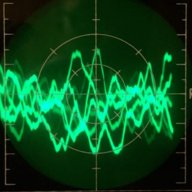
You tune the first string, and are within one cent. The next string will be within one cent off the first, which could be one cent off. By the fourth string... even if you have basically "perfect" hearing... you can be off by four cents.

Where lowly old me with my TU-2 is only 3 cents off ;)


And I realize this is all theoretical. Like I said... I doubt 90% can hear with 10 cents... so four cents is very good.

P.S. If anybody has some accurate numbers on hearing accuracy.... I would *love* to see them.
 
Lately I use a rack tuner always. But i can and will use my ears as often as possible. I learned speed tuning working in a major music chain very long ago. There were no tuners available, beyond pitch pipes and tuning forks. ( I still keep my A-440 AFM certified fork in my tool kit.) When i was a salesman? I needed to hand the customer a tuned and playable instrument. We kept them hung on the wall at the ceiling level. Went up a ladder and down with the instrument, and it had to be tuned when it reached the floor. They were'n t always in perfect pitch, but you could chord them or play runs with confidence. And the experiance stuck. As a side note? Early in the evening I can tune dead on, after a few hours though my accuracy falls off, ear wear?
 
it's definitely worth it to learn to tune by ear. I don't know all the specific cent-skills that i've got, but I find that I can tune my bass entirely by ear and be within a few [3-4] cents on each string when i check it with a tuner. it helps to check the strings against all the others, instead of just the adjacent ones too.

My cello teachers back when had me memorize the sound of a perfectly in tune A...it irritated me at the time but I like being able to tune completely on my own, for most situations. i'm sort of a luddite sometimes.

having a tuner is indispensable however, since silent tuning is helpful, if not necessary at times. but you can get by by putting your ear right next to the string.
 
I don't mind that much hearing people tune at gigs as long as they are moderately efficient at it. Whenever I see an orchestra play, everyone hears the ensemble tune - I kind of like that ritual. You hear the whole cacophony of the orchestra warming up as the audience takes their seats, then the concertmaster comes out to applause and the oboe plays the A. It's almost like a cleansing tone that focuses everyones ear and prepares them for music.

Maybe I'll try something like that with my rock band sometime. Just playing a drone A on an electric tanpura or something for a bit before we start, take the stage and slowly tune out instruments to the drone, fade out the drone and start rocking!