• TalkBass has been independent since 1998. Add your voice.
    Create a free account to reply to discussions, view embedded media, and browse with fewer display ads.
    Join freeLog in
    Want zero display ads or expanded classifieds tools? Compare plans.

Tuning you bass in thirds?

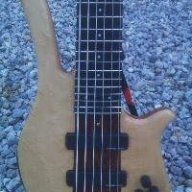
As an experiment I tuned my bass in major thirds. Tuning from low to high is Bb D F# Bb (normally this bass is tuned in tenor tuning).
Was quite hard at first first because the distances are so close. But eventually got the hang of it and it became fun.
I also tuned in tritones and fifths and other alternative tunings before.

What do you think, is tuning in thirds a good idea or not? Does it inspire you? Or maybe you think it's of no use?
Anyone tried it here and what are your findings? Maybe other ideas for alternate tunings?
Any input is welcome. Thanks, Barend

 
Last edited:
I know a guy who tunes in flat 5's - D Ab D Ab - it doesn't work of rme but that's how he learned. Reading this I'm reminded of an old 5-string bass tuning from the late 19th - early 20th century orchestras which was E A D F# A. My guess is that with the tuning you are experimenting with, music would need to be written around the instrument. I wouldn't be able to show up to a gig or jam session with it. Then again, I don't know if I could fit a tenor bass into most situations, either.
 
As an experiment I tuned my bass in major thirds. Tuning from low to high is Bb D F# Bb (normally this bass is tuned in tenor tuning).
Was quite hard at first first because the distances are so close. But eventually got the hang of it and it became fun.
I also tuned in tritones and fifths and other alternative tunings before.

What do you think, is tuning in thirds a good idea or not? Does it inspire you? Or maybe you think it's of no use?
Anyone tried it here and what are your findings? Maybe other ideas for alternate tunings?
Any input is welcome. Thanks, Barend


Nice URGE bass :bassist:.
 
  • Love
Reactions: Les Fret
It would probably inspire me. Speaking of tuning in tritones, there is a really cool Swiss band called Sonar, where the bassist and both guitarists are tuned in tri-tones. C F# C F#. Very Crimson inspired music.

I talked to the bassist when they toured and he mentioned that it took him almost two years before he felt really comfortable doing any kind of soloing/improvising in this tuning. He is also the proud owner of the eighth Warwick bass ever made, and takes very good care of it, ha.

 
For some reason I am never really motivated to explore altered bass tunings outside of tuning up or down in variations of standard tuning or dropped tunings (e.g. Drop D), although I enjoy the work of players like Michael Manring and Zander Zon who change up their tunings practically song by song.

On guitar I sometimes experiment with open tunings, and I also have come to enjoy tuning the guitar in all fourths (i.e. removing the "glitch" at the B and high E strings).
 
  • Like
Reactions: Les Fret
is tuning in thirds a good idea or not?
depends: good for what? Good for exploration, sure. Good for a gig? no

Does it inspire you?
Not much

Or maybe you think it's of no use?
See first answer

Anyone tried it here and what are your findings?
I'm going on 30 years in standard tuning. *every* alternate tuning I have ever tried has lasted less than a day.
I cannot make my musical intentions come out nearly as fluidly when that stuff changes.
It doesn't "make some things easier" for me, It just makes everything fight my hard earned intuitive understanding.

Maybe other ideas for alternate tunings?
Jacob Colliers approach to his 5 string guitar tuning has a logic to it that can appreciate
I tried it an found interesting, but still went back to standard in less than a day.
 
Interesting!

I've always been intrigued by 5ths, like a cello. Not sure why I haven't tried it yet :) I wonder how the Bach Cello Suites will fall under the fingers if tuned in 5ths!
The cello suites would play much easier, especially in 1st position and played in whatever key that is on your 5ths bass. Most rock is blues-scale based so it doesn't translate well on a cello. Power cords are all just one finger barred, like drop-D, so metal is natural.
 
  • Like
Reactions: Les Fret
Strikes me that tuning in thirds provides an excuse for more strings, as a 7 string only covers 2 octaves from the lowest open string to the highest. Tuning in a minor third provides even more of an excuse. The logical question is, of course, why not a bass where every half step up is....the next string?

I play 5 string, 22 fret instruments. 23 notes possible per string means there are 115 places you can play a note - far more than a piano, which usually have 88 keys. Yet, there are only 43 actual notes I can play, and seldom going above the 15th fret, that means I only regularly play 36 notes - essentially 3 octaves. The tighter you tune a bass, the more overlapped/duplicated the thing becomes. I already have 2 notes I can play in 5 places....
 
I can see some value in 5ths if you are playing cello lines but no reason to tune in 3rds. I cannot think of any music that progresses in 3rds, though I like to play scales in intervals of 3rds, just for practice, or for fills. Plus don't forget major 3rds are essentially sharp when played on a fretted instrument. Tritones are useful for chromatic movement and very easy to play when tuned to 4ths, so I see no value in tuning to that.

Patitucci talks about how bored he would get when someone wanted to go diminished, and the bored look the drummer would give him if he suggested it. Alternate scales like many psychoactive substances are best if consumed in small quantities.

I think alternative tunings, unless you are talking about tuning down to B, make little sense on bass. They make more sense on guitar and even more sense if you are tuning to an exotic scale, like Fripp used to do with KC.

But that's just me....the more I learn the less I know. You do you.
 
I've experimented over the years with fifths tuning (on 4- and 5-string) and Orkney tuning (on 6-string bass). They are good for working on originals and open up more possibilities for new ideas based on the different range of notes available in any position (especially harmonics). The con is if you are used to standard tuning (as most of us are), it takes quite a while to get good at being "fluent" at improvising (without hitting a boatload of clams). :laugh:

I sometimes still just alter either low or high string of a 6-string bass to CEADGC or BEADGB. This is probably the easiest way to experiment as it keeps the middle strings same as a standard 4-string. In case anyone is wondering "why" - I've found tuning low-B up to C gives tighter, more defined notes (due to slightly higher tension). Tuning high-C down to B gives you easy major-3rd chords and harmonics on the higher strings.

Altered tunings can really work well for solo bass - Michael Manring is a jedi master at this!
 
  • Like
Reactions: Les Fret
It would probably inspire me. Speaking of tuning in tritones, there is a really cool Swiss band called Sonar, where the bassist and both guitarists are tuned in tri-tones. C F# C F#. Very Crimson inspired music.

I talked to the bassist when they toured and he mentioned that it took him almost two years before he felt really comfortable doing any kind of soloing/improvising in this tuning. He is also the proud owner of the eighth Warwick bass ever made, and takes very good care of it, ha.


I’m loving this!

I couldn’t put my finger on what they remind me of… then at 5:46 I hear it… Mahavishnu Orchestra’s “meeting of the spirits”

Going to dive into this band!