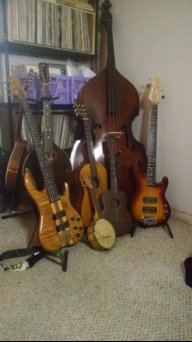
I just bought my first adjustable one, built into my Broughton Messenger Jr., which is proving to be a champ as a one-box solution for ampless gigs. When I dialed it in at home I was shocked by how much subharmonic content the raw bass had vs. the hpf set at 40 or 50. Now, that raw bass sounds amazing through an amp playing reggae gigs, not so much at my ampless theatre gig going through EAW subs. When I started using the Messenger Jr. in the theater, the sound guy complemented me. He may have already applied an hpf on the mains, but bleed from the monitors is unavoidable in this venue, and the sound from them seemed to tighten up considerably with the application of the filter. I also applied a mild cut at the Mjr’s fixed bass frequency of 80 hz. I don’t think I would like the hpf set that high, but I might try it.

Enjoy the benefits of a premium membership!
Upgrade Account
-
TalkBass has been independent since 1998. Add your voice.
Create a free account to reply to discussions, view embedded media, and browse with fewer display ads.
Join free Log in
Want zero display ads or expanded classifieds tools? Compare plans.
You are using an out of date browser. It may not display this or other websites correctly.
You should upgrade or use an alternative browser.
You should upgrade or use an alternative browser.
Two questions about High-Pass Filters
- Thread starter Ralph124C41
- Start date
More options
Who Replied?
edwinhurwitz
Supporting Member
I just wanted to note that the HPF I use is the Thumpinator. One thing I like about it is that it seems to introduce less phase shift than other designs. I don't mind that it's fixed.
The Genzler Kinetix also has a HPF that is adjustable with the lean/fat/thick switch, although it's not very flexible as it's coupled with other EQ adjustments that get made with the position of the switch. However, despite that, it's great amp that allows a lot of control over the low end.
The Genzler Kinetix also has a HPF that is adjustable with the lean/fat/thick switch, although it's not very flexible as it's coupled with other EQ adjustments that get made with the position of the switch. However, despite that, it's great amp that allows a lot of control over the low end.

How are you measuring and comparing the phase shift of other designs to the Thumpinator (presumably the microThumpinator as Max doesn't typically produce the full size Thumpinator anymore, at least last I checked)?I just wanted to note that the HPF I use is the Thumpinator. One thing I like about it is that it seems to introduce less phase shift than other designs. I don't mind that it's fixed.
edwinhurwitz
Supporting Member
I haven't measure them, but the low end seems less smeared compared to other HPFs. Admittedly, it's a small sample. YMMV.How are you measuring and comparing the phase shift of other designs to the Thumpinator (presumably the microThumpinator as Max doesn't typically produce the full size Thumpinator anymore, at least last I checked)?
YMMV indeed. I've owned many HPFs and have never noticed any of the typical phase anomalies that occur with pedals, most notably because an HPF, by its very nature, removes the portion of your signal's bandwidth that reveals destructive phase relationships most effectively. An analog HPF is doing nothing to the time domain aspect of phase (speed of light differences notwithstanding), and the frequency domain aspect is why one is employed in the first place which would be consistent regardless of which model is being used. I suspect any "smearing" you're hearing is related to something other than phase.I haven't measure them, but the low end seems less smeared compared to other HPFs. Admittedly, it's a small sample. YMMV.
Last edited:

Never noticed any phase issues or low end smearing (?) with neither Broughton BBE nor Broughton HPF. I had a Thumpinator but it didn’t quite do it for me. I wanted a variable HPF at the end of the chain. I also prefer BBE to Thumpinator at the start of my chain because it gives me a volume control for as much boost as I’d want and need, plus it gets rid of subsonic and ultrasonic frequencies. Zero unwanted effects from these 2 pedals.

I also have 2 HPFs, currently both towards the end of my chain (Broughton HPF/LPF and the Genzler Magellan Pre-DI) -- stacking them gives a very steep roll-off (in my case 36 dB/octave, which I like). Never noticed any phase issues. They don't impart any magic in and of themselves, but they make the bass controls on my EQ much more usable.
I'll make a second comment here:
For me, the HPF is my cheat code for a venue. EQ never changes much nor the 'floor' tone for my amp settings. Assuming that I am not using FOH (FOH guy will run this himself), if the bass sound is boomy or muddy in the room, I start turning up the HPF until get gets cleaner. In genreal I baseline the HPF at 30hz as that covers the low-B, starts going up from there. 60hz seems to be the sweet spot for a lot of smaller indoor venues
For me, the HPF is my cheat code for a venue. EQ never changes much nor the 'floor' tone for my amp settings. Assuming that I am not using FOH (FOH guy will run this himself), if the bass sound is boomy or muddy in the room, I start turning up the HPF until get gets cleaner. In genreal I baseline the HPF at 30hz as that covers the low-B, starts going up from there. 60hz seems to be the sweet spot for a lot of smaller indoor venues

All I can do is laugh at this post. Someone else may have the patience...I don't. Hope you find your answers.
I believe I should explain my response.
For several years, I have found this forum to be a great resource...so much so I committed to paying for a Supporting Membership. I thought I should contribute to a cause that has educated me and provided the opportunity to help others. I have done this and started a number of threads that have been successful in doing just that.
Recently, it has become apparent that "guests", with no membership affiliation, a keyboard and a desire to troll, can post their "stuff" and paid members feel obligated to respond. This is wrong.
I have suspended my Membership and refuse to respond to these "guests" until TB realizes this failure.
Just like no one who is not a Paid Member can post an ad in the Classifieds, Paid Members should be the only ones who can post anything on TB.
Other web sites do this. I can find no reason why TB doesn't...maybe someone else can?

A HPF can solve a lot of problems quickly, but there are many other ways to achieve the same effect. Reducing the 31.5 of a graphic equaliser is similar. Reducing the preamp bass to tune your sound to a venue is another. I found a reverse P took out a lot of finger noise and too much thump from my E string.
A HPF can also help save a speaker at high output level, by reducing the amount of rumble it can't easily reproduce. I was using 12" and 15" cabs, and the 12" couldn't handle the lows, so I built a simple crossover for it. Some call it a filter; you might call it a passive HPF.
A HPF can also help save a speaker at high output level, by reducing the amount of rumble it can't easily reproduce. I was using 12" and 15" cabs, and the 12" couldn't handle the lows, so I built a simple crossover for it. Some call it a filter; you might call it a passive HPF.

I have one of these and it’s a good piece of kit.I have a sine effect L24 and it makes a pretty noticeable difference. I got mine off eBay and the owner was pretty quick to respond to any questions I had.

H24 - high-pass filter (24dB/octave)
The H24 is a steep high-pass filter pedal for guitar and bass. This HPF pedal has an adjustable frequency of 25-400Hz, and a slope of 24dB/octave.sineeffect.com
Like any tool it has its uses but isn’t the be all and end all.
If find it pointless at bedroom practice volume unless I am using headphones.
I find it useful at high power volumes.
It reduces the power wasted on frequencies you can’t hear in a mix and are only heating your voice coils for no good purpose
A useful tool to have when you need it
This 1000x. 1000 times 1000. For live sound I usually HPF all vocals, A-gtr, e-gtr, piano, ... basically everything except bass guitar and kick drum. The rest of the drum kit gets HPF. And between bass and kick, I'll usually HPF one and not the other depending on who I want top carry that low end and the capability of the PA.As an audio tech I tend to be pretty aggressive with HPFs, and they can really clean up a mix.
I run HPF because my bass gigs are all IEM with my signal going DI straight to FoH. I want to clean up both the FoH and the IEM. Most of the sound techs I work with are just fine with me sending a "wet" signal to them (compression, amp sim, HPF, LPF, OD, noise gate) and I get the benefit of a studio quality sound in the IEM.

This might be the biggest unintentional plug for the Empress Compressor (i.e. sidechain-high-pass) I've ever seen! Love that feature of that compressor. For those unfamiliar, the Empress Compressor essentially allows you to set a frequency where, below the frequency you set it, the compressor will take extra care to not 'grab on too hard' to those notes...
When I use a HPF (and sometimes I do) it's always with a rather low cutoff frequency, never higher than around 40 Hz. I want a minimal effect on my tone. My main use for a HPF pedal isn't even about the "room" at all. I use it right in front of my compressor pedal (and after all other effects), to avoid the compressor overshooting on low notes. Normally this isn't a problem with bass specific compressors (unless it's caused by user error, like boosting the lows too much on an active bass or somewhere else in your signal chain) but some pedals can have an inherent bass boost that can be problematic.
...
D
Many (probably all?) bass-specific compressors have a HPF in the side chain, but making it adjustable is a very clever addition. Especially for 5-string players, if they struggle with "overshooting" on the lowest notes.This might be the biggest unintentional plug for the Empress Compressor (i.e. sidechain-high-pass) I've ever seen! Love that feature of that compressor. For those unfamiliar, the Empress Compressor essentially allows you to set a frequency where, below the frequency you set it, the compressor will take extra care to not 'grab on too hard' to those notes
I've never tested the Empress myself. It has definitely been on my radar, but I've come to realize that I really just want a simple "one knob" compressor for live gigs. I used to go nuts with expensive pedal comps on my board. In fact, I often used two, one with a FAST attack to catch peaks, followed by another with a slower attack to gently shape the envelope. It was basically a take of the classic 1176+LA-2A setup with pedals. But I got sick of twisting knobs on dark stages, so I'm back to my trusty old EBS Multicomp. It works great and gets the job done with a minimum of hassle. In my studio I've got lots of classic hi-end rack gear like LA-2A, 1176, etc. and hardly ever used comp pedals at all.
So I guess the Empress sits somewhere between my gig/studio requirements. But you definitely made me want to try it!

I would like to add one thing though: If you like to experiment with different styles of compression, a separate HPF in front of the comp pedal can give you more flexibility. But if you get what you need from the Empress that won't be an issue of course.
Fdeck has a newer model for pedalboards. I've owned all of his models, and like this one the best. Works great!

 sites.google.com
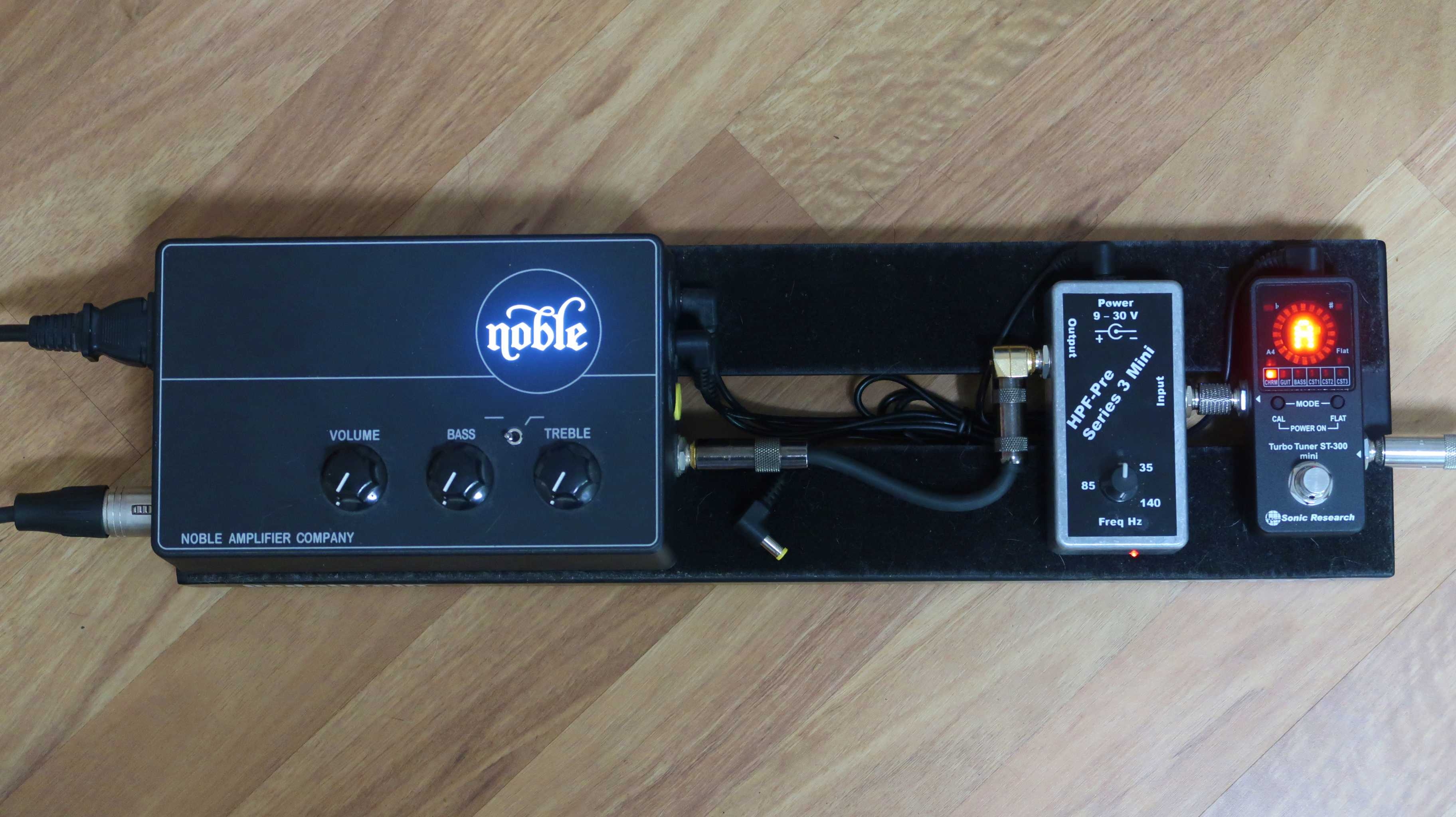
hpftechllc - HPF-Pre Series 3 Mini
Over the years I've received many requests for a pedalboard-friendly HPF-Pre. The original HPF-Pre was designed for upright bass use, and I expected that it would usually sit on top of a small bass amp. But the HPF-Pre also caught on with electric bassists, and the electric world had already
BROUGHTON AUDIO HPF = 12 dB per octave low frequency filter. The knob controls the cutoff frequency and ranges continuously from 25 Hz to 190 Hz.
=> smoothest and musical
SINE EFFECT HPF = 24 dB per octave low frequency filter. The knob controls the cutoff frequency and ranges continuously from 25 Hz to 400 Hz.
=> compromise ?
SFX SOUND THUMPINATOR = 36 dB per octave low frequency filter. The cutoff frequency is fixed at 25 Hz + buffer.
=> effective cutoff + buffer
Usage depends on where you place the filter in the signal chain, at the very beginning/end of the signal path, just like an EQ, to help the gear, before/after an octaver, to remove muddiness, to protect the speakers, to remove the sub bass as it only adds unnecessary energy to the total sound...
The Thumpinator is good but it would be even better with the cutoff frequency fixed at 35/40 Hz and personally, I prefer to have an HPF filter at the end of the signal path...
Afterwards, everything that happens after the HPF filter can generate new unwanted low/sub frequencies, most amps and speakers are designed to receive a wide range of frequencies and often, they already cut below 30/40 Hz, most sound systems/PA/FOH already have EQ and filters...
May the Groove be with you.
=> smoothest and musical
SINE EFFECT HPF = 24 dB per octave low frequency filter. The knob controls the cutoff frequency and ranges continuously from 25 Hz to 400 Hz.
=> compromise ?
SFX SOUND THUMPINATOR = 36 dB per octave low frequency filter. The cutoff frequency is fixed at 25 Hz + buffer.
=> effective cutoff + buffer
Usage depends on where you place the filter in the signal chain, at the very beginning/end of the signal path, just like an EQ, to help the gear, before/after an octaver, to remove muddiness, to protect the speakers, to remove the sub bass as it only adds unnecessary energy to the total sound...
The Thumpinator is good but it would be even better with the cutoff frequency fixed at 35/40 Hz and personally, I prefer to have an HPF filter at the end of the signal path...
Afterwards, everything that happens after the HPF filter can generate new unwanted low/sub frequencies, most amps and speakers are designed to receive a wide range of frequencies and often, they already cut below 30/40 Hz, most sound systems/PA/FOH already have EQ and filters...
May the Groove be with you.


