

Enjoy the benefits of a premium membership!
Upgrade Account
-
TalkBass has been independent since 1998. Add your voice.
Create a free account to reply to discussions, view embedded media, and browse with fewer display ads.
Join free Log in
Want zero display ads or expanded classifieds tools? Compare plans.
You are using an out of date browser. It may not display this or other websites correctly.
You should upgrade or use an alternative browser.
You should upgrade or use an alternative browser.
Upgrades for Fender Jaguar
- Thread starter r05c03
- Start date
More options
Who Replied?Anyone ever considered putting stacked vol knobs in?
yes, i want to do it but unfortunatly i have to wait for my new pus (delano jc 4 he/m2) and electronic (delano sonar 2) - i´m not exactly sure but i think i change (my tech is doing it) both to stacked ones (2x volume, 2 x tone) - i have tested such a system with a jabba 4 and it works very fine

well i poped SD stacked vintage jazz PU in mine and did a shield job.
sonically the same but without the single coil hum (for that burpy bridge tone). i had a 'F' logo ashtray but i took it off (love the look but cant play on the bridge PU ).
).
i have red fretfx too just for the pimpin style
never had any build issues or 'stock gear' issues other than the sheilding.
i recon given time you wont miss the ray especially if you arnt/wearnt a 5 player.
sonically the same but without the single coil hum (for that burpy bridge tone). i had a 'F' logo ashtray but i took it off (love the look but cant play on the bridge PU
).i have red fretfx too just for the pimpin style
never had any build issues or 'stock gear' issues other than the sheilding.
i recon given time you wont miss the ray especially if you arnt/wearnt a 5 player.

My thoughts on the stock bridge are that it is awesome in design, but fairly poor in execution these days (especially in the standard, and MIJ stuff). 2 primary reasons for that.
1 - It is of minimal mass (aka cheaply made, as cheap as possible)
2 - It couples to the body very poorly. The fender entry level bridges (maybe all) are stamped out of a press. What is the retooling schedule like for that/those presses? A stamp press, like any other machine requires maint. The working surfaces of those stamp presses take CONSTANT wear and tear and over time perform less than optimumly. This creates a situation where the underside of each of those bridges is less than truely level/flat and causes it's surface area to contact the body at less than 100%. This, in my opinion, will affect sustain and tone negatively to variable degrees.
But, all of this in my opinion personall experience and potentially unfounded in your respective scenarios? Although, if you test one of these bridges by applying a micro-thin coating of say charcoal (pencil, not briquet) to the underside and then sit it on a piece of paper, what % of the underside leaves behind a trace of the charcoal? I have seen this done with two different stock Fender bridges and both were at 75-80%.
On the other hand, the probable impact to tone of all this is likely imperceivable to the average ear, so who cares?
Truth be told, I switch my bridges because I like to mod things (basses, cars, computers, etc)...
1 - It is of minimal mass (aka cheaply made, as cheap as possible)
2 - It couples to the body very poorly. The fender entry level bridges (maybe all) are stamped out of a press. What is the retooling schedule like for that/those presses? A stamp press, like any other machine requires maint. The working surfaces of those stamp presses take CONSTANT wear and tear and over time perform less than optimumly. This creates a situation where the underside of each of those bridges is less than truely level/flat and causes it's surface area to contact the body at less than 100%. This, in my opinion, will affect sustain and tone negatively to variable degrees.
But, all of this in my opinion personall experience and potentially unfounded in your respective scenarios? Although, if you test one of these bridges by applying a micro-thin coating of say charcoal (pencil, not briquet) to the underside and then sit it on a piece of paper, what % of the underside leaves behind a trace of the charcoal? I have seen this done with two different stock Fender bridges and both were at 75-80%.
On the other hand, the probable impact to tone of all this is likely imperceivable to the average ear, so who cares?
Truth be told, I switch my bridges because I like to mod things (basses, cars, computers, etc)...
I have heard what Fralin PUs can do for a stat....can they do the same thing for a bass?
I think so, yes. They get stellar reviews. Check out Bassplayer.com for Herrara's (I think) write up on them.
Lollar's friggin' kill too by the way. I have a Nash J unlined maple fless with Lollars and it is a growly little beast (which you wouldn't expect give the overall composition and wood combination).

Anyone ever considered putting stacked vol knobs in?
Great minds!
I was wondering about stacked knobs on a Jaguar last night. It seemed an obvious mod...
A fretless Jag bass in burgundy mist nitro with matching headstock and stack knobs would seriously make my day
I'm actually surprised there isn't a "Pimp your Jag club", or "Hot-rodded Jag Bass club"
So far the mods I've seen have been:
* replacement pickups (including JMJ who had Fender add a P bass pickup to his).
* replacement pickup covers.
* replacement bridge (primarily Gotoh or BAII).
* straplocks.
* replacement pickguards.
* replacement maple jazz bass neck.
* stamped Fender bridge covers
* 1 x relic white jaguar - shown on the old Dude Pit before it closed...
Anyone got any photos of a completely refinished Jag bass, or one with DarkStars?
Cheers
Andy
So far the mods I've seen have been:
* replacement pickups (including JMJ who had Fender add a P bass pickup to his).
* replacement pickup covers.
* replacement bridge (primarily Gotoh or BAII).
* straplocks.
* replacement pickguards.
* replacement maple jazz bass neck.
* stamped Fender bridge covers
* 1 x relic white jaguar - shown on the old Dude Pit before it closed...
Anyone got any photos of a completely refinished Jag bass, or one with DarkStars?
Cheers
Andy
And while I think of it, has anyone tried a Stellartone "Tonestyler" in a Jaguar bass? I'm curious if it would work.
Cheers
Andy
Cheers
Andy

I put a Badass II on my jaguar.
And I'd like to put a Fender bridge cover. I had bought the Precision model (small, without the F) and it didn't work (badass II is larger than the stock bridge).
Does the other bridge cover (the one with the "F" on it) fit with a badass II ?
Edit: until now I haven't done oher change than the bridge. But I'm going to replace the pickups an preamp soon. Certainly with delano pickups and their sonar 2 preamp.
And I'd like to put a Fender bridge cover. I had bought the Precision model (small, without the F) and it didn't work (badass II is larger than the stock bridge).
Does the other bridge cover (the one with the "F" on it) fit with a badass II ?
Edit: until now I haven't done oher change than the bridge. But I'm going to replace the pickups an preamp soon. Certainly with delano pickups and their sonar 2 preamp.
Does the other bridge cover (the one with the "F" on it) fit with a badass II ?
Hi JulienJeff, no, the stock chrome bridge covers will NOT fit over a BAII bridge. There are aftermarket bridge covers that look similar but are designed to fit over a BAII bridge. They used to be everywhere, but I haven't been able to find any online while searching this week.
There's an English dude, Theo, who is selling his stripped Jag bass on the for sale forum. He has one of the bigger bridge covers on his Jag, and tried helping me find one, but he couldn't find any for sale anywhere either: http://www.talkbass.com/forum/showthread.php?t=517793
Cheers
Andy

Any of you guys find your Jag's are neck heavy? What do you do about it?
I don't. But I always recommend you get a good strap that's got a bit of texture to grip onto your shoulder which will hold it up. The cheap plasticky one's slide around.
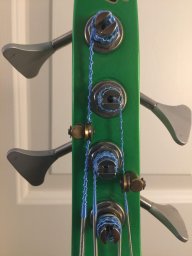
The Jag's upper horn isn't very long, which makes it neck heavy when you play standing up. I use a suede leather strap and have no problems now.
The problem I *do* have however, is my electronics decided to get all screwy on me, and I get a bad grounding buzz (unless I touch the bridge), and have to play with the volume knob to get the full output of the bass sometimes. Looks like I'll be tearing it apart soon. Will probably do the shielding and grounding fixes as well when I get in there.
The problem I *do* have however, is my electronics decided to get all screwy on me, and I get a bad grounding buzz (unless I touch the bridge), and have to play with the volume knob to get the full output of the bass sometimes. Looks like I'll be tearing it apart soon. Will probably do the shielding and grounding fixes as well when I get in there.
Hey Ashtry, Mine did the same thing and all I had to do is tighten the nut on the input jackplate, check it out anyway. By the way, the first thing I said to the guy at the music store as I was checking out is, all you need to do is add a stacked volume control, and you have a regular Jazz bass as well. 
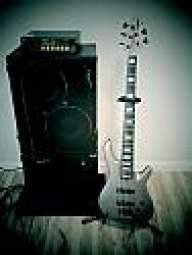
I'm planning to add Gotoh 201 Bridge and pickup cover like Marcus'
I'm thinking of pickup swap but I'm kind of afraid that I might mess up something...
I'm thinking of pickup swap but I'm kind of afraid that I might mess up something...

I have the 2006 in Red and have thus far replaced the stock pickups with Lace Man-O-War Js, which really helped. However, I still thing the tone could sound fuller. I am thinking the electronics need to be altered next, but I don't want to rip out the stock pre amp because I think it's somewhat tonally charming. Any suggestions for replacement pots and capacitors to get a fuller tone out of it? Also, I am thinking of replacing the pickup switches for a Gibson style toggle switch (as having only 2 pickups really doesn't necessitate the independent switches) so I was wondering if anyone had some suggestions for what to throw in that extra slot?

Idk but I could imagine a good pickup swap to Bart’s or Nordstrands on a Jag. Might do that on a Squier Jag or Fender Jag depending whichever I can lay my hands on one for under $300 used!


