
Enjoy the benefits of a premium membership!
Upgrade Account
-
TalkBass has been independent since 1998. Add your voice.
Create a free account to reply to discussions, view embedded media, and browse with fewer display ads.
Join free Log in
Want zero display ads or expanded classifieds tools? Compare plans.
You are using an out of date browser. It may not display this or other websites correctly.
You should upgrade or use an alternative browser.
You should upgrade or use an alternative browser.
Upgrading a Squier or saving up for a Fender.
- Thread starter Bassistent
- Start date
-
- Tags
- buying advice tips
More options
Who Replied?


Save up for a Fender. I can tell you I recently got a Squier 40th Anniversary Precision Bass, Gold Edition and it is not good. The neck pocket has tons of overspray and is very uneven, bridge screws are driven in at angles, bad ground connection to the bridge, and more. I mean the bass looks awesome and the neck feels great but under the hood it's disastrous. All QC issues.
Interesting! My 40th Anniv. Squier P is great! Looks and sound. Luck of the draw, I s'pose. Mine's Lake Placid Blue.
The Bar Band Bassman

Why do you automatically assume that if you get the Squier that it will require upgrades? Way too many people seem to think that just because it's an "inexpensive" bass that it's somehow lacking. Changing pickups will make it sound somewhat different (maybe) but better? Highly subjective. Different strings often have a much more dramatic change in tone than pickups do.
You really should give it a chance before you just assume different pickups will somehow be an improvement. Unless you know in advance exactly what improvement you're going for and exactly which pickup will do that a lot of folks spend a lot of money chasing their tails looking for some magical sound they can't define in their own minds and thus have a difficult time ever finding to their satisfaction.
Bridges - the Fender-style bent metal bridge has been the standard for 70+ years and it works quite well, obviously. Unlikely you'll see much improvement (if any) in sustain etc going to a high mass type bridge, and depending on the Squier model it may well come with a high mass anyway. Undoubtedly some will come along here and argue that point, however anything gained there will be incremental at best.
Tuners I can see a bit more. Generally stock Fender/Squier tuners will give great service life and hold tune just fine. Going to a finer gear ratio tuner will make things a bit easier to get just exactly right but again the gain IME is small and incremental at best. Where is your Point of Diminishing Returns investment wise?
I play large places/gigs rotating between two bone stock Squier P's (a Matt Freeman and a Vintage Modified PJ) and a Fender P I paid 5X more for and tonally/looks wise/playability wise no one knows the difference, myself included. These days the Squiers, Epiphones, Sires etc of the world are perfectly good working mans instruments in stock form and just because they're "inexpensive" doesn't somehow necessarily mean they're "cheap". Give it a chance before you just start throwing money at one. Or just save up and get the one you think you want and save yourself the headaches and frustration of chasing some poorly defined thing you think you hear in your head but somehow just can't quite find.
Exactly this!
Back in the 90's or even the early-aughts, hardware and electronics manufactured overseas typically skimped on materials and/or robustness of design in order to keep costs down-- flimsy hardware, pickups wound with low quality, high-capacitance wire, etc.
That's not really much of a thing anymore, although a few examples still pop up here and there.
Nowadays, "upgrading" components on an inexpensive imported instrument is more a matter of "personalization" than it is an "upgrade". The one exception I can think of is the shielding, wiring, pots, and caps-- a quality set of electronic components manufactured with tight tolerances can still make a noticeable improvement. There are still plenty of examples-- both imported and American-made-- where a linear taper pot was used where a logarithmic taper pot should have been used, and vice-versa, but Squier is not one of those brands where I have seen a plethora of examples.
The old adage "you get what you pay for" still *generally* applies... but there's still a point of diminishing returns, and the advent of computerized CNC routing and machining has brought that down to a much lower price point for many working musicians.
Give the Squier a try. If it feels good and still sounds the way a P-bass or J-bass should (and there is very little reason to believe it wouldn't, frankly), then buy it and save the extra money to put toward the best speaker cabinet you can *almost* afford!

I found the Fender MM sig to be heavy, and the neck was slathered in a heavy PU finish. Be sure you take a test drive.
Buy the bass you can afford, used, because your $ goes out twice as far.
Mods can bea money pit.
Buy the bass you can afford, used, because your $ goes out twice as far.
Mods can bea money pit.

For me, I know it was going to be a money pit, however, it is the first time time to do that much of modding by myself and want to try EMGs again and I am pleased with the result. Probably I did not need to change the bridge and tuners (Hipshot KickAss and Ultralites) and that's where the vanity part came. However what the Hipshot HW did is to be able to dial in the B string -- and I am almost at parity with a EBMM MusicMan Stingray 5 (which I recently got) in having a really good B string for a 34. scale. I think that the EBMM Stingray Special 5H has a better neck because of the roasted maple

bones91
Commercial User
I used a Squier for years as a recording and live show bass with no modifications. I buy a good bass because it's good and doesn't need any upgrades, that's my barometer.

But if you have Squire money and want the Marcus Miller sound for that price I'd Get a Sire V3 or V5 new or a Used 2nd Gen V7.
yeah, just get a Sire. They’re better than Squiers and closer to what you want out of the box

Squier has come a long way over the years. I personally like to change pickups, bridge, and tuners. I do that on most fenders anyhow. But that's my preference after 20+ years of playing. My honest advice, get a Squier and don't look back. Save for your dream bass still, but don't worry about the decal on the headstock and have some fun

My (unsolicited) advice (but you asked . . . ):
First, whether you get the MM Fender, a Squier, a Sire, you're going from a FOUR string to a FIVE string.
That's a big transition.
The Squier Jazz Fives (especially if you can find a store demo or a barely used one) would be your cheapest buy-in. I'd have it set up properly by a genuine, experienced repair tech with the strings you intend to use, and then you're going to have the task of learning to get around on a five instead of your four. It's a real task, and some people take longer than others to make the jump. All depends on how much you're willing to work at it.
So I would suggest to concentrate on that first before I ever thought about 'modding' your bass. You can go broke trying this pickup or that bridge and often not hear what you thought you'd hear. The best investment is to practice, gain fluency on this new axe that's properly playable, live with it for a while. A good musician can make a so-so instrument sound great, but all the expensive pickups, preamps, and hardware will only amplify how poorly the unrehearsed and untrained really sound when it's time to stand and deliver. Don't be that guy.
Then, if you think it needs something, now you're in a position to make a smart decision.
Should you decide to mod it, I'll add this caution:
Most of us are going to play this or that bass for a while, then get the bug for something new, and you're going to sell it or trade it. When you do this, buyers are going to expect to pay the going rate for whatever bass it is, not withstanding the 'mods' you did to it. You often will never see that money back. If a new Squier Jazz Five is around $500USD, buyers are going to expect to pay less than that for a used one. So if you mod, shop carefully and try and stay around the price range a good used one will sell for.
First, whether you get the MM Fender, a Squier, a Sire, you're going from a FOUR string to a FIVE string.
That's a big transition.
The Squier Jazz Fives (especially if you can find a store demo or a barely used one) would be your cheapest buy-in. I'd have it set up properly by a genuine, experienced repair tech with the strings you intend to use, and then you're going to have the task of learning to get around on a five instead of your four. It's a real task, and some people take longer than others to make the jump. All depends on how much you're willing to work at it.
So I would suggest to concentrate on that first before I ever thought about 'modding' your bass. You can go broke trying this pickup or that bridge and often not hear what you thought you'd hear. The best investment is to practice, gain fluency on this new axe that's properly playable, live with it for a while. A good musician can make a so-so instrument sound great, but all the expensive pickups, preamps, and hardware will only amplify how poorly the unrehearsed and untrained really sound when it's time to stand and deliver. Don't be that guy.
Then, if you think it needs something, now you're in a position to make a smart decision.
Should you decide to mod it, I'll add this caution:
Most of us are going to play this or that bass for a while, then get the bug for something new, and you're going to sell it or trade it. When you do this, buyers are going to expect to pay the going rate for whatever bass it is, not withstanding the 'mods' you did to it. You often will never see that money back. If a new Squier Jazz Five is around $500USD, buyers are going to expect to pay less than that for a used one. So if you mod, shop carefully and try and stay around the price range a good used one will sell for.

Totally agree!
OP:
I have a '95 MIA JB, a '11 MIM Strat and '21 CV Jazz master. They're all great instruments. Although the Strat has been modded, for me it's all about how the neck feels and if it has been properly set up. I also have a Yamaha BB435 that is a great instrument and only the strings have been changed.
In the end, you have to play the instrument a lot to really know if it needs any mod. I do like to change things, but only for customization, and it can be expensive. I do recommend you to take your instruments to a very good guitar tech. A good setup can make any instrument play much better.
EDIT: I do have a heavily modded Epi Les Paul that became one of the best guitars I've ever played, but just because it was already a very good guitar!
OP:
I have a '95 MIA JB, a '11 MIM Strat and '21 CV Jazz master. They're all great instruments. Although the Strat has been modded, for me it's all about how the neck feels and if it has been properly set up. I also have a Yamaha BB435 that is a great instrument and only the strings have been changed.
In the end, you have to play the instrument a lot to really know if it needs any mod. I do like to change things, but only for customization, and it can be expensive. I do recommend you to take your instruments to a very good guitar tech. A good setup can make any instrument play much better.
EDIT: I do have a heavily modded Epi Les Paul that became one of the best guitars I've ever played, but just because it was already a very good guitar!
Exactly this!
Back in the 90's or even the early-aughts, hardware and electronics manufactured overseas typically skimped on materials and/or robustness of design in order to keep costs down-- flimsy hardware, pickups wound with low quality, high-capacitance wire, etc.
That's not really much of a thing anymore, although a few examples still pop up here and there.
Nowadays, "upgrading" components on an inexpensive imported instrument is more a matter of "personalization" than it is an "upgrade". The one exception I can think of is the shielding, wiring, pots, and caps-- a quality set of electronic components manufactured with tight tolerances can still make a noticeable improvement. There are still plenty of examples-- both imported and American-made-- where a linear taper pot was used where a logarithmic taper pot should have been used, and vice-versa, but Squier is not one of those brands where I have seen a plethora of examples.
The old adage "you get what you pay for" still *generally* applies... but there's still a point of diminishing returns, and the advent of computerized CNC routing and machining has brought that down to a much lower price point for many working musicians.
Give the Squier a try. If it feels good and still sounds the way a P-bass or J-bass should (and there is very little reason to believe it wouldn't, frankly), then buy it and save the extra money to put toward the best speaker cabinet you can *almost* afford!
Last edited:

I want to buy a Fender Marcus Miller signature 5 string but I don't have that much money right now and income is close to non existant. So should I buy a Squier 5 string and upgrade it or save up money and eventualy buy the Fender, what would you guys do?
Save the money.
If income is close to non-existent, how are you going to pay for a Squier and upgrades anyway? No sense thinking about buying things you can't afford. For many years I lusted after plenty of gear but only bought what I really needed and I paid for it with money I made from playing out.
Oh yeah, did I mention you should save the money.

27604042[/URL], member: 381156"]A good question might also be, "What do you think that the Fender (including squire) offers you that your current Bass does not?" i.e. What are you hoping to achieve? Yes GAS is good, but try out other instruments first and THEN decide what advantage migh be gained by changing gear.
Very true. One symptom of GAS is wanting an instrument without being able to clearly state the reason(s) why.
I’ve often discovered wanting something was better than actually owning it. Sorta like that “special someone” who turned out to be not so special once you got to know them. Often right after the first date.
My problem is I pretty much like everything when it comes to bass. So anytime I start thinking I absolutely have to get another piece of gear, and I have the money for it, I go cold turkey and make myself wait three days. If I still decide I want it after that I’ll buy it. But nine times out of ten I’m no longer in heat and just as happy I didn’t.
Can’t guarantee it will work for everyone. But it’s saved me a boatload of money and disappointment over the years.


Are you dead set on a fender product? Lots of really good basses available from other manufacturers. Do you like how your Ibanez feels and plays? They've got lots of great basses at different price points. I really like Schecter and I've seen Sire suggested as well and those are also great players. I'd suggest deciding whether you need to upgrade now or if you can wait. Decide what your budget is going to be based on that and then go play whatever you can get your hands on in that range

The best feeling P bass I've ever played was a 2002 Squier 20th anniversary bass made in China. I defretted it, epoxied it and sold it to someone for nothing which I regret now but that bass had a special mojo to it.
That being said I learned fretless on a squier VM jazz and have had nothing but problems with it. The neck pocket itself is cut at the wrong angle and needs a huge shim for any neck, the neck needed to be leveled twice and will not hold relief for more than 10 minutes, the bridge and control plate screws are beyond stripped- things like that.
Go look for a Squier or even better Sire in the store and try it before you buy. The sire P5 is a 5 string passive P bass and is one of the coolest things Ive ever seen for like $500
That being said I learned fretless on a squier VM jazz and have had nothing but problems with it. The neck pocket itself is cut at the wrong angle and needs a huge shim for any neck, the neck needed to be leveled twice and will not hold relief for more than 10 minutes, the bridge and control plate screws are beyond stripped- things like that.
Go look for a Squier or even better Sire in the store and try it before you buy. The sire P5 is a 5 string passive P bass and is one of the coolest things Ive ever seen for like $500
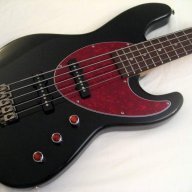
It really depends on how much you want the Miller. But given you have no income, saving could take a long time.
Personally, I’d go with the Squier in this situation. I’ve owned a number of USA Fenders, including active and reissue models. They are all gone. My “Fender” is a Squier affinity J 5 with Fender USA pickups. Build quality is not on par with USA Fenders, but it’s still very good. It plays beautifully (better than some USA models I’ve owned) and sounds like a Fender.
Personally, I’d go with the Squier in this situation. I’ve owned a number of USA Fenders, including active and reissue models. They are all gone. My “Fender” is a Squier affinity J 5 with Fender USA pickups. Build quality is not on par with USA Fenders, but it’s still very good. It plays beautifully (better than some USA models I’ve owned) and sounds like a Fender.

Been there too, buying a secondhand used Fender Marcus Miller 5 here in France was... damn tough: too much pricey when you're lucky enough to find one available, too much hard to find overhall, so I choose to get a similar one custom made by a euro luthier, as I'm french. He did an outstanding job for a new custom bass that costs the same as a Fender MM 5... used. And with A list components like an Hipshot A bridge, Hipshot light tuners, Lollar pickups, Hard rock maple neck with graphite rods, swamp ash body, just upgraded the preamp a few years later.I want to buy a Fender Marcus Miller signature 5 string but I don't have that much money right now and income is close to non existant. So should I buy a Squier 5 string and upgrade it or save up money and eventualy buy the Fender, what would you guys do?
So yeah, just forget the idea to find the real deal, to me it's not worth. If you think you can get a decent instrument with a Squier as long as it is a 70's pickups spacing one, then why not !


