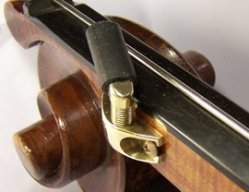
I think that both types of necks do exist for a reason and if one was considered far superior to the other, then it would be more dominant in the market. It can also be regional if there is a particularly prolific teacher in the area. Just like German bow and French bow, if you find a teacher or a school of teachers that have strong opinions and a lot of influence, then their students end up purchasing basses that fit those requirements. I had a teacher that liked a bass that had the "wrong" neck (I forget which one) and had the instrument altered to be the opposite.
Some of our luthier friends would be far more knowledgeable than myself, but the proportions/measurements apparently work out nicer on a D neck. While inches and cm were important to a lot of makers, many traditionally worked with ratios and things like thumbs and hands and more easily available measurements. With a D neck the heel is at 1/3 of the vibrating string length, where on an Eb, it is some other much less friendly fraction. I am not going to pretend to know how/why all of that works, but "the math works out" seems like it would hold some value. A lot of makers offer both options though, because keeping your customers happy is always a good idea.
I have played a couple of both, and I have to say that I have become familiar with and grown to like my in between neck. A colleague at my university bought a cheap instrument to keep at home when his nicer bass stayed at school, and he couldn't figure out why his intonation completely fell apart around the heel. He finally brought in both basses and we discovered one was a D and the other was an Eb. He learned to play both and adapt, but you really don't need any extra reasons for a practice room meltdown when you're at university.
As far as preference, I never even thought about the keys encountered in classical or in jazz. I think knowing what note is going to be under your finger in that part of the neck is more important than which note that is, as it is just nice to have a reference point somewhere. If you are used to one and that makes your life easier and someone else is used to the other, I don't see either one as more or less valid. It is one of the first things I check if I am sitting in on a bass that is not my own. Given how rarely I sit in these days and how rarer still it is for me to play a bass in 4ths, it is comforting knowing what note is going to be there when I'm trying to find the rest of them.