Hi!
I hope I'm not asking to stupid a question

.
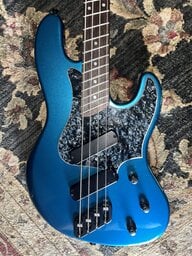
I often read people use compression to get an even sound across all strings, but I'm wondering if a similar effect can ben obtained with an EQ pedal? I have a fairly simple setup, playing (now exclusively home) with a FGN boundary Mighty Jazz plugged into a cheap Warwick BC20. With all settings at noon on the amp, I feel the G string is much quieter than the other strings.
When using a Tech21 Strip with mids boosted at around 180Hz and 1k, with both HPF and LPF engaged, I feel the D and G string sound much thicker. Is this purely subjective, or does increasing those frequencies really affect the sound of those smaller gauge strings? Do you often use an EQ replace a compressor for this specific application?
You know of course that your choice of strings also has a lot to do with that tinny or weak sound in the low notes of the D and G string. When I bought my '82 Jazz in 1985 it had a set of Dean Markley Blue Steel strings on it. These were actually the first round wound strings I ever played. My 1965 Jazz that I bought in 1966 came with Fender flat wounds and when I was touring in the early 70's, I put a set of Fender Black Nylon Tape strings on it. I used those strings and was quite happy with them until all my touring gear was stolen in 1976.
Of course round wounds were rougher feeling than flats, but that wasn't really a problem. The nice thing about them is they had a lot more of the upper harmonics than I was used to getting with flats. The bad thing was that the D and G-strings sounded week when playing low on those strings, for instance the E on the D-string and the A on the G-string. So instead of playing those notes on the 2nd fret of the D and G strings, I would play them on the 7th fret of the A and D strings to get more "body" in the note. I figured that was just the cost of getting the brighter sound they produced.
After replacing them 3 or 4 times, I gave DR Black Beauty strings a try because a friend was endorsed by them and he thought they were great. The balance of sound from string to string was better with the DR's, but I continued to play the needed notes from the lower part of the D and G string up on the frets above D an G on the A and D string. And then my Black Beauty strings turned into ugly mottled gray strings. Sound didn't really die, I just hated to look at what had been black strings that now looked like diseased strings. So I went looking for another option.
I have to admit that an SBL video convinced me to give LaBella Tape Wound strings a shot. Scott has done at least two comparisons of flats, round wounds, and taped and I think it was the first one he did. Through my Bose headphone they sounded more balanced than the round wounds I'd used and yet had a lot more of the upper harmonics than flats typically do. So I bought a set of LaBella Deep Talking Bass White Tape Wound strings from the store here on Talkbass. When I put them on, the sound was even better than I expected. Scott had used the Black Tapes and I ordered the White ones. The black ones are deeper and the white ones are the brightest of the LaBella tape wound string. Even more unexpected was the fact that the low notes on the D and G strings did NOT sound thin, wimpy, and weak.
The balance from string to string was great and I no longer need to go up to the 7th fret to play the E and A on the A and D stings. Playing them on the second fret of the D and G strings sounds almost exactly the same. At least it is close enough that I can play those notes on which ever string and fretting position is closest or most convenient, depending upon my hand position at the time.
If you are really trying to get a nice string to string balance of sound, I'd suggest you give the LaBella tape wounds a try. It may save you from buying a compressor. The White Tape Wounds are semi-opaque, so you can tell there's a silver core in them. The Black are totally opaque. Besides their Black Tape Wounds, they also make White with a Copper core, and White with a Gold core. Both of those are in between the sound of the white ones and the black ones but I haven't used them so I don't know which of the two is brighter or darker sounding. On my '82 Jazz that has an all-maple neck and 70's era pickup spacing (has a brighter sound than my '65 did), the White Tape Wounds are perfect for my sound. I think it would be worth a look for you.






 !
!