• TalkBass has been independent since 1998. Add your voice.
    Create a free account to reply to discussions, view embedded media, and browse with fewer display ads.
    Join freeLog in
    Want zero display ads or expanded classifieds tools? Compare plans.

Double Bass Viennese bass disaster repair

Matthew Tucker

Commercial User
Aug 21, 2002
2,686
387
Sydney, Australia
www.bresquebasses.com.au
Disclosures
Owner: Bresque Basses, Sydney Basses and Cellos
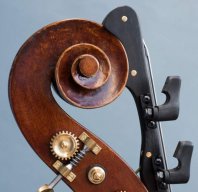
I wonder what this bass cracks up to be ...

[Invalid or Expired Link Removed]

The google translation is essential for understanding, for it throweth up such gems as

"My prick staff has 10mm in the diameter and has at the point a thread with M10. The other end is easily chamfered.
Prick Holzstab Prick Holzstab Prick Holzstab Prick Holzstab. Subsequently, the Holzstab because of the optics black pickled and by means of Kontaktkleber a commercial rubber-glean glued to."

and

"maple eddies (however if one wants to save, then is safe this an alternative) why it actually these eddies with managing buttoning on the left and on the right gives? No notion however it looks very cool"

LOL
 
Suspicious of what? Gerald emailed me some time ago too to exchange links and slap each other on the back, cos we're both amateurs making basses. But he has some serious tools! I can't really work out what stage his bass is at though or what he's going to do with the train crash ... Gerald, are you watching?
 
Bob Branstetter said:
I was under the impression that Chuck Traeger recommended 3/8" spacing at the nut. Please post the page number so I can re-read that section.

It was printed in a back issue (few months ago) of the Double Bassist magazine. I don't know the issue off-hand. However, stating that string nut spacing affects volume is hilarious.
 
nicklloyd said:
It was printed in a back issue (few months ago) of the Double Bassist magazine. I don't know the issue off-hand. However, stating that string nut spacing affects volume is hilarious.
I guess I'm going to have to get a copy of that back issue. This is the second time where the magazine has Chuck Traeger saying things that differs from what I've read in his book. In the book he says that reducing the string spacing to 3/8" improves the feel and sound of a bass. To the best of my memory, he did not use the word volume in relation to nut spacing. I've been using 3/8" spacing for as long as I can remember, so that comment didn't strike me as being particularly unusual.
 
Well he does mention that it affects volume - amongst other things, like playability - on p22, but that's just the "executive summary" (my term). In the chapter on nut making and adjustment, he give a lot more information, plus his reasoning - which some people will never get unless they read the book.

I guess that's why Traeger gets quoted out of context - some people (double bassist reviewer?) only get as far as the executive summary instead of reading the detail. Some never even read the book, but happy to quote him anyway.

Traeger covers a lot of ground, is very clear why he believes what he does, speaks from his experience at all times and does not, in my opinion, deserve the ridicule he seems to attract here!

Now can we get back to Gerald's bass?
 
The corpus of this bass is very similar to that of one belonging to my first teacher, which he claimed was more than 200 years old. Tuners look very similar as well. His had no edges either and had that kind of violongated shaped gamba body. These are so beautiful to me. I hope Gerald is able to patch it up and get it to sing again, regardless of the obvious problems translation might engender.
nicklloyd said:
It was printed in a back issue (few months ago) of the Double Bassist magazine. I don't know the issue off-hand. However, stating that string nut spacing affects volume is hilarious.
And humor is a good thing. I thought string spacing at the bridge was what Traeger mentioned as affecting volume, and his reasoning was plausible, at least to me. I don't recall anything about the spacing at the nut being referred to as affecting volume, I'd like to hear more about this in a different thread. Thanks for the reference Mattew, I'll look it up in my dog-eared copy.

I think I have seen "optimal sound" or similar wording used by those who know nothing of Traeger, perhaps even very recently.:smug: No doubt he didn't invent that pair of words, just the notions it includes in his book. My German is not so good, does Gerald specifically mention Traeger or just optimizing sound?
 
(Soundoptimierung lt. Ch. Traeger) Well, I guess Ch. Traeger is German for Ch. Traeger, but I'm having trouble with the rest of it. Anyone has ideas about what Ch. Traeger stuff he's doing, other thatn the endpin??

Link Removed

All I see on this page is the wooden endpin being made and replacing the metal endpin. So this seems to me to be about Ch. Traeger's idea about wooden endpin. Seems I read in a magazine interview with Ray Brown that he also favored wooden endpins.
 
Silversorcerer said:
(Soundoptimierung lt. Ch. Traeger) Well, I guess Ch. Traeger is German for Ch. Traeger, but I'm having trouble with the rest of it. Anyone has ideas about what Ch. Traeger stuff he's doing, other thatn the endpin??

Link Removed

All I see on this page is the wooden endpin being made and replacing the metal endpin. So this seems to me to be about Ch. Traeger's idea about wooden endpin. Seems I read in a magazine interview with Ray Brown that he also favored endpins.

A short summary would be: "I made a wooden endpin, but the difference in sound between a wooden endpin and a metal endpin seems not very big to me."
 
Silversorcerer said:
I hope Gerald is able to patch it up and get it to sing again, regardless of the obvious problems translation might engender.

Er ... what have google translations got to do with his ability to do bass repairs? :eyebrow:

Like most Europeans he reads english just fine; his website just happens to be in German!

He isn't using Traeger as his only reference either.
 
Matthew Tucker said:
Er ... what have google translations got to do with his ability to do bass repairs? :eyebrow:

Like most Europeans he reads english just fine; his website just happens to be in German!

He isn't using Traeger as his only reference either.
It was just comment (intended humorously) bassed on your first Google translation. Sorry you didn't see it that way, I was just imagining myself trying to follow a Google translation like the one you posted. Better to guess at the German. I wouldn't expect him to have any problems given what I saw of his workshop and other construction photos, nor would I expect Traeger to be his only source for information. Most Google translations I've seen were just as garbled, if not as funny.
 
Hello Friends,

i followed with pleasure your discussions about googles german - english translations ;) Yes in fact they are not the best :help:

However, yes i use Chuck Traegers Book for inspiration.
The bridge you see with the Balsereit Piezo-Pickup is not made by myself. I just had no other pic at the hand at that time.
I too use with an high interest the books from:
Bob Hitchings : Double Bass Making
Peter Chandler : So you want to build a double bass
H.S. Wake: To make a double Bass
Furthermore some different violin making books & articles...

I am actual in making some sides for one bass but as you see on my webpage there is all the time some things coming in between (viennese bass from michael ignatius stadlmann 1796)

I have to say that i am an amateur bass builder & repairer.
And with this in mind i decided now to give the bass to an befriended professional bass luthier KLAUS ZUCKERSTÄTTER Invalid Link Removedin Hallein near Salzburg in Austria for further repair.

The Instrument is from important historical value for Austria and the Old Music scene and i want to preserve this with the best repair i can get.

I like working with wood and sharing infos & experience with other bass-building friends thats the reason i put this weppage together and documentate my works. I am sorry but i made it in german as there is very few information about Double Bass Making in the European Internet esp. in German. I hope you dont mind. Maybe i should think about an 2nd page translated well :D

About the Wooden Endpin:
Yes i tried it and i am not sure if it improved the sound :rollno:
But yes i think its sounding more with deepth, fundament or something like that...
I just surely can say that i cracked the endpin by going down stairs last week after an gig - so thats an disadvantage of less stiffness ;)

So keep on discussion and have fun with your bass working.
I would be very pleased to get replys and info on bass building.
Its a problem that in Europe the luthier business and bass building is not that public as in other areas as i think.
I have the feeling the luthier want to keep it an mystic handicraft. On the other hand a lot of bass players as i am are interested in details about bass building and how it works.
Thats why i also share my works on the web.

for further reading some european pages:
http://www.doublebassguide.com/
Invalid Link Removed

Good Luck,
Gerald Dallhammer :-)
 
And with this in mind i decided now to give the bass to an befriended professional bass luthier KLAUS ZUCKERSTÄTTER Link Removed Hallein near Salzburg in Austria for further repair.

Hi Gerald!

I think you'll get five stars from the luthiers here for that decision!

Can you make the thnumbnails on your website any bigger? Using firefox at least, they are tiny, very hard to see in context.

Matthew