Check this out. This is a textbook example of Differential Expansion; what happens when two different materials glued together expand at different rates.
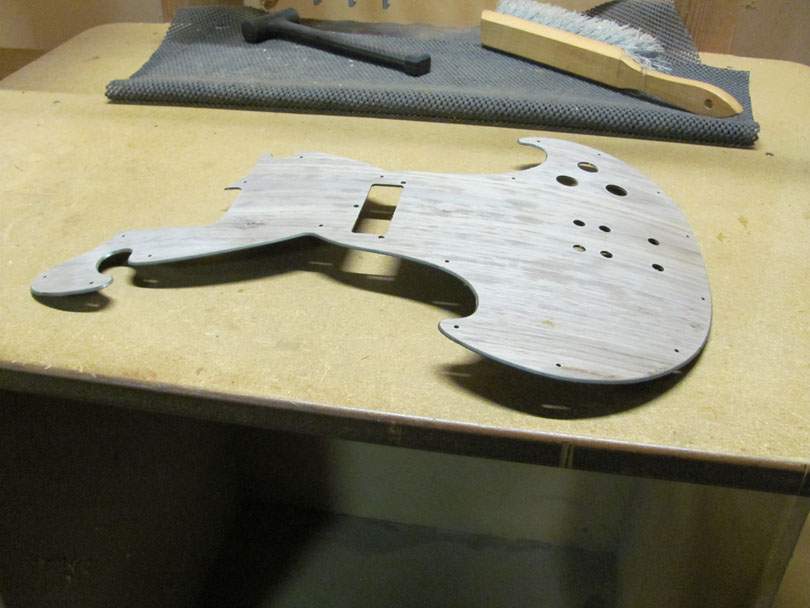
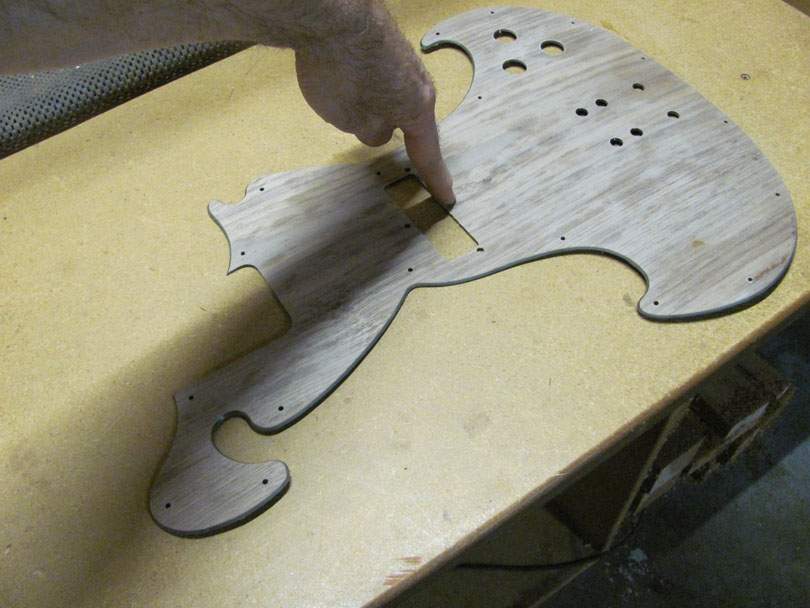
This is an unfinished walnut veneer pickguard for one of my AMB-2 Scroll Basses. It's an optional feature that I offer on my all-walnut model AMB-2. This is a spare pickguard that I made up back in the spring, and has been sitting in a cabinet. It's made from a sheet of 1/16" Garolite plastic laminate, with 1/64" plain (non-paper backed) walnut veneer epoxied on to it using West Systems epoxy.
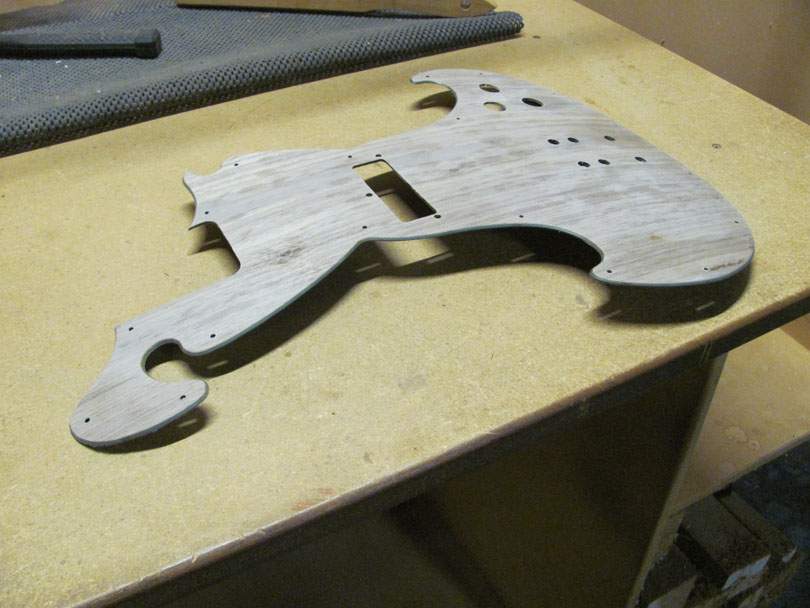
We've had really dry weather here in the past few weeks, with the outside humidity sometimes down below 5%. Right now, it's "up to" 13% here in my shop. I happened to notice this in the cabinet and thought it was amusing.
This is a pure example of differential expansion at work. The walnut has expanded just a little bit more than the Garolite, but over that distance, the difference in expansion rates adds up, and results in the uniform curve.
Notice that all the expansion is along the grain of the walnut. There's almost none across the grain. Also, it's curious that it bowed convex. That means that the walnut has expanded more than the Garolite. I would have thought that the walnut would be shrinking in the dry weather. Huh?
Regardless, the epoxy bond must be good, because there's no bubbles or buckling of the veneer. And it's not really a problem. With one finger, I can push it down flat. This pickguard is still good and useable. I'll be watching it to see if it flattens out as the humidity gets back in the normal range (35-50% around here).
This does make you think about the perils of joining dissimilar materials. You know, like soft necks and hard fingerboards.....
This is an unfinished walnut veneer pickguard for one of my AMB-2 Scroll Basses. It's an optional feature that I offer on my all-walnut model AMB-2. This is a spare pickguard that I made up back in the spring, and has been sitting in a cabinet. It's made from a sheet of 1/16" Garolite plastic laminate, with 1/64" plain (non-paper backed) walnut veneer epoxied on to it using West Systems epoxy.
We've had really dry weather here in the past few weeks, with the outside humidity sometimes down below 5%. Right now, it's "up to" 13% here in my shop. I happened to notice this in the cabinet and thought it was amusing.
This is a pure example of differential expansion at work. The walnut has expanded just a little bit more than the Garolite, but over that distance, the difference in expansion rates adds up, and results in the uniform curve.
Notice that all the expansion is along the grain of the walnut. There's almost none across the grain. Also, it's curious that it bowed convex. That means that the walnut has expanded more than the Garolite. I would have thought that the walnut would be shrinking in the dry weather. Huh?
Regardless, the epoxy bond must be good, because there's no bubbles or buckling of the veneer. And it's not really a problem. With one finger, I can push it down flat. This pickguard is still good and useable. I'll be watching it to see if it flattens out as the humidity gets back in the normal range (35-50% around here).
This does make you think about the perils of joining dissimilar materials. You know, like soft necks and hard fingerboards.....