• TalkBass has been independent since 1998. Add your voice.
    Create a free account to reply to discussions, view embedded media, and browse with fewer display ads.
    Join freeLog in
    Want zero display ads or expanded classifieds tools? Compare plans.

Wall of Sound?

Hi.

As I understand it, what You described is the "normal", usual way and in the wall of sound also the PA cabs are behind the band. At least that's how I've done it :).

Small places, wall of sound for me. Larger places, usually a normal setup.

The benefits, well it's easier to mix from the stage and helps You with balance, everything sounds more natural (to me at least) and the band takes up less space.

Th main reason not to do it, would be the going deaf part. On a loud gig, the stage sound level can rise rather quickly, and the vocals are a bit tricky to control. Another reason is the vocal mic feedback, along with the feedback from every other open mic on stage.

Regards
Sam
 
grateful_small.jpg


Ah, The Dead. Glory days.
 
  • Like
Reactions: Bill Whitehurst
I'm not sure that the GD wall of sound was "the birth" of the line array.

My band has 2 SRM 450's and in certain venues when we have not run our hot spot vocal monitors, I have placed one as a monitor right underneath the other as a main. The idea was to minimize phase issues by having both speakers right above and below one another.

The challenge is to get my band memebers to understand that there is no need for "stereo" placement of the speakers with our mono mix.

Line arrays are pretty much the way to go at concerts now-- it's what you see above the stage in the center, the cruving array of trapezoidal speakers.
 
One of the advantages the Dead claimed from the Wall of Sound was that they could maintain reasonable stage volumes. So many of the drivers projected over their heads and past the band, that the volume from the drivers that actually washed the band was not excessive.
 
I think the Wall of Sound was a neat curiosity in its day, but I see so many acoustic nightmares in it that it couldn't have been easy to control. I'll take the modern line array/sub arrangement any day.
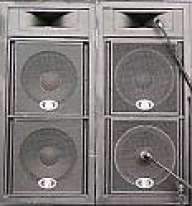
 
I think the Wall of Sound was a neat curiosity in its day, but I see so many acoustic nightmares in it that it couldn't have been easy to control. I'll take the modern line array/sub arrangement any day.
No doubt the Dead would agree (they've come light years in their live set up since then, too). The WOS was an attempt to accomplish things that modern technology would have made much easier. It was more than a curiosity, though. When it worked well, it was head and shoulders above anyone else's sound - in or outdoor. Experiments like that raise the bar, if nothing else.
 
Never cared much for concerts that were Wall of Sound. Wall of Noise, more like. But man, do you start to realize what a wide range of (very loud) sounds can be emitted by musical instruments.

And it's so different behind the stage or onstage, I always wondered what the musicians thought we were listening to, out in the audience - often, the audience made so much of its own noise, it was its own wall.
 
owsley designed the sound system, not the line array.

Can't beleive how we have to be precise on what we say on forums sometimes.......

What I was trying to say when I said "birth of the line array" is;
This concept of putting alot of same sized speaker on top of each other , wich was named "line array" long after , was first applied in "live" PA reinforcement by Owsley.

People picked up on this idea later to develop the Line array we know today.

birth of the line array ? lol, you gotta go read some audio books from the 1920's-40;s. the line array was around way before the gratefull dead were alive. be carefull of the info on here,,,,,, johnny a

Please post the link where I can see PA reinforcement in Live situation of a "line array" in the 20-40's. I'm very curious to see that....
 
Actually, Johnny A is right. They didn't call them "line arrays," but stacking same-sized speakers vertically has been around for ages. Ever see those Shure Vocal master PA's from the 60's? Same concept. According to Bill Fitzmaurice, stacking has been touted as the way to set up a PA pretty much since PA's existed, but people didn't use them once the big PA systems came out because of the mistaken belief that PA's worked like light shows.