• TalkBass has been independent since 1998. Add your voice.
    Create a free account to reply to discussions, view embedded media, and browse with fewer display ads.
    Join freeLog in
    Want zero display ads or expanded classifieds tools? Compare plans.

Weber Speakers T/S Parameters

Has anyone ever received any info from these guys? I've tried a few times but I'm getting zero response. I'm very interested in the 10FH for a 6x10 build (as it has a 24 OHM option) but so far it's radio silence. From what I've gathered in Kringle77's posts, they'd behave okay in a cab with SVT810 construction/ (relative) dimensions, but it seems like his experiments were a ways back and that he found more fetching suitors. Has anyone else played with these speakers and/or has any data on them?

 
I’ve emailed and asked but got the same (zero) response. Apparently they don’t bother taking measurements and if you’re going to tune the cab I wouldn’t bother with their speakers.

I have one of their bass 15 drivers and have used their guitar speakers. They sound good for the price. But yeah, not useful for proper design work.
 
Weber doesn’t make the specs available. They design speakers and know what the specs are.

I suspect that they don’t want to play the specs game. A lot of companies exagerate on their specs. When people start comparing specs without a proper baseline specs don’t mean a lot. Unless you are designing a cabinet, all that is needed is impedance and power handling. Their speakers are sold as replacements for specific amps.

I once got some specs from Ted for a 10” bass speaker, he was well versed in how it performed.

They were selling speakers to Fender. I can’t imagine Fender using a speaker that they didn’t have specs on.
 
  • Like
Reactions: ianworz
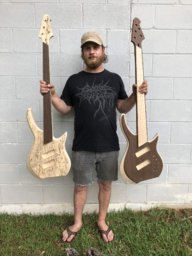
Thanks guys. Seems odd to opt out of giving information that could gain sales... but I guess that coin flips both ways. I was thinking of building a heavily braced 6x10 1/2" cabinet with an I.D. of 35"t x 25"w x 13"d (volume of 6.583 cu. ft.) so maybe just a bit more internal volume (1.01 cu.ft. v.s. a flatback svt's .99 cu.ft per speaker) but I wanted to model for both (2) horizontal dividers and (1) vertical divider and see if there was any significant change in parameters. I figured with a vertical divider I could shift each set of 3 vertical speakers to an offset arrangement to cut down on beaming. I'm sure someone will hop in here and tell me that building such a cab is a waste of time/money and will sound like garbage, but I'm a woodworker by trade and build multiscale guitars and basses, so frankly, building a box (regardless of how well it's braced) is not much of an investment of time for me, and I have all the tools and materials available save for drivers and hardware. Still though, if anyone has any experience on this particular driver, I'd love to hear your thoughts.

Thanks,

Ian
 
Thanks guys. Seems odd to opt out of giving information that could gain sales... but I guess that coin flips both ways. I was thinking of building a heavily braced 6x10 1/2" cabinet with an I.D. of 35"t x 25"w x 13"d (volume of 6.583 cu. ft.) so maybe just a bit more internal volume (1.01 cu.ft. v.s. a flatback svt's .99 cu.ft per speaker) but I wanted to model for both (2) horizontal dividers and (1) vertical divider and see if there was any significant change in parameters. I figured with a vertical divider I could shift each set of 3 vertical speakers to an offset arrangement to cut down on beaming. I'm sure someone will hop in here and tell me that building such a cab is a waste of time/money and will sound like garbage, but I'm a woodworker by trade and build multiscale guitars and basses, so frankly, building a box (regardless of how well it's braced) is not much of an investment of time for me, and I have all the tools and materials available save for drivers and hardware. Still though, if anyone has any experience on this particular driver, I'd love to hear your thoughts.

Thanks,

Ian


Call them and tell them that you would like them to recommend a speaker. Ask a reverse question. Tell them the details of you cab and ask them to recommend a speaker for it. See what they offer up.

BTW, 1 cubic foot per driver is what the SVT 10” speakers were designed for. Plus or minus a bit is not a big deal.
 
  • Like
Reactions: ianworz
Call them and tell them that you would like them to recommend a speaker. Ask a reverse question. Tell them the details of you cab and ask them to recommend a speaker for it. See what they offer up.

BTW, 1 cubic foot per driver is what the SVT 10” speakers were designed for. Plus or minus a bit is not a big deal.

Pretty slick idea! I find it so tempting to avoid phone interaction in the age of the internet, but it's hard to ignore someone during a phone call. And a reverse question might tease out more information than what is publicly available. Cheers!
 
  • Like
Reactions: beans-on-toast
I suspect that they don’t want to play the specs game.
Theile-Small specs isn't a game, it's science. Without Theile-Small specs it's impossible to match a bass cab and driver. You can with guitar drivers, because guitar cabs aren't frequency tuned. Maybe you're confusing driver specs with the 'specs' provided by cab manufacturers. They're not the same thing.
they must test their product and then choose not to make that info public.
If you search enough back far enough you'll find where they once were quoted as saying they did not have gear to test Theile-Small specs, but planned on getting it. Maybe they never did. I can't think of a single name brand driver manufacturer that doesn't post full sets of Theile-Small specs for their drivers, not Eminence, EV, Celestion, JBL, B&C, Beyma,18 Sound, Faital Pro, Fane, or a dozen others. Not even most cheap Asian imports.
 
  • Like
Reactions: agedhorse
Theile-Small specs isn't a game, it's science. Without Theile-Small specs it's impossible to match a bass cab and driver. You can with guitar drivers, because guitar cabs aren't frequency tuned. Maybe you're confusing driver specs with the 'specs' provided by cab manufacturers. They're not the same thing.
If you search enough back far enough you'll find where they once were quoted as saying they did not have gear to test Theile-Small specs, but planned on getting it. Maybe they never did. I can't think of a single name brand driver manufacturer that doesn't post full sets of Theile-Small specs for their drivers, not Eminence, EV, Celestion, JBL, B&C, Beyma,18 Sound, Faital Pro, Fane, or a dozen others. Not even most cheap Asian imports.

I’m not defending or trying to justify Weber’s policy. They have been adamant about not releasing their data. In personal conversations I’ve had with Ted, he knew what the all the specs were. They just weren’t publically shared.

Manufacturers are not in the habit of publishing TS data of OEM products because they are considered proprietary. Weber isn’t the only company that doesn’t share their information.

I don’t buy that Weber couldn’t obtain the TS specs for their products. Without the equipment to perform the measurements, they could have been sent out to be measured when they were doing their R&D.

The game some manufacturers have played in the past is to make claims that are not accurate to market their products in a more favorable way. Companies sometimes put their own spin on standards. Test equipment is better now than it used to be. Keeping modern equipment calibrated is easier than it used to be. There is less room for error today. Measurements are more accurate and precise and modern published data better allows people to compare products. It didn’t used to be like that.

Not every manufacturer verifies the published TS parameters on every batch that they receive to put in their products. Variation in raw materials can affect the TS data. Some amp/cabinet manufacturers do test as part of their quality control process. Some inspect the speaker manufacturer and through a certification process, accept a certificate of compliance or a lower level certificate of analysis and accept what they are shipped as meeting the required specifications.
 
Last edited:
  • Like
Reactions: jnewmark
Sealed cabinets are pretty forgiving and small variations have very little effect.

But in sealed application it's good to be able to see the ripple response or how boomy it is.

I've played sealed Ampegs for years. I know how they bloom and boom. So it's a good comparison in a model with the legends to get a idea what your looking at and why they do what they do.

Also F3 doesn't always change unless we are talking big volume changes. But as far as ripple response.
.3 to .5 cubic feet or 8 to 14 litres can help tame the boom.

As far as your question with the webers I just don't feel like they are worth the money.

Likewise feel using common stamp steel 38 ounce magnets like the common ampeg eminence legends are dramatically more impressive in the eminence 12" format. And consider a sealed 6x12. Same cost just a buttload more sensitivity. 93 dB per speaker to 97 to 98dB per speaker by 6 drivers is crushing. Beta12a2 lol hint hint
 
Manufacturers are not in the habit of publishing TS data of OEM products because they are considered proprietary. Weber isn’t the only company that doesn’t share their information.
We're not talking about OEM products here, we're talking about retail drivers. Weber might not be the only company that doesn't publish driver data sheets, but you'd have to do a lot of searching to find another driver manufacturer that doesn't. While a full Klippel Analysis requires very expensive gear, basic T/S specs and response can be measured with a $350 rig from Parts Express.
Invalid Link Removed
 
Sealed cabinets are pretty forgiving and small variations have very little effect.

But in sealed application it's good to be able to see the ripple response or how boomy it is.

I've played sealed Ampegs for years. I know how they bloom and boom. So it's a good comparison in a model with the legends to get a idea what your looking at and why they do what they do.

Also F3 doesn't always change unless we are talking big volume changes. But as far as ripple response.
.3 to .5 cubic feet or 8 to 14 litres can help tame the boom.

As far as your question with the webers I just don't feel like they are worth the money.

Likewise feel using common stamp steel 38 ounce magnets like the common ampeg eminence legends are dramatically more impressive in the eminence 12" format. And consider a sealed 6x12. Same cost just a buttload more sensitivity. 93 dB per speaker to 97 to 98dB per speaker by 6 drivers is crushing. Beta12a2 lol hint hint

Thanks for the input Bogey,

I also plan to build an aesthetically matching 2x12 with BP122's, all to sit under my SVT-II Pro. Why do you recommend the Beta12a2?