I find that the right balance for me is flatwounds on one bass, tapewounds on another, and roundwounds on everything else.

TalkBass has been independent since 1998. Add your voice.
Create a free account to reply to discussions, view embedded media, and browse with fewer display ads.
Join free Log in
Want zero display ads or expanded classifieds tools? Compare plans.


Any thing else in the bass world that I definitely should have experienced at this point?
Just as you missed an important way you/your tone contribute to the music don't go dogmatic. This is how you got here in the first place. Your guitarist was right and wrong. Find you. It's not 4 is better than 6. It's where, when, how and why. Be open to every possibility. Ask, hear, listen for what the music calls for. This is sacrilege to say on TB but the gear is only a way to get the music out.I bought my first bass 34 years ago, an early 80's Japan Squire P bass for $200. I have played on and off since in bands and at church. I have owned probably a dozen basses over that time, initially trying to emulate the style of Duff McKegan, then Bobby Sheehan, and in the last few years I have been trying to think like Phil Lesh. I have a Starfire II on the way, and have been reading what I can about Phil's strings. As a result of that reading I decided I will use flats on it, and while I waited for it to arrive I ordered some to try just to see what they are about.
So yesterday I put on GHS CM3050 Precision Custom Medium) on a bass for the first time, in this case an Elite Jazz (18v active, but not the best pre-amp ever, for sure) and went to rehearsal. I play through a Markbass 210 combo tied into the PA that has an 18" sub.
Doh!
I believe I actually became a better bandmate and player just by changing the type of strings! I now understand the "thump" that I have read about, that my sound has apparently been missing. We do some old country in addition to classic rock, and this new anchor on the bottom was absolutely the sound those tunes needed. The character of the tone allowed whatever it is in my brain that drives me to overplay to chill out and lay back. The space became more useful than it has been with all the other bass/string combinations I have played in the past, and using that space and that thump to do my job on the bottom end created a noticeable improvement in the sound of the band overall. I actually played differently in response to how the strings played, and that smooth slick feeling is totally new to me. And great!
I am shocked and chagrined that as I get older I only realize how little I have known all this time. It seems a bit late to make a "discovery" that has been there on the shelf of every music shop I have perused since high school. I have a Grainger 4 with D'Addario XL ProSteels that fits me like a bespoke glove, but it didn't come out of the case last night. I guess now I will be figuring out what to do with this new sound. I don't know whether it changes everything for me, or if I will find having the option between what will soon be 3 fairly different tones results in me using them all, or if I am a straight flats guy now.
Any thing else in the bass world that I definitely should have experienced at this point?
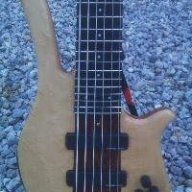
Oh wait I do see a pattern here - I just recalled that the guitarist and I had been poo-pooing 6 strings with comments like, "If I haven't mastered 4 strings, why do I need more. When 4 just isn't enough for saying what I want to say I, then maybe I will need a 5 or a 6, but I am nowhere near that now. If 4 was good enough for Europe 72, 74, 77-78 for Phil it's certainly good enough for me. Those guys with 6's are mostly kidding themselves." Then I tried one at an open mic and realized how easy it was to play across the board to riff more easily, more quickly, and more articulately. It wasn't about needing more notes, it was accessing them efficiently, how they sound in different places, and having more choice.
Ok so aside from flats and 6's, what else does everyone else know that I continue to kid myself about?

Surprising how many Sheehan's have turned to Bass - there was Fran Sheehan of Boston too.Bobby Sheehan was the bassist for Blues Traveler before he passed 1999. I don’t believe he had any relation to Billy.

The gear is the thing between my fingers and my ear. That portion of the feedback loop has me constantly adjusting myself based on how the wood plastic and metal is interpreting my intent. In this case the gear caused a clear, and positive, shift in my musical expression. Hearing a different version of my own ability, brought on by a change of gear, was quite a pleasant surprise, but also a bit embarassing after all this time.It’s not about the gear, it’s about the music. The gear exists to facilitate musical expression. On it’s own, the gear is just a bunch of wood and metal and plastic.
Flats always last longer because dead flats sound just like new flats.The Thomastik flats will last you a way longer than your 2-3 sets of rounds.

Hmmm. I’m puzzled by your line of thought. With respect, the instrument does not interpret. It is a tool. If you have a high quality tool, there is no impediment to your ideas other than your own skill level. Changing strings is probably the one single thing that will change your sound the most and I appreciate that you have been pleasantly inspired by the result. Enjoy that feeling. I changed from round wound to flats several years ago now and also enjoyed the new tone and feel that they provided but it’s me that plays well or badly. Like any tool, the instrument just puts out what I put in.The gear is the thing between my fingers and my ear. That portion of the feedback loop has me constantly adjusting myself based on how the wood plastic and metal is interpreting my intent.
Sad story about Fran-apparently, he was in some sort of an accident-motorcycle accident I believe, which left him unable to play.Surprising how many Sheehan's have turned to Bass - there was Fran Sheehan of Boston too.
Surprising how many Sheehan's have turned to Bass - there was Fran Sheehan of Boston too.
Feel like we may simply have different perspectives but I will use another hobby of mine as an analogy - I was a club racer in motorcycles decades ago and enjoy track days with both cars and bikes these days. Each machine responds differently to a corner. As a result, I have to change my approach to those corners to get the most out each given machine. They don't produce a perfectly unfiltered response to my intent. Some do this better than that, and I have to put more focus on certain aspects of the physics to get the result I am after. A satisfying solution to the same corner can be very different depending on the machine. I find the same thing with instruments. They are not perfect reflections of my intent, and they have their strengths and weaknesses that need to be heard and responded to to try and achieve something I find pleasing. I have presumed that we are all sensitive to this phenomenon and constantly adjusting ourselves in a loop with what we are hearing, trying to find the most satisfying place in both the pocket and the soundscape for the moment. If that isn't something you experience then I can chalk that up to me learning another new thing and again realizing there are (shocker! lol) people who don't think like I do, or experience music in the same way I do. I took it as a given that all musicians were in a feedback loop with their instrument but I have been wrong about a million things in the past and this could easily be 1,000,001.Hmmm. I’m puzzled by your line of thought. With respect, the instrument does not interpret. It is a tool. If you have a high quality tool, there is no impediment to your ideas other than your own skill level. Changing strings is probably the one single thing that will change your sound the most and I appreciate that you have been pleasantly inspired by the result. Enjoy that feeling. I changed from round wound to flats several years ago now and also enjoyed the new tone and feel that they provided but it’s me that plays well or badly. Like any tool, the instrument just puts out what I put in.
May I also respectfully suggest that while we all have our influences and they impart something to the way we play, perhaps trying to sound like those players is a blind alley. Let them influence you but seek out the player inside you. That is a very gratifying quest.
Yes I think we are approaching the challenge differently. I own and play regularly, four quite different basses but I’ve never seen them as accommodating my ideas well or badly. I’ve always believed that any shortfall in the result has been because of my own limitations.Feel like we may simply have different perspectives but I will use another hobby of mine as an analogy - I was a club racer in motorcycles decades ago and enjoy track days with both cars and bikes these days. Each machine responds differently to a corner. As a result, I have to change my approach to those corners to get the most out each given machine. They don't produce a perfectly unfiltered response to my intent. Some do this better than that, and I have to put more focus on certain aspects of the physics to get the result I am after. A satisfying solution to the same corner can be very different depending on the machine. I find the same thing with instruments. They are not perfect reflections of my intent, and they have their strengths and weaknesses that need to be heard and responded to to try and achieve something I find pleasing. I have presumed that we are all sensitive to this phenomenon and constantly adjusting ourselves in a loop with what we are hearing, trying to find the most satisfying place in both the pocket and the soundscape for the moment. If that isn't something you experience then I can chalk that up to me learning another new thing and again realizing there are (shocker! lol) people who don't think like I do, or experience music in the same way I do. I took it as a given that all musicians were in a feedback loop with their instrument but I have been wrong about a million things in the past and this could easily be 1,000,001.
As for trying to sound like other players being a blind alley, I agree in the strictest sense. As for me I would like to have the crisp attack of Duff at times that allows my playing to ring out like his in You Could Be Mine, or have the melodic ability to move as I please under the vocals like Sheehan without crowding the vocalist, or over-playing just to hear myself play. I would like to approach the instrument like Lesh without being bound by the rules of convention, and construct a foundation for songs that expresses the melody yet rarely uses the root or the one beat to do so. The playing will always be uniquely mine, but I will cop to aspiring to gain the skills/sonic worldview of players who I respect. I'll admit I thought that was a given as well, and that very few us approach music without a goal we developed by hearing others.