It seems to me that what gbaker is really doing is designing another instrument with acoustic properties that he may find more desirable. Whatever the result, it will not be what we think of as a double bass. The acoustic characteristics of the instrument that have evolved over the centuries are precisely what define the instrument.
gbaker said, "I began to wonder why bass manufacturers do not lower the resonance to smooth the mid response and increase the loudness of the lower register." The answer is simple. It is because to do so would produce an instrument that does not sound like a double bass.
The goal is not at all to produce a "flat" or "smooth" response. The goal is not necessarily to produce an instrument that radiates more acoustic power in the "lower register." The double bass is a resonating body. The particular acoustic response, the spectral peaks and valleys, precisely how the overtone structure occurs, etc. are exactly what characterize the double bass.
To be sure, there are differences in personal preference in terms of desired sound. Still, there is pretty good agreement on what are particularly good exemplars of different "classes" of the double bass sound (e.g., the French sound, Italian sound, powerful orchestral depth, more delicate solo sound).
This is not to suggest that gbaker's project is folly. He may produce an interesting sounding instrument. I doubt, however, with the goals he has defined, that he will produce an instrument that has sonic characteristics that will be recognized as that of a fine double bass. Rather, he will likely produce an instrument with a different sound, however interesting it may be.


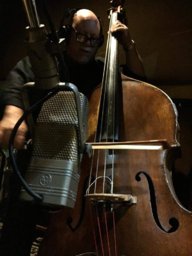




 What I should have said is that the design and placement of the ffs is mostly about adding flexability by cutting the arch of the top at the plane of the bridge. ffs definatly do let the sound out and tune the resonnance of the body, and you definatly need a hole in the top for an acoustic instrument to work, but bowed strings need that arch cut at the bridge to function mechanically. I'm really not clever enough to think of this on my own, I got it from a luthier when I asked him why we couldn't put the sound holes somewhere else.