

Enjoy the benefits of a premium membership!
Upgrade Account
-
TalkBass has been independent since 1998. Add your voice.
Create a free account to reply to discussions, view embedded media, and browse with fewer display ads.
Join free Log in
Want zero display ads or expanded classifieds tools? Compare plans.
You are using an out of date browser. It may not display this or other websites correctly.
You should upgrade or use an alternative browser.
You should upgrade or use an alternative browser.
What are Tapered Strings?????????
- Thread starter Ari Schor
- Start date
More options
Who Replied?
I believe what you are referring to is the taper that some strings have near the ball end of the string. It is very thin where the string passes over the bridge saddle, and gradually tapers out to the full width of the string as it passes over the pickup. Some really like the sound of taperwounds, especially on the low E and B strings.
It also can mean having the string taper out close to the bridge so it fits easier in the saddle, and it is common in B strings
Originally posted by Davy0
It also can mean having the string taper out close to the bridge so it fits easier in the saddle, and it is common in B strings
Sorry, that's what I thought I was saying!

I interpreted your post as meaning not at full thickness until almost reaching the pickups, the purpose being to change the string's tone.
For all I know, there could be strings made like that
For all I know, there could be strings made like that

Hategear
Workin' hard at hardly workin'.
A tapered string would indeed be a string that has an exposed core as it passes over the bridge saddles, and then expands to normal size when it passes over the pickups.
Imagine if you will, me actually telling you this fact. I would use my fingers to make quotation marks in the air as I said the words "normal" and "expands."
Imagine if you will, me actually telling you this fact. I would use my fingers to make quotation marks in the air as I said the words "normal" and "expands."

john turner
You don't want to do that. Trust me.
not all tapered strings go down to the core, some go down to the last winding before the core. i use dean markley sr2000s, that are tapered on all strings bigger than the G string. also, tapered strings should be full size by the time the string gets 1/4" - 1/2" from the saddle, well before the pickups, or even the playable length of the string.
why taperwound strings? (repost from an earlier thread...)
taperwound strings intonate much more accurately than non-tapers, especially on the bigger strings. they provide a more concise witness point to the bridge, which in turn forces only harmonics that are closer to multiples of the fundamental to sound.
first off, some theory...
when an ideal, perfect string is plucked, only frequency multiples of the fundamental will sound. the fundamental is directly related to the length of the string, and all the harmonics are multiples of the fundamental, all in tune and sound pretty, regardless of how high they are.
with a real string, the witness point of the string to the bridge, along with the fact that real strings are not infinitely flexible like a "perfect" theoretical string, both work together to cause a sort of "gray area" for the string, where it is bending, not at a perfect point over the bridge, but more of a curve, due to the thickness of the string.
this gray area reflects in the fact that the actual length of the vibrating portion of the string is not clearly delineated. this causes higher harmonics to be present that are out of tune with the fundamental. a smaller witness point and a sharper break angle will cause this gray area to be smaller, and keep the higher harmonics more in tune with the fundamental.
a pic will help explain this better...
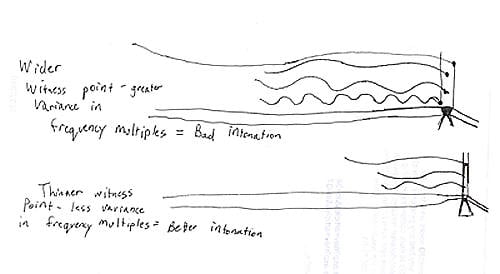
that's the main reason why tapers are better than non-tapers.
why taperwound strings? (repost from an earlier thread...)
taperwound strings intonate much more accurately than non-tapers, especially on the bigger strings. they provide a more concise witness point to the bridge, which in turn forces only harmonics that are closer to multiples of the fundamental to sound.
first off, some theory...
when an ideal, perfect string is plucked, only frequency multiples of the fundamental will sound. the fundamental is directly related to the length of the string, and all the harmonics are multiples of the fundamental, all in tune and sound pretty, regardless of how high they are.
with a real string, the witness point of the string to the bridge, along with the fact that real strings are not infinitely flexible like a "perfect" theoretical string, both work together to cause a sort of "gray area" for the string, where it is bending, not at a perfect point over the bridge, but more of a curve, due to the thickness of the string.
this gray area reflects in the fact that the actual length of the vibrating portion of the string is not clearly delineated. this causes higher harmonics to be present that are out of tune with the fundamental. a smaller witness point and a sharper break angle will cause this gray area to be smaller, and keep the higher harmonics more in tune with the fundamental.
a pic will help explain this better...
that's the main reason why tapers are better than non-tapers.
Thanks, JT! I've been thinking about using SR2000's. I currently have Blue Steels on my P and they sound pretty good, but it seems like you're saying I could get better clarity on the lower strings with a taperwound set. That's what I'm looking for.

JT, thanks for the details and the drawing.
My choices of strings are somewhat limited, because I prefer tapers on my RB5 on both the B and E strings. As far as I know so far, only GHS and Fender offer tapers on both strings.
I just got in a few packs of GHS Progressives in M8000 size and will string them up Thursday night's gig.
My choices of strings are somewhat limited, because I prefer tapers on my RB5 on both the B and E strings. As far as I know so far, only GHS and Fender offer tapers on both strings.
I just got in a few packs of GHS Progressives in M8000 size and will string them up Thursday night's gig.
john turner
You don't want to do that. Trust me.
Originally posted by bgavin
JT, thanks for the details and the drawing.
My choices of strings are somewhat limited, because I prefer tapers on my RB5 on both the B and E strings. As far as I know so far, only GHS and Fender offer tapers on both strings.
as i said earlier, dean markley sr2000 strings taper every string from the d larger, down to the last winding before the core. their e's and b's are tapered, as well as a's and d's.
try them out, they're excellent.
JT, thanks, I stand corrected.
I've been keeping an XLS of all sorts of stuff, strings included, and will check out the Dean Markley strings and add that info.
I've seen chatter about the DM strings having early end of life. Any truth to this?
Just checked the SR2000's on the DM site... they mention taper in the text, but didn't specify which strings. I had it in my notes as "yes" for taper, but didn't know which strings specifically.
Thanks for the update.
I've been keeping an XLS of all sorts of stuff, strings included, and will check out the Dean Markley strings and add that info.
I've seen chatter about the DM strings having early end of life. Any truth to this?
Just checked the SR2000's on the DM site... they mention taper in the text, but didn't specify which strings. I had it in my notes as "yes" for taper, but didn't know which strings specifically.
Thanks for the update.
Originally posted by bgavin
I've seen chatter about the DM strings having early end of life. Any truth to this?
Hi bgavin and welcome to talkbass.com.
I am not sure if some of the chatter you are refering to includes one of my posts, but I have expirences a sub-standard life span out of DM Blue Steels. They lasted me less then 2 weeks.
That was before I learned to wash my hands about 5 minutes before playing and wipe my strings off before and after playing. That pobably would have helped them survive a little longer.
john turner
You don't want to do that. Trust me.
i'm not too experienced with the blue steels, but the sr2000's last me about 2 months of fairly heavy playing.

Ken Smith also makes taper sets that taper everything but the D & G in a 6 string set. They're called "tapercore" and they're exceptional strings. I use 'em on my Smith BSR6 GN.

Another vote for the Dean Markley sr2000's here. I had them on my Conklin GT7 when I bought it. I put non tapers on next, and couldn't stand them. A week into it I bought another set of sr2000's to put on. The do sound great and have a very reasonable durability.

A question: Do tapercore strings cause weird overtones when you play in the upper positions of the low B and E strings? Because my Smith 6 is doing this, and I want to check to see if it might be the strings before bothering Ken about it. It came with Smith Tapercores on it, and still has the original set.
do tapered stirings have any effect on sustain or how long the string/notes will ring for? and do they work on string through bodys and topload or just STB?
also, dont rotosound make a set of tapers called p.s.d? (piano.string.design)
also, dont rotosound make a set of tapers called p.s.d? (piano.string.design)

yupOriginally posted by affro
...also, dont rotosound make a set of tapers
called p.s.d? (piano.string.design)
 The RS99 & 995 (130 B) stainless rounds with "adjustable
 ball ends". I've never tried a set so can't say how you 'adjust' them.
DR "Longnecks" and Invalid Link Removed "Taper Wound" & "Power Core" are also
out there.
Here's a purty picture...
...and the Link Removed from whence it came

I would also like to toss into the mix Labella Super Steps. These are taper wound TO THE CORE or the inner most and thinnest piece of wire that actualy wraps around the ball end. I use them on my Smith 6 and the only string that is not wound this way is the C string. So if you play a 5 then ALL 5 of you strings would be exposed to the core. IMO, they make for lower action when you think you can't get it any lower. And they sound great. Well, let me quantify that. They sound great TO ME. Lot's of zing when they're new. I've had mine on for just over a month with at least 15 hours a week of play/practice time. Still sound great. They are worth a try if you're into tapered strings. Others that come close to the LaBella definition of Taper Core are GHS Contact Core Steels. I've tried them as well, but there is 1 winding on the core cord. So it doesn't come over completely bare in the saddle like the Labella's do. I can't speak for the SR2000's, but I'll look in another thread I posted where someone said the the SR2000's were not tapered to the core.


