• TalkBass has been independent since 1998. Add your voice.
    Create a free account to reply to discussions, view embedded media, and browse with fewer display ads.
    Join freeLog in
    Want zero display ads or expanded classifieds tools? Compare plans.

What did you all do when you were a beginner?

am looking into bass lessons around here, just trying to find the best place to go.

Where is 'around here?' The best way to get a good teacher is through referrals from other players.

What did you all do as a beginner? What should I be doing? Does it all click one day and you just find it easier to learn the songs you want?

Becoming a good bass player is a lot of work. It's not all fun and games like playing a video game. Some of that hard work is boring. There are no short cuts, tricks, or secrets to learning. If you want to be good, find a good teacher and practice hard.
 
I did a lot LESS by the book than you're doing, so kudos to you and to others for so much good advice.

As for me.. since you've asked...

I've been playing 36 years, but when I started I began learning Zep tunes (Dazed and Confused for starters), then the intro to the Overture for 2112 (just the E-A, C-D-A part - not the fast part lol).

One day in school I was telling a more experienced bass player I'd just gotten a bass but didn't know what to do, and he took out a sheet of notebook paper, drew four horizontal lines and a bunch of vertical ones. From there he drew dots for C-D-E and F-G-A. That was it. I had to figure out B a little later. :D
 
I got my bass when I was 16 (16 years ago) and bought a bass instruction book that came with a cassette tape. It had some instruction on some simple progressions that are used in many rock songs, but I didn't find it engaging enough to just stick with working through that book for long.

My older brother had gotten an electric guitar a little while before I got my bass. When I was 17, we started taking lessons at a local guitar shop. We split the hour session once a week where he would learn guitar and I would learn bass. After first learning the layout of the fretboard and how to play some basic scales along with some other finger exercises to get better at fretting notes, our lessons resorted to just bringing in CD's of music that we would like to play and the instructor helping us play by ear.

We kept up these lessons for about 10 months. We both had some piano lessons as children and knew some music theory from that, and I had been in the school choir and learned a bit more theory. I know now that the way we took our lessons was probably not the best way to learn to play an instrument, but it suited me. I am much more logically minded than my brother and as I learned to play the types of music that I listened to, I was able to recognize patterns and apply my music theory knowledge to what I was playing. I've been playing regularly at my church and had the opportunity to fill in at other churches now for about 14 years. My brother, on the other hand, barely touches his guitar these days and probably couldn't play more than a few chords without a significant refresher course.

To sum it up, the speed at which you progress will depend on the music knowledge you already have, your learning style, and how persistent you are in working on your skill. I was fortunate to find teaching method that worked for me, however unconventional it is, but this method obviously didn't connect with my brother the same way, which is why he no longer playing.
 
I suspect I am the oldest student my music teacher has.... I am 59

63 years young here! Been taking lessons from a youngster (~35YO) professional bassist for over a year now and it was the best decision I ever made.

Find a teacher you like and can "click " with and don't be afraid to fire him if you find someone better.

Do your homework (practice) at least 30 minutes daily and eat your veggies!
 
Take a step back and learn blues riffs. You'll develop your 2,3 & 4 finger techniques.

Tube into classic classic rock stations that play 50's and 60's and pick a simple song.

I learned "We gotta get out of this place" by the Animals before I learned "Detroit Rock City" by Kiss and then Who, Montrose, Stones, Beatles, etc and songs I had to learn so I could jam as a surrogate bassist for friends who were in between bands.
 
I think you're on the right track, but bring in some easier songs, as other posters have noted. I started with Pink Floyd's "Dark Side of the Moon" which are easy bass lines but excellent songs. Led Zeppelin is another good thing to work on. Of course I also tried to play stuff I couldn't learn properly note-for-note, like you are finding with Tool, in that case, just play along as well as you can but concentrate on coming up with a simpler part that fits the groove and feel of the song. I also suggest playing some blues, like playing along with all of the Blues Brothers CDs (all on iTunes I am pretty sure). You can hear the bass, and you will learn some bass lines that encompass scales and patterns that will be useful for all kinds of music, when applied with a different rhythm.
 
My opinion is that consistency playing everyday is the most important. 30 minutes (or more, a lot more if you can). Warmups on familar stuff. Then scales, arpeggios, things that challenge your finger movement in new ways. Combine with ear training by saying and singing the notes. Then some jamming to the radio or CD's.
 
When I first started playing I started playing other peoples music before trying to create my own stuff. I learned a lot of metallica, Marilyn manson, audio slave, stuff like that. All fairly simple but fun. This will help you develop your finger and fret hand skills as well as timing. TOOL is actually my favorite band. One of the first of there songs that I learned was 46 & 2 it is one of there simpler songs however the person who posted saying that TOOL is not beginner bass is 100% correct. Justin Chancellor isn't exactly the kind of bassist that is going to sit in the back groove for the whole song, the bass in tool is a key instrument that makes TOOL what it is.
 
I spent about 8 hours a day with a book that showed where all of the notes were on the bass and I learned to read bass clef. After about 3 months of doing that I was a pretty good reader. I'm really glad I took the time to learn to read music, it has served well over the past 25 years. Learn to read, this will open many doors for you and allow you to learn quicker.
 
Buy more gear.

No seriously, you can take the boredom out of dexterity exercises by just doing them while you're watching TV.

Play along with songs.

Play with other people when you get the chance.

Keep it fun.

Play what's fun and offers interesting but winnable challenges for whatever level you're at. You'll confront more difficult stuff when the time is right.
 
Buy more gear.

No seriously, you can take the boredom out of dexterity exercises by just doing them while you're watching TV.

Play along with songs.

Play with other people when you get the chance.

Keep it fun.

Play what's fun and offers interesting but winnable challenges for whatever level you're at. You'll confront more difficult stuff when the time is right.

Warning - Geezer Alert!!!

Part of the problem with young people today is that everything has to be fun and they need to be entertained 24X7.

Not that they shouldn't reserve part of every practice session to have some fun, but if they want to get good, they need to exercise self discipline and realize that not everything provides instant gratification.

And stay off of my lawn!!!
 
I came over to the bass from the 6 string acoustic guitar where we played from fake chord sheet music.

I brought the fake chord sheet music over to the bass and belted out roots on the first beat. When I could do that I then added a 5 for R-5-R-5. When that flowed I added an 8 for R-5-8-5. That kept me busy for several years.

Here is what fake chord looks like.
http://tabs.ultimate-guitar.com/n/norah_jones/cold_cold_heart_crd.htm.
From here I cheat a little more. Songs in D. so I change the sheet music over to Nashville numbers. This will help. http://www.guitar-chords.org.uk/chords-key-c.html

D- Em-F#m-G--A--Bm-C#m-D
R--2---3-----4--5--6----7-----8

So my A's are now 5's, the E's are now 2's and the D's are now R or roots.


Remember chords are listed as Roman numbers, I-ii-iii-IV-V-vi-vii. Upper case Roman numbers are major chords and lower case numbers are minor chords. The notes themselves (within those chords) are listed in Arabic numbers, 1-2-3-4-5-6-7 The 1 of often listed as the R or root. and then if you use Nashville numbers all chords are shown in Arabic numbers.

Why in the World would I do that? Take a look at the major scale box pattern I give below. That puts everything into generic patterns and makes my job a whole lot easing. Use as much of this as you like. I do suggest you copy and paste it some where you could find it later on.

As a warm up I would run my scales. Why? So my fingers could get used to the bass and my ears could recognize the good notes from the bad notes. I would recommend you spend time running your scales and you chord tone arpeggios (R-3-5-7-5-3-R) Get to the point that when you see a chord name your fingers already know what will be expected of them.

I used the major scale box, ran my scales and built simple bass lines. Fake chord calling for the Cmaj7 chord, just the C note on the first beat will get you started. Next chord showing as a Dm7 chord, here again the D note on the first beat --- and 3rd beat will work.

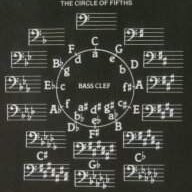
Here is the cheat sheet I grew up with.


Eat this monster one bite at a time. Enough to satisfy your hunger, but, not so much at one time that it makes you sick.

Good luck.
great info, and a nice guy for taking the time for such a great reply. idk, u may even owe him like 50 buks!?!
seriously, it takes alot of time and dedication to get where you'd
like to be. there is tons of free info to get u started out there. good luk fellow bass player